Showing posts with label Daily Telegraph. Show all posts

Sunday, December 09, 2018

The collapse of Ukip

Twenty-four Kippers sitting on a bench,
And if one Kipper should decide it's more important to fight for Brexit and defect,
There'll be twenty-three Kippers left sitting on the bench.

Twenty-three Kippers sitting on a bench,
And if one Kipper should get expelled for "serious financial allegations",
There'll be twenty-two Kippers left sitting on the bench.

Twenty-two Kippers sitting on a bench,
And if one Kipper should punch another's lights out,
There'll be twenty-one Kippers left sitting on the bench.

Twenty-one Kippers sitting on a bench,
And if one Kipper should find her relationship with the party "increasing difficult",
There'll be twenty Kippers left sitting on the bench.

Twenty Kippers sitting on a bench,
And if one Kipper should lose confidence in the latest leader and all the potential replacements,
There'll be nineteen Kippers left sitting on the bench.

Nineteen Kippers sitting on a bench,
And if one Kipper should go and form his own local party,
There'll be eighteen Kippers left sitting on the bench.

Eighteen Kippers sitting on a bench,
And if one Kipper should find himself out of kilter with the party,
There'll be seventeen Kippers left sitting on the bench.

Seventeen Kippers sitting on a bench,
And if one Kipper should feel the party's been hijacked,
There'll be sixteen Kippers left sitting on the bench.

Sixteen Kippers sitting on a bench,
And if one Kipper should find the party has become a "vehicle of hate",
There'll be fifteen Kippers left sitting on the bench.

Fifteen Kippers sitting on a bench,
And if one Kipper should discretely change her listing on a website,
There'll be fourteen Kippers left sitting on the bench.

Fourteen Kippers sitting on a bench,
And if one Kipper should find the party's direction an impediment to securing Brexit,
There'll be thirteen Kippers left sitting on the bench.

Thirteen Kippers sitting on a bench,
And if one Kipper should point out the party wasn't founded to fight a religious crusade,
There'll be twelve Kippers left sitting on the bench.

Twelve Kippers sitting on a bench,
And if one Kipper should find the party has left him,
There'll be eleven Kippers left sitting on the bench.

Eleven Kippers sitting on a bench,
And if one Kipper should find the party promoting English nationalism,
There'll be ten Kippers left sitting on the bench.

Ten Kippers sitting on a bench,
And if one Kipper should rush off to be Flash Gordon, Saviour of the Universe,
There'll be nine Kippers left sitting on the bench.

Nine Kippers sitting on a bench,
And if one Kipper should find the party has lost its way,
There'll be eight Kippers left sitting on the bench.

Eight Kippers sitting on a bench,
And if one Kipper should be another to object to relations with the English Defence League founder,
There'll be seven Kippers left sitting on the bench.

TO BE CONTINUED...?

Tuesday, March 07, 2017

Campus freedoms

Once again, the question of freedom of speech on campuses has come up, this time with the news that the University of Lincoln Student[s'] union bans Conservative society from speaking out - because they challenged its position on free speech (Daily Telegraph). It brings back memories of my once having found myself having to wade through this mess but also highlights how the debate has shifted a lot over the years.

Many years ago, now I was elected as the University of Kent students' union Anti-Racism Officer and so I found myself handling considerations about whether or not the students' union should reintroduce a "No Platform" policy; the previous one having lapsed in earlier years (in part, it has to be said, because one of those proposing its renewal was frankly not trusted by some groups on campus). The issue was on the ascendancy in wider student politics at the time - during that year there was a general election with the BNP vote rising and it was also in that year that the National Union of Students added Al-Muhajiroun to the list of organisations banned nationally.

(This is as good a place as any to tackle the first big misconception and problem. Unless things have changed in recent years, the NUS policy is not binding on individual affiliate students' unions who are free to adopt their own policies. However, NUS has long encouraged individual affiliates to adopt a No Platform policy as well. Many have simply reproduced the text and some even automatically use the banned groups list as defined by the NUS.)

It rapidly became clear that the standard No Platform policy within the student movement is a complicated affair that years of poor institutional memory and localised practice have turned into a difficult to understand, explain and defend mess. This stems from it being an awkward hybrid of a public order measure, a more general welfare measure and gets into a political measure. The aims can be quite distinct and so mixing them all together results in confusion and anger over just what the policy was or is aiming at.

Thus, what was originally intended as a measure against violence on campus by not allowing groups with violent track records to rally on students' union owned or booked facilities has steadily turned into a more political weapon to also deny a platform or refuse to share one with people who make entirely peaceful expressions of opinions deemed racist and fascist - with a very unclear process for determining exactly how that deeming is carried out objectively. It's made even worse by meeting procedures that often require deeply complicated philosophical questions to be expressed in a speech just a minute or two long. The result is the policy gets poorly explained and misunderstood, both by its detractors but also by those who find themselves having to operate it.

Now other organisations have No Platform policies as well. But a combination of the organisation's overall scope and a much stronger historical understanding of the policy's purpose means that it is much clearer what it's for, what it's aiming to do and how to explain it clearly. However, students' unions are very heterogenous bodies with numerous societies and media forms, with the result that there's far more potential for issues to arise. So it gets overused and at times abused.

Worse still it encourages a more general approach to trying to fight ideas through bans.

And that's before we even consider the potential legal mess that can arise out of this, with those keenest often not the ones legally responsible.

A return to basics of stating clearly that an organisation will not host particular organisations, will not allow them to use media outlets and will not have its office holders appear in official capacity at events with them (e.g. appearing on panels or in debates) should be a priority. Trying to police individuals' speech is a route doomed to failure. Where necessary, there are laws in place for that.

Thursday, April 12, 2012

The failings of UKIP

There's an excellent piece in the Telegraph entitled Why no decent Tory should vote Ukip by Abhijit Pandya, who spent a year advising UKIP, has seen up close just how useless, ineffective and incoherent a party it is. Amongst the damaging charges:

[The] party's MEPs are obsessed with infantile stunts. These include wondering around Brussels, at the taxpayer's expense, singing "there is a hole in my bucket". Entertaining as it is watching Mr Farage doing this, and giving bombastic speeches in the European Parliament, it does nothing to curb the powers of the EU.

...[T]here is not a single amendment to a European regulation forced by Ukip, despite being Britain’s second-largest party in the European Parliament... [I]t is extraordinary that Ukip has not, in over a decade, managed to develop a strategy to undermine European law by appropriate subtle and strategic amendments.
...
The party is more interested in ranting and raving than in the more thoughtful task of fully engaging with its opponents on policy terms. This is why its failure to alter the course of Europe away from a social-democratic federal state has been immense.
...
...[A]s a consequence of being a one-issue Party, they are just about split on everything else. Ukip will go Left, Right or centre to grab the next available vote.
...
For Tories yearning for the old years of glory, a move to Ukip would be a move back to the feeling of looking at the remnants of the Tory Party after its 1997 catastrophe... Worse still it would benefit Labour, and another Labour victory is the last thing this country needs.

It just confirms that UKIP is not a striding force for anything, but just a protest vote accumulating, rabble rousing, whinge-the-whinge not fight-the-fight shouty movement.

Monday, April 09, 2012

Flashback: The 1992 election

Twenty years ago today it was the 1992 general election. A record breaking election that saw the Conservatives win a fourth term, with the most votes for any party in British electoral history. And they did it without spin - compare Neil Kinnock's grandiose Sheffield rally with John Major going out on the streets and speaking common sense on a good old fashioned soapbox.

Yet for many Conservatives 1992 has become a forgotten election. For some the victory is an uncomfortable truth, that the party could win elections without Margaret Thatcher and thus justified deposing her. For others the memory of the next five years is dominated by so many problems that they'd really rather not remember them and secretly wish the election had been lost.

However there are signs of a slow change in John Major's reputation with even some of his old critics starting to reappraise his record - see for example It's time to give John Major the credit we so cruelly denied him by Peter Oborne in the Daily Telegraph. And the various historical rankings of Prime Ministers of the United Kingdom have seen Major slowly rise up the charts judged by academics, in recent years overtaking Edward Heath (University of Leeds: Academics rate Brown one of the worst post 1945 PMs). Maybe he will rise further in years to come.

Would it have been better to lose the 1992 election? It's hard to say, though if the party hadn't deposed Margaret Thatcher it's likely we would have lost. Indeed if the landslide had come five years soon, Thatcher might even have had the humiliation of losing her own seat. Such a result could have been the necessary blow to the neo-Thatcherite wing of the party and silenced the sirens who spent much of the last twenty years claiming that going more Thatcherite than even Thatcher did was the solution for the country. And some of the more Machiavellian might point out that a loss would have given the chaos of Black Wednesday to Neil Kinnock and John Smith. Perhaps the Conservatives would have taken rather less than thirteen years to return to government.

But losing would have meant the country being run by Neil Kinnock. And that's truly a horrific thought. Whether losing might have been better for the party, it would have been far worse for the country.

So as the BBC Parliament channel reruns the 1992 election coverage, a big cheer to John Major for achieving such a victory and saving us from that nightmare.

Sunday, December 20, 2009

Gordon Brown and his old cheques

I missed the story earlier this week that when Gordon Brown was a student his rent cheque once bounced. (Daily Telegraph: Gordon Brown's £3 rent cheque bounced at university halls of residence) Frankly this sort of thing has happened to many of us, particularly if (as in the case of Brown) you have more than one account and get muddled between them. I've had a few problems over the years when I've had direct debits and standing orders going out of the wrong account, taking them into the red or even bouncing.

Quite a few commentators are trying to seize on this as saying something about Brown's handling of the economy - e.g. the Telegraph byline "Gordon Brown has repeatedly declared that he is the man to lead Britain out of its financial crisis" or this blogpost Tory Outcast: Gordon Brown's financial incompetence spans 4 decades. But they're missing a key point in a hope to get a cheap dig. A lot of Chancellors and Prime Ministers have not treated their own finances with the most rigorous care. Amongst the more famous cases, Pitt the Younger left huge debts when he died whilst Norman Lamont was embarrassed by revelations about his credit card bill. Winston Churchill engaged in some highly creative personal accounting (as set out by Roy Jenkins) and Asquith was also careless. And this was all when they were in office. Compared to all this, a student once drawing a cheque on the wrong account is meaningless and no proof whatsoever of any incompetence on Brown's part.

(And there's plenty of real proof anyway.)

Friday, May 29, 2009

Why do the Italians keep on re-electing Berlusconi?

In amidst all the Daily Telegraph revelations I've not yet heard of any ministers who are using Parliament to pass laws just to give them immunity from prosecution. But there are countries with a level of corruption in politics that makes the UK's, even at this moment, look completely amateurish.

In Italy Silvio Berlusconi has taken corruption to new levels, so far successfully evading prosecution. I have never quite understood why he is the Prime Minister's residence instead of jail, but then maybe they have a different attitude over there and he's delivering pork to his voters. However thanks to the EU he is one of many leaders who has influence over us.

But the latest Berlusconi story about him denying "a spicy or more than spicy" relationship with a minor is beyond belief, even for him. (BBC News: Berlusconi denies 'spicy' affair) And you don't need to have seen Yes Minister to know what an "official denial" is in politics, especially when his wife is divorcing him. There is something just sickening about this - the man is old enough to be her great grandfather! (Even if he has had a hair transplant.)

Why does this man do so well in Italy? Is it just his huge control of the media, is it a supportive attitude to sleaze or is he just forgiven for other things he has done?

Friday, May 22, 2009

Does the Speaker need to be an MP?

As the election for Speaker of the House of Commons gets underway, complete with the Daily Telegraph checking each and every candidate's own expenses claims, one has to wonder if in the current environment there is any sitting MP who could command sufficient public confidence in the role to make the necessary changes. But does the new Speaker have to be an MP at all?

Now it's quite possible that there are various laws, standing orders and conventions that currently require the Speaker to be an MP. But then there are various laws, standing orders and conventions about MPs' expenses and look where those got us! And since no Parliament can bind its successor these could be changed.

So would it be worth a thought to looking outside the present House of Commons for a candidate to be Speaker? Is there be somebody who has not been part of the current mess who has a track record on fighting corruption and who commands public respect? And if so, why not change the present way of doing things to allow them to be brought in? Does anyone know of a reason why we can't?

Sunday, May 10, 2009

The end of a generation

Ernest Millington who was the last survivor of the House of Commons from before the 1945 general election, has died. (BBC News, Daily Telegraph obituary) He was originally elected in a by-election in April 1945 for the Common Wealth Party, and was the only Common Wealth MP to hold his seat in the 1945 general election, but he joined the Labour Party in 1946.

In 2006 he succeeded John Profumo as what we might term the "Grandfather of the House", the surviving former MP who had entered the House of Commons the earliest. I am not sure who now holds the distinction - Michael Foot and John Freeman, both first elected in the 1945 general election, are both still alive, but I am not sure who took the oath first.

With Millington's death comes the passing of an entire political era's generation of MPs.

Friday, May 01, 2009

Are we on course for another 1931?

The headline in the Daily Telegraph today says "Brown's lost it, say ministers - Prime Minister is heading for poll defeat on scale of John Major's, warn senior Cabinet figures". Some seem to fear an even bigger defeat.

Could we be on course for a landslide election like that of 1931? In that election the results were: National Government 556, Labour 52, Independent Liberals 4, Irish Nationalists 2, Independent 1. Or to put it in a bar chart:

I think it's a little fanciful that things could get this bad, but for much of the current Parliament I've been sceptical about all the polls, being scared they're too good to be true.

Still things could be even worse for Labour. In the 1993 Canadian election the governing party went from having a majority to winning a mere two constituencies.

And if that doesn't frighten Labour enough, the two surviving MPs comprised one new member and the party's deputy leader. Are Labour members prepared to cry "Hail Harman! Leader of all you survey; nothing!"?

Friday, March 20, 2009

Obama conforms to stereotype

The arrogant American abroad is a well known stereotype. They exhibit many traits but one of the most annoying is when they automatically assume that everyone can use their things, usually their money, and tries to force it on. I have experienced it myself once when selling something on eBay and the buyer mailed me dollar notes. Unless I go to the US anytime soon they are utterly useless (they're too low an amount to make changing them worthwhile and the small number of shops who do accept them are primarily ones for tourists at airports that neither sell much I want nor charge low prices).

A similar thing comes with DVDs. In order to prevent free trade in DVDs, especially in an era when one can buy directly from the US over the internet, the DVD industry included the region code system that means many DVDs can only be played on players configured for the same region. Some but not all DVD players in the UK can play discs from any region but it's not exactly "recommended" by the manufacturers. But the stereotypical American seems ignorant of the problem and assumes that any player in the world can play a Region 1 disc.

And Barack Obama has conformed to the stereotype. (Daily Telegraph: Gordon Brown is frustrated by 'Psycho' in No 10) His entire gift to Gordon Brown is utterly useless over here.

By the way this has a bearing on Brown's DVD meme. I now get just six points for seeing the films, as I don't have any of them on Region 1. How do other people do?

Sunday, March 01, 2009

UKIP - One party, one(ish) policy, one leader

I have just read Daily Telegraph: Why Ukip has just lost another member in which leading UKIP member Robin Page explains why he has resigned from the party.

Five years ago the story about UKIP was one of optimism, a party that was self-confident and aiming for a major breakthrough. Ever since the party has flopped around, it has lost a quarter of its MEPs, it has had very public spats and has degenerated into a cross between a rubbish bin for dissatisfied politicians and a vehicle for one politician's ego. Nigel Farage has achieved his ambition of being the biggest fish in the goldfish tank that is UKIP. A party run on undemocratic lines by a leader noted for his racism (Iain Dale's Diary: The Question Nigel Farage Must Answer) - UKIP is going in a very dangerous direction.

Friday, October 03, 2008

Gordon and Peter - what aren't we being told?

The headline of thelondonpaper tonight reads "Brown: I need you today, oh Mandy". FT.com - Westminster Blog: The hatred between Brown and Mandelson reports:
Tom Bower's biography of Gordon Brown (yes it is somewhat sensationalist) described difficult relations between the chancellor and Mr Mandelson: "Their conversations were fraught... Their conversations ranged repeatedly over the same ground: loyalty, dependability and trust. 'I love you, but I can destroy you,' Mandelson frequently screamed, threatening to marshal his black arts against Brown."
It's a story repeated in The Guardian: How the feud between Gordon Brown and Peter Mandelson thawed and The Daily Telegraph: Peter Mandelson's rift with Gordon Brown: In quotes.

Now there could be nothing in this. Nor in the past rumours about Brown's sexuality. Nor in the rumours from fifteen years ago about two leading Labour figures being caught in the showers together in the Commons. Nor in much more. It could just be an odd choice of headline. Couldn't it?

Thursday, July 31, 2008

Portilliband?

History often repeats itself. But it takes time to recognise precisely where and how, and often the key players fail to duplicate the historic figure they are most often compared to. For example during the last years of the Major government Ken Clarke was often compared to Roy Jenkins during the end of the first Wilson government. But Clarke did not go on to play a damaging role that electorally crippled the Conservative Party in subsequent years and certainly never formed a breakaway party. Nor did the players always play quite the role at the time that subsequent myth gives them.

Right now it seems umpteen comparisons are being drawn between the Brown government and John Major's circa 1995. So invariably David Miliband is being talked of as the Michael Portillo, the one who lays the ground for a leadership bid and then backs out of it. (e.g. The Debatable Land: Alea Iacta Est, Global Dashboard: Miliband's folly, Daily Telegraph - David Hughes: David Miliband - a leadership tick list and Raedwald: Miliband - too weird-looking to win.) But there are some key differences.

Portillo personally never forced the 1995 leadership election - John Major opted to call that off his own back in response to his weak position on the back benches, not to outmanoeuvre Cabinet colleagues. But once the leadership election was on he, and for that matter Michael Heseltine, went and prepared campaign headquarters for a second round. It's a bit of a myth that either man was preparing to challenge Major but rather both were planning on Major being toppled in the first round and opening up the second round. Really it's only because another Cabinet minster - and to be honest a not very important one - resigned to contest the first ballot that the myth of Portillo preparing and bottling it emerges. Conservative assassinations take place behind closed doors not in full view. Nor did Portillo completely blow his chances then - most people think that if he hadn't lost his seat in 1997 then he would have won the resulting leadership contest. And in 1995 the issue wasn't really about John Major personally but about the direction of the party and policy issues.

This is a very different thing from Miliband all but openly reminding his party there are alternatives to Gordon Brown and putting forward a vision. If he is to challenge Gordon Brown then he must either round up a set of Cabinet heavyweights (if there are enough for a set!) and issue an ultimatum or else he must somehow try to get Labour MPs to support a formal leadership challenge through a very complicated procedure that requires the challenging candidate to publicly put up whilst simultaneously avoiding the odium of adding to the government's problems. That's a very tall order and it's not really clear what Miliband hopes to get out of this. Being sacked for telling Brown he needs to go for the party's sake would at least give him a clear status for a leadership contest. Being sacked for just shit stirring and compounding the government's problems would have the reverse effect.

If Miliband is anyone from that era he's William Hague - seen in some quarters as the Great Hope of the future despite not really having done anything or been properly tested. And when Hague ascended far too soon he proved a disaster as leader. (He should have stuck to his original plan to run as Michael Howard's deputy on a "dream ticket" and then win or lose waited until 2001 for his own bid when he would have been in a stronger position.) So maybe it's not "Portilliband" but "Milihague"?

Monday, July 14, 2008

Cheeky Boy no more?

News has emerged that Lembit Öpik has been dumped by his fiancée, Cheeky Girl Gabriela Irimia. (Daily Telegraph: Lembit Opik ‘dumped by his Cheeky Girl fiancée Gabriela Irimia')

Once again Öpik is in the news for all the wrong reasons. There have been murmurings of dissent in the Liberal Democrats about him before (see Liberal Democrat *leaders* in trouble, admittedly several leaders ago) and I wonder just how much further his stock can fall. And will Liberal Democrat activists want to fight the fight in Montgomeryshire for him? (See Can a political Jonah save himself?)

Saturday, December 29, 2007

Time to acknowledge the Anglosphere?

I've just read an interesting article in the Telgraph by John O'Sullivan
about A British-led Anglosphere in world politics?. "Anglosphere" is a word slowly gaining in usage and the concept seems very appealing. As O'Sullivan notes:

If you want to know which countries the British feel really close to, check which ones they telephone on Christmas Day (Australia, Canada, New Zealand, America... but you knew that).
Indeed. I do a lot of selling on eBay and it is very telling where my overseas sales go - by far and away most go to the USA, Australia, Canada, Ireland and New Zealand. The cultural connections of the Anglosphere are never far away - just look at this week's Doctor Who, set on a vessel mimicking a trans Atlantic liner and co-starring a popular Australian singer and actress. And it was the second highest watched show of the week. The UK's culture has many external influences and look where they come from.

Politically it's similar as shown by the pattern of alliances and friendships. Nor are the links rooted through a single country:

The idea, lagging well behind the reality, is now seeping into politics. Last year Canada's prime minister, Stephen Harper, delivered an eloquent speech to the Australian parliament that praised the common British heritage linking both nations.

Even more significantly India's PM, Manmohan Singh, gave a speech at Oxford in 2005 that neatly stole the entire concept for New Delhi: "If there is one phenomenon on which the sun cannot set, it is the world of the English-speaking peoples, in which the people of Indian origin are the largest single component."

That raises a painful question. If Australians, Indians, Canadians, and even Americans can recognise the Anglosphere as a new factor in world politics, why is it something from which the Brits themselves shy?
Too often those who've talked about the Anglosphere in the past have been accused of being reactionaries dreaming of the old days of Empire. The idea that Manmohan Singh fits that bill is plain absurd. There are ties in so many fields - family, culture, business, politics and so many more - that reinforce the bonds between the nations of the Anglosphere. Why not take the next bold step and reinforce those ties on the world stage as a force for good? The idea is gaining more and more credibility:

Its academic foundations are rooted in work demonstrating that England always had a more individualist culture than continental Europe, that the "civil society" tools of this culture were transmitted to the colonies settled from England, and that those countries have since not only prospered unusually, but also established a world civilisation rooted in liberalism.

Bennett in The Anglosphere Challenge makes unmistakably clear that it is English cultural traits - individualism, rule of law, honouring contracts, and the elevation of freedom - rather than English genes that explain this success.

These traits enable a society to pull off the difficult trick of combining trust with openness. Nations with different genetic backgrounds that adopt such traits seem to prosper more than their similar neighbours. Hence the Anglosphere includes India and the West Indies, as well as the "old Commonwealth".
So is now perhaps the time to take the plunge?

Wednesday, November 07, 2007

So what did Enoch actually say?

In the past week I've had two reminders, one minor and one major, about Enoch Powell's most famous speech. Both in their way seem to miss the point.

Steptoe and Son - The Christmas SpecialsThe first, and minor, was last week when I got the final Steptoe and Son DVD - The Christmas Specials. In one of them we see Albert Steptoe singing "Enoch's dreaming of a white Christmas..." and the implication could not be clearer. (Albert, incidentally, was shown to be a fan of Enoch as early as 1965 - see my previous post Steptoe and Son - "My Old Man's a Tory".) But the implication also seems false to what Powell actually said.

The second, and more major, has been the row about Nigel Hastilow's article. There are those in the blogosphere arguing that he should have been discipline discretely. Clearly they fail to comprehend that in this day and age of the media watching everywhere a discrete disciplining would have left the party open to the charge it was doing nothing.

Enoch PowellBut what's also telling is that people still cling to the idea that Powell made a "racist" speech. As Simon Heffer points out (Daily Telegraph: When will Tories admit that Enoch was right?) "there is a long tradition in the party of not reading the speech." It is a tradition widely shared outside the party. Indeed I remember back in 1998 when Channel 4 ran The Trial of Enoch Powell on the thirtieth anniversary of the speech (and two months after Powell died) and many, including Darcus Howe (who wrote about it afterwards in the News Statesman), encountered the actual words of the speech for the first time. Since Howe was the leading "prosecutor" this speaks volumes about how Powell is remembered. (But then "the Trial" was not exactly impartially composed - it was adjudicated by Trevor Phillips, who in the week of Powell's death had denounced him as a racist on Question Time.) "Evidence" that Powell was "a racist" was mixed, with Howe at one stage falling back on a story of how one of Powell's teenage daughters invited a friend and her boyfriend round for tea. When Powell answered the door to a six foot black man he is said to have "blanched" - defined as "turned white" - and retreated to the kitchen throughout the visit. It was a story firmly denied by Powell's widow and daughters in a letter afterwards. (Though I suspect many a teenage girl would be only too glad if their father gave them freedom of space when they had friends round!) Despite such a loaded attack, "the Trial" found Powell "not guilty".

Since the speech itself seems to be so unknown, the Telegraph amongst others have reproduced the entire text at Enoch Powell's 'Rivers of Blood' speech and I would urge people to read it before commenting.

Many of the comments about poor integration are comments that numerous politicians in all parties are making today (and, as Powell pointed out, were made by Labour ministers at the time). Powell was deeply sceptical of the workability of integration, something I think he was wrong about, but his comments about the numbers, the sense of resentment and the divisive effects of what we now call "positive discrimination", and how all these were detrimental to community relations are not that dissimilar to what many are saying today.

Heffer also writes:

This was a man who loved India and Indians so much that he reached interpreter standard in Urdu, and who in 1959 had made what by popular assent was one of the great speeches ever heard in the Commons, in which he attacked the government of which he was a supporter for the brutal treatment of Mau Mau detainees in Kenya. Powell was about as much of a racist as Mother Teresa of Calcutta, and his warnings in the Birmingham speech have proved grounded.
There are many aspects of Powell that surprise those only familiar with the popular, misleading caricature. Powell was very much a social liberal, voting to abolish the death penalty and co-sponsoring a 1965 bill to legalise homosexual intercourse. As the UK retreated from Empire Powell was amongst the first to admit that it was no longer the power it once was. His opposition to the UK getting dragged into American wars and the "world policeman" attitude of some of our leaders, such as over Iraq, are views that many in this country share today. His calls for reform of the Conservative Party to be more professional and businesslike, where merit and not birth or old boy networks determine promotion have been at the forefront of calls for party reforms for a long time, if currently submerged beneath focus on gender and race in candidate selection. And his predictions that devolution would lead to the break-up of the United Kingdom - that's hardly an unvoiced view now is it?

But unfortunately Powell is primarily remembered not for one speech but for the misconceptions of that one speech. As Tony Benn said the day Powell died, Powell was not a racist himself but his speech unleashed a lot of racist expression from others.

Thursday, July 12, 2007

Ming stops delivering

Does he ever actually perform?At the Liberal Democrat campaign office in the Ealing Southall by-election, the three photocopiers are named "Dave", "Gordon" and "Ming". Only one of the three is not performing properly.

You've guessed it - the useless one is Ming!

Thanks to Telegraph Blogs: Little and Large - Ming conks out for the story.

Wednesday, November 15, 2006

Is the Labour Deputy Leadership worth a pitcher of warm piss?

Antonia has declared her support for Jon Cruddas as Deputy Leader of the Labour Party. But why is this the contested post?

A good Daily Telegraph editorial on Saturday noticed that the last time a Labour Prime Minister announced he was retiring in government, no less than five candidates had declared to succeed him within a few hours. And these were not lightweights - they included the Foreign Secretary, the Home Secretary, the Employment Secretary, the Energy Secretary and the Environment Secretary. The Chancellor of the Exchequer soon threw his hat into the ring.

By contrast it is now two months since Tony Blair was forced to concede a timetable and there is only one candidate for the leadership. Meanwhile the Deputy Leadership race is getting crowded. But just what does a Deputy Leader actually do?

I'm reminded of the way that the Vice President of the United States is traditionally one of the most maligned positions in any democracy. Just think for a moment as to how many Vice Presidents you can name. I bet very few of them did not go on to become President.

Who can remember the Vice President who remarked that the post was "the most insignificant office that ever the invention of man contrived or his imagination conceived"? Well he was quite famous but for other things - he was John Adams. Or the one who said "Once there were two brothers. One went away to sea; the other was elected Vice President of the United States. And nothing was heard of either of them again." He was not so famous at all - Thomas R. Marshall. (He also said "Indiana is the mother of Vice Presidents, home of more second-class men than any other state." He was probably wrong - New York has produced no less than ten - though Indiana, which ties with Massachusetts for second place with four apiece, did go on to produce Dan Quayle.)

And then there's the one who called the job "not worth a bucket of warm piss". Otherwise the only thing John Nance Garner is notable for is living to just 15 days short of his 99th birthday - the record for any President or Vice President.

The office only really gained some significance under Richard Nixon, who had the benefit of both media attention and a President who wished to stand above partisan debate. Even then the post has risen and fallen - George H. W. Bush seemed to spend most of his time going to funerals and other dull diplomatic tasks.

What precise role does the Deputy Leader of the Labour Party serve? Gordon Brown does not hold the position, nor did Tony Blair. Indeed I can think of only two Deputies who became leader - Clement Attlee (and this was only because when George Lansbury insisted on resigning despite unanimous please by MPs for him to stay, most sitting Labour MPs believed Arthur Greenwood was unsuitable and Attlee was about the only viable person about) and Michael Foot (hardly a leadership career to aspire to repeat).

And so we're left with a situation where Gordon Brown looks set to take the real position all but uncontested (maybe a token challenge to force a ballot but that's about it) whilst numerous Labour politicians fall over the Deputy Leadership. Is it worth it?

Friday, May 12, 2006

Alarm bells Minging... and who's running the show?

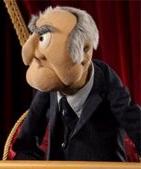
Statler doesn't have much experience actually on the stage eitherFollowing on from earlier, I've noticed that the Daily Telegraph has it even worse for Sir Menzies Campbell with "I'm sorry for my poor showing, says Sir Menzies". Amongst the highlights:

Sir Menzies Campbell has been forced to apologise for his poor performance as Liberal Democrat leader.

Some of the party's MPs fear that they will have to replace him within the year, it emerged last night. They gave Sir Menzies, 64, until the party's autumn conference "to get his act together" even though he was elected only two months ago.
...
Last week's local election results were a disappointment, with the party gaining two seats overall. One MP said the party was "hitting the panic button" over the threat from David Cameron, the new Tory leader.
...
But some Lib Dems are now privately convinced that they will have new leader within a year, with Nick Clegg, 39, the so-called Lib Dem answer to David Cameron and the party's home affairs spokesman, as the frontrunner.

"Ming will be gone within a year," said one Lib Dem MP.

Some Lib Dems fear that the idea that Sir Menzies's experience would outshine the youthful energy of Mr Cameron is proving mistaken. One MP said last night: "I just think he is not physically up to it."
And most intriguingly there are serious questions about just who is setting direction for the party, if there is one at all:

Sam the Eagle often tries to set his own stamp on the way the show is going
Another, on the Left of the party, bitterly complained that Lord (Paddy) Ashdown was pulling the party's policy strings by virtue of the Right-leading CentreForum think-tank.

He cited ideas of ditching the party's traditional opposition to tuition fees as one such potential policy reversal, but complained that Sir Menzies was not giving direction.
Could he return sooner than people expected?The criticism of Campbell has been quite high profile and public before and it seems it's getting to be yet another Groundhog Day. The Lib Dems are criticising the leader for underperforming and demanding he raise his game, otherwise they will depose him. And old leaders are emerging from the shadows. Could we see the Lib Dems come full circle and bring back the leader who they so brutally deposed?

Thursday, April 27, 2006

The redundancy the NHS needs

Minister under firePatricia Hewitt must be thanking her lucky stars. Any other day and her reception at the Royal College of Nursing would have been the main political story, putting all pressure on her. Instead other events have made it partially buried bad news, a mere part of the wider story of the government's troubles, being upstaged by Charles Clarke.

This Health Secretary is convinced that the NHS has just had its best year ever despite having only visited thirteen hospitals during the last year. Yesterday she was confronted by one of the least militant trade unions of all, a union that has never gone on strike. These are not people who will jeer the government for the sake of it. Nurses know from first hand experience just what state the NHS is in.

A Health Secretary who denies reality about the state of the NHS, who has no clear grasp of the deficits in healthcare trusts and who fails to reassure the medical professions about potential job cuts does nothing to boost crucial morale. There is one redundancy that would give the NHS a morale boost and that is Hewitt's. But it would only be effective if her replacement will get a firm understanding and grip on the job, not live in some other reality.

LinkWithin

Related Posts Plugin for WordPress, Blogger...