Showing posts with label United States. Show all posts

Monday, September 30, 2013

Bicameral deadlocks

As I write this, the US Congress is still in deadlock as the two chambers disagree over the budget, with the potential for the federal government to be shut down. Each chamber can claim a democratic mandate (although how an overall minority can veto an overwhelming majority's desire to even debate a measure is interesting - News from ME: Majority Rules, Minority Drools has more about the "the Hastert Rule") and add in the President's democratic mandate and there's not a great deal of progess.

Second chamber reformers here rarely want to give the Lords (or Senate or whatever they want to call it) budget powers but that doesn't mean there's any less of a risk of a deadlock between the two over some other key legislation. It's often forgotten that when the Australian Prime Minister Gough Whitlam was dismissed there were no less than twenty-one pieces of legislation other than supply in formal dispute between the two houses, or that the previous year key legislation such as universal healthcare insurance had only been got onto the statute book through the nuclear option of a snap "double dissolution" election of the whole parliament. It may be budgets in one place and time and healthcare in another and doubtlessly a different issue in a third but the problem remains that when multiple elements in the system claim separate democratic mandates the result can be a recipe for gridlock and chaos.

Monday, January 02, 2012

"Mummy, what does 'santorum surging' mean?"

So far the US Presidential election is just dull.

Compared to recent contests this one just hasn't caught fire. On the Democrat side the euphoria from when Obama was first elected has now died down as even his most ardent supporters realise he can't walk on water and isn't going to deliver endless change they can believe in. But he's basically unopposed for his party's nomination. (Yes pedants I know there's probably a few non-entities who've managed to get their name onto the odd primary ballot paper but that won't make a difference.) The last incumbent President in such a position who went on to lose re-election was Herbert Hoover back in 1932. That should give Obama comfort until he remembers that Hoover fell in harsh economic times - and no Obama can't simply magic away the world's economic problems. We're not in Doctor Who!

On the Republican side we have the return of Mitt Romney and the succession of "stop Romney" candidates, and all it's done is reinforce perceptions of the Republican Party as full of nutters. Now just because I'm a British Conservative doesn't mean I should automatically cheer on anyone from one of our "sister" parties around the world - you don't see many Conservatives cheering on Nicolas Sarkozy and Angela Merkel at the moment despite their parties being founder members of the IDU. The nuttier wings of the Republican Party are not ones that should be copied here. But they can at least make things exciting - and at the moment that hasn't happened. Instead it's one long dull fest.

Of course there is the occasional moment of humour, especially with Rick Santorum. For there is a not very nice meaning for "santorum" and if he pulls off an early primary win a lot of people will be searching for more information on him.

So why are journalists so keen to write that "Santorum is surging"?

Monday, June 14, 2010

Do we need a Flag Day?

I have just learnt that today is Flag Day in the United States. (Hattip Walaa Idris: Happy Flag Day!) I have to admit to not being aware of this before but then Flag Day probably has about as much trans-Atlantic awareness as the Queen's Official Birthday.

I'm surprised that the US needs a special day for the flag as they seem to have it on display all the time. By contrast it's much rarer to see the Union Jack * flown here, even though most government departments can now fly it all year round, expect perhaps during international football matches.

In recent years some politicians have suggested that we need to wave the flag a bit more as though it will solve the problems of integration in British society. (Well okay some of them also talk about tinkering with the school history curriculum as a magic wand solution.) That rather misses one of the key factors of the British national character - we tend to be reserved and not shout about these things. A special day to commemorate the flag is about as British as the White House.

(* Before some pedant starts writing in the comments; it's not 100% clear that "It's only called the Union Jack when at sea" is accurate. And regardless of regulations it's the familiar name for the flag.)

Thursday, January 21, 2010

The election count - get it right not get it first

I have just seen Iain Dale's Diary: Election Night Bill Needed in which he's now calling for legislation to have all the counts done immediately on the night. You'd think from all this "Save Election Night" campaigning that things have been done this way since time immemorial.

But as some my readers will remember, there have been many parliamentary elections when the votes haven't been counted until the next day. In 1945 the votes weren't counted for a whole three weeks. I have no idea if the 1945 equivalent of the blogosphere got worked up about this. (The reason for such a lengthy delay was that time was needed to collect the votes of servicemen overseas.) At most other elections there have been many constituencies that have not counted on the night, usually because of the time it takes to bring all the ballot boxes together - has this caused uproar and fraud? Seats in Northern Ireland have almost always counted the next day after all!

Nor have governments always changed immediately on the day after polling. In 1929 polling day was on May 30th but Ramsay MacDonald didn't kiss hands until June 5th - was there widespread outrage at Stanley Baldwin still being in office for a few days?

And in many other countries the final result, and the change of leadership, often takes days on end. In the last Australian election polling was on November 24th but the formal result took nearly two weeks to finalise, and Kevin Rudd's government wasn't sworn in until December 3rd. In the last US Presidential election some of the counting went on into December.

Counts in Australia, the United States and many other countries take so long for one main reason - postal votes (and other forms of distant voting) do not reach the count by the end of polling day. The requirement is usually that the vote be sent by polling day, not that it be received by then. There are also other arrangements for remote voting in various countries, including one provision that allows a voter to walk into any polling station in the country on polling day, provide proof of their address and receive valid ballot papers for their local polling station that they are away from. Again these votes take time to make it back to the relevant count.

The way the count is done in many countries differs from our methods. Instead of taking all the ballot boxes to a central location and counting them on one site, they are often counted at the polling station and the individual results declared. The ballot papers can, of course, be recounted at a central location if the result is close and/or there are disputes over the rulings on questionable papers. This isn't so different from the European Parliament or devolved parliaments or Greater London Authority elections where for all the list elections and the London Mayoralty the votes are counted at several different locations.

Now in none of these cases did civilisation collapse just because the final election result wasn't available on the night. And in all of them the provision for postal/overseas/absent ballots meant that it wasn't possible.

Which brings us to the UK counts. Whilst simple cost and travel logistics are and always have been reasons for some seats not counting on the night, there is a new factor - the massive increase in postal voting on demand. With postal votes arriving even at the end of polling day the system going to come under a much greater strain than before in order to carry out accurate verification. That is going to make the whole thing take longer, increasing the risk of mistakes because the counting staff are ever more tired.

Speedy, sloppy election results benefit no-one. And if the election is incredibly close and hinges on one or two very tight seats, is it really in anyone's benefit if there are disputes and questions about the results in those seats because of the judgement calls made in a hurry to get the result out on the night?

If this means a lameduck government leaves office on a Saturday or Sunday rather than a Friday, so what? And yes it will mean political junkies don't get the full fun of results at 3 o'clock in the morning, but democracy should not be run as a spectator sport.

(And we've barely touched on the cost. Are the "Save Election Night" campaigners willing to personally stump up for the overtime rates? Or do they expect it to come out of our council taxes?)

So let's stop worrying about whether the vote is counted on the night or the next day and put election accuracy first. It may take a little longer but it will be well worth it.

Friday, March 20, 2009

Obama conforms to stereotype

The arrogant American abroad is a well known stereotype. They exhibit many traits but one of the most annoying is when they automatically assume that everyone can use their things, usually their money, and tries to force it on. I have experienced it myself once when selling something on eBay and the buyer mailed me dollar notes. Unless I go to the US anytime soon they are utterly useless (they're too low an amount to make changing them worthwhile and the small number of shops who do accept them are primarily ones for tourists at airports that neither sell much I want nor charge low prices).

A similar thing comes with DVDs. In order to prevent free trade in DVDs, especially in an era when one can buy directly from the US over the internet, the DVD industry included the region code system that means many DVDs can only be played on players configured for the same region. Some but not all DVD players in the UK can play discs from any region but it's not exactly "recommended" by the manufacturers. But the stereotypical American seems ignorant of the problem and assumes that any player in the world can play a Region 1 disc.

And Barack Obama has conformed to the stereotype. (Daily Telegraph: Gordon Brown is frustrated by 'Psycho' in No 10) His entire gift to Gordon Brown is utterly useless over here.

By the way this has a bearing on Brown's DVD meme. I now get just six points for seeing the films, as I don't have any of them on Region 1. How do other people do?

Saturday, January 24, 2009

Malapportionment in the UK?

One of the issues that has exercised many fingers in the Conservative blogosphere in recent years is the basic question of apportionment of constituencies for the House of Commons, with discussion of concepts of "fairness", "how many votes does it take to elect an MP from each party?", "Scotland is overrepresented" and so forth being thrown around. And a lot of the discussion is frankly poorly informed, out of context and mixing up several different concepts. See for example some of the comments below ConservativeHome: John Leonard: Don't reduce our representation at Westminster.

So I'd like to try and have a go at looking at what the various issues and confusions are, to see if there really is a bias in the system and whether it's deliberate or not.

Firstly a note on a few terms. "Gerrymandering" is the deliberate fixing of political boundaries to secure results. "Malapportionment" is when some people/areas have more representation than others. Although the two can be combined they can also occur separately - the United States has taken the principle of exactly equal sized constituencies to ridiculous extremes (with courts rejecting even a difference of just 19 voters) but has amongst the worst gerrymandering in the democratic world, whilst Australia has seen virtually no gerrymandering in its history but has a long history of malapportionment.

The other key terms are the "Boundary Commission", one of four impartial bodies that amend parliamentary boundaries, and the "quota", which is both the average number of voters per constituency in the existing constituencies and the desirable target size for each constituency on the new boundaries. I'll say upfront that I don't believe the Boundary Commissions have an inbuilt bias. Rather they are trying to apply the various rules and precedents to a situation that is far more complicated than its critics often realise, but are coming from a non-partisan background.

This brings us neatly to the first key distinction. All too often the population, the total electorate and the people who actually turn out to vote are used almost interchangeably. But these are three distinctly defined groups. One of the biggest confusions comes because constituencies in the UK are designed on the basis of the total number of registered voters and not just those who turn out. Since the turnout varies across the country this often means that even if the constituencies have exactly equal numbers of registered voters there will still be some seats with more people voting than others. And because turnout in safe Conservative seats is invariably higher than in safe Labour seats this is the start of the numbers appearing to show a bias.

(A further factor in this is the accuracy of the electoral register. In urban areas in particular there is often a high turnover of population with the result that there are many people still listed on the register at both an old and new address, thus reducing the nominal turnout. Similarly many people with multiple addresses like students are registered at both addresses but can only vote once per election. The Boundary Commissions are presently not allowed to take either of these factors into account. Changes to the way voter registration is done in this country are likely to have a significant effect on the numbers.)

The second distinction is the point in time at which equality must occur. The Boundary Commissions are required by law to use only the numbers on the electoral register at the start of the review. But reviews often take a few years to complete and in turn the resulting boundaries are often used for several elections - for instance the boundaries produced in a review based on voter location in 1976 were not replaced until 1997 (bar a few minor local changes). The result is that by the time the boundaries come in they are already out of date and as time goes on the perceived problem worsens. It is no coincidence that this issue has arisen in the last few years, when the current boundaries date to 1991.

The obvious solution is to have more frequent boundary reviews, but this presents other problems, as discovered by the political parties at the 1955 election when the boundaries were changed after only five years. Several MPs found their seats disappearing, there was political chaos when new seats had two (or more) "sitting MPs" who battled for the nomination, local parties had to be reorganised and voters became confused by the sudden changeover. As a result of this it was agreed to have a longer period between reviews so as to minimise the disruption.

By far the most complicated set of number variations comes with the main stage. As you can probably guess an attempt to redraw boundaries for 533 constituencies in one go would overload the work of the Commissions, as well as make it very hard for members of the public to hold it to account. The result is that the review is broken into smaller amounts, usually at the level of the county. Invariably this forces some rounding - for instance Surrey in the most recent review has 11.43 quotas and so is rounded to the nearest whole, 11. Generally this effect balances itself out, though as urban unitary authorities tend to be smaller than provincial counties the rounding effect does create a slight urban bias.

A further bias comes in the use of the local government ward as the basic building block. Rather than face a potential infinite number of lines on the map that can be proposed and counter-proposed, the Boundary Commissions reinforces their neutrality by rarely going below ward level. This make the process much easier to follow, but once again the ward forces a rounding effect. Some wards in Birmingham have getting on for 20,000 voters and can leave the Commission facing either a 10,000 undersized seat or a 10,000 oversized one. Once again this effect is more urban as the wards usually have more voters there, though some rural wards are awkward combinations of several scattered villages. (And these can be further complicated if different villages in the same ward have different main towns.)

The cause of the most extreme variations is physical geography. Often there are some incredibly natural boundaries in existence, whilst in many rural areas it is difficult to represent the scattered voters if the seat is too large. The result is that some big variations come. As I've blogged before (A nice big seat) the constituency with the most voters is the Isle of Wight, because it's just too small to split in two and having a seat span the Solent is absurd. Similarly the smallest seat is Na h-Eileanan an Iar, formerly known as the Western Isles, where representing a scattered cluster of islands is already difficult enough without adding on the mainland as well. Mainland areas can also have undersized seats - the Scottish Highlands, Cumbria and Northumbria all get extra seats because of this.
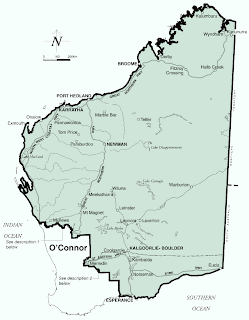
Division of KalgoorlieSuch a practice is followed in most parts of the world. The Division of Kalgoorlie (to the right) is not well known in the UK. If it were people would be amazed to learn it has a single MP. For this constituency in the Australian Parliament covers most of the non-Perth & environs area of Western Australia - a "mere" 2,295,354 km². At the last election it had 80,773 voters. Representing the seat must be an onourous task and perhaps this is why despite regularly being held by the government of the day it has not been represented by a minister since 1949.

Division of LingiariThe Division of Lingiari (to the left) has fared better, with the present member currently sitting in the Cabinet. But Lingiari is another monster seat, covering the entire of the Northern Territory except for the city of Darwin, and also includes the Christmas and Cocos (Keeling) Islands. It has an area of 1,347,849 km² and still has one of the smallest electorates, only 60,341 at the last election. And it's not just Australia with such large constituencies - Canada has the Nunavut electoral district covering the entire of the territory of the same name. It has an area of 2,093,190 km² and just 17,088 voters.

And there are many others. Whilst some of the earlier biases have benefited urban areas, and thus Labour, this one is anti-Labour. The extra seats in Northumbria and Cumbria are both Conservative, whilst all five seats, and thus the two extra, in the Scottish Highlands and Islands, are not held by Labour. It's also interesting to note that, as with some of the other causes of grievances in the system, this is also one that was agreed in recent times. In 1944 when the rules for the current system of reviews were agreed, proposals for a greater equality of constituency size resulted in many natural communities being broken up. It was agreed that a greater level of discretion would be allowed to cover natural communities and rural areas. (I don't think it's a coincidence that a large part of the complaints about the current set-up come from people in urban areas where this is less of an issue.)

Perhaps the biggest myth is that Scotland is still overrepresented compared to England. Since 2005 this has no longer been the case as Scotland now has seats based on the English quota. The reason it has a slightly lower number of voters per constituency is because of the extra seats in the Highlands and Islands, but as this rule also applies to England there is no imbalance.

There is however an imbalance when it comes to Wales. Firstly legislation gives Wales a minimum of thirty-five constituencies when on the same numbers as England it would have only thirty-two. Unlike Scotland this provision has not been repealed. Secondly Wales also has geographically sparse areas, with most of its smallest seats in the north and west (not the Labour the heartland in the south). Thirdly because each part of the UK has a separate Boundary Commission, the quota for each part is calculated separately and imbalances are rarely explicitly reset, and Wales has been operating on separate figures since 1944 (although amendments to both the Scottish and Northern Irish provisions in the last thirty years have had a reset effect).

This has been quite a detailed post so far but I hope it has shown that the imbalances in the system are not deliberate and are instead the by-product of several individual factors designed to make the system easier to use. There is, however, one area where political influence can make a difference.

As part of the public accountability of the review, the proposals must be subjected to a public enquiry if there is sufficient demand. At these reviews local parties and individuals will comment on the proposals and sometimes argue alternative proposals. Some of this is with an eye to partisan benefit, but argued on the basis of what the natural ties in an area are. Others are simply concerned with local ties, such as having a village in the same constituency as its main town, or matching the seat to things such as school catchment areas, bus routes and local newspapers and so forth. Unfortunately if one side makes a fantastic effort and the other a dire one it can have a distorted outcome. And during the 1990s review the Labour Party devoted central resources to supporting and co-ordinating responses to the individual sections of the review. By contrast the Conservatives left it to local parties who often wound up arguing against each other, with some in safe seats seemingly prioritising having the largest majority in the area over all other concerns! But to blame the Commission for accepting the better argued Labour cases is like an amateur who knows nothing about law arguing in court with a top QC and accusing the judge of bias for accepting the latter's outcome.

My very last point on this is the whole notion that there should be equity in the "number of votes it takes to elect an MP from a particular party". Such a concept is totally alien to a constituency based electoral system. If a party has a weak and scattered vote (as the Conservative vote has been in recent elections for reasons that having nothing to do with the boundaries) then it will find it difficult to win seats. By contrast if the vote is strong and concentrated it becomes easier. The first past the post electoral system has always carried this risk, regardless of constituency size, and trying to rig the boundaries to make the seats deliver a predetermined outcome would be a gerrymander that produced hideously unnatural seats. If people want "fairness" and "equality" in this area, the logical solution is a change in the voting system (though few proportional systems deliver absolute "equality" either), not a boundary fix. But I doubt many want to take that leap into the dark just yet.

I hope this post has helped enlighten what is a very complicated process. I don't believe there is any simple solution in this area because the problem is in the detail. The simplistic changes proposed in some quarters would produce awkward alternatives that no-one is actually advocating in and of themselves. And the differences are hardly on the grand scale of some of the grand malapportionments around the world in the past. The way to get more seats is to get more people voting Conservative.

Tuesday, January 20, 2009

When another fresh face entered the White House

Mars Hill has been running various YouTube videos of past US Presidents (see President Kennedy On Civil Rights & President Johnson's Announcement That He Won't Seek Re-Election, President Carter on the Success of the Egypt/Israel Talks and President Reagan on the Cold War Situation and President Nixon's Resignation Speech and President Ford's First Speech as President ). So in response I'd like to post another, this time another inaugural address. And it's one that seems very appropriate for today.

It was a time when after years of tension and turmoil the United States had been left bitterly divided. Then in a fiercely fought Presidential election a fresh face won the election and entered office with so many full of hope that everything would change, that the country would recover its lost international prestige and greatness and that it would be a glorious new era.

Not so different from now, eh?

So without further ado I give you the inaugural address of the President whom Obama seems to be most like:

Yes Jimmy Carter and his oh so wonderful presidency. Now how long before Obama becomes Carter in deeds as well as in entrance?

Still after years of Carter came Reagan so in the long run things turned out better!

Sunday, January 04, 2009

So where's the US democracy?

I have a confession to make about US politics. From what I've read and seen from Al Franken I find him funny. Compared to the po faces, ranters and zealots that dominate the US right in the media, Franken is a breath of fresh air. Just look at the way he wiped the floor with Ann Coulter:


But Franken's politics are a very different matter. Electing him to the US Senate would be like electing Ian Hislop to the British House of Commons. But the people of Minnesota (who after all once elected an ex-wrestler as governor!) have decided differently and the result is all but formally declared. (Minnesota Public Radio: Franken increases lead over Coleman to 225 votes)

Now call me old fashioned but I was always led to believe that in a democracy the representatives are chosen by the people. However it seems that some in the US Senate have different ideas, wanting the courts to choose the winner and threatening to invoke obscure rules to block Franken from taking his seat as the duly elected Senator. There is something seriously wrong with democracy as practised in the United States if elections are being determined not by the voters but by the courts and losers can't accept they've lost but keep running to the courts to change the rules as they go.

As a side note, it seems that the determination of the Democrat Senate leader to seat Franken is generating criticism because of the controversies surrounding the Illinois seat vacated by Obama, with people declaring that seating Franken, who is white, and not the appointee, who is black, by an arrested sleaze consumed governor, will be a sign of racism. But it is clear the two situations aren't remotely the same. Those throwing around accusations of racism are the ones playing the race card themselves. Such accusations merely belittle racism and encourage people to be dismissive when it really happens.

LinkWithin

Related Posts Plugin for WordPress, Blogger...