"One Person One Vote" is a slogan that has had multiple uses over the years. It has been used to call for universal suffrage, for the abolition of plural voting and for equal sized constituencies (also called "One Vote One Value" in places). But the basic principle is the same throughout.
So it's interesting to note that at the same time that the Labour Party is running around screaming fake moral outrage about steps to reduce malapportionment in this country, they are also conducting a leadership election where One Member One Vote is noticeably absent. Instead some members will be getting significantly more votes than others. In theory a member could get no less than 32 different ballot papers and cast every single one of them without breaking the rules.
So much for Labour's claims for equality and democracy!
Hattip to Cllr Iain Lindley's Diary: Unequal Votes and Tory Radio: Do Labour MPs advocate stuffing the ballot box?.
Showing posts with label malapportionment. Show all posts
Showing posts with label malapportionment. Show all posts
Monday, August 09, 2010


Saturday, January 24, 2009
Malapportionment in the UK?
One of the issues that has exercised many fingers in the Conservative blogosphere in recent years is the basic question of apportionment of constituencies for the House of Commons, with discussion of concepts of "fairness", "how many votes does it take to elect an MP from each party?", "Scotland is overrepresented" and so forth being thrown around. And a lot of the discussion is frankly poorly informed, out of context and mixing up several different concepts. See for example some of the comments below ConservativeHome: John Leonard: Don't reduce our representation at Westminster.
So I'd like to try and have a go at looking at what the various issues and confusions are, to see if there really is a bias in the system and whether it's deliberate or not.
Firstly a note on a few terms. "Gerrymandering" is the deliberate fixing of political boundaries to secure results. "Malapportionment" is when some people/areas have more representation than others. Although the two can be combined they can also occur separately - the United States has taken the principle of exactly equal sized constituencies to ridiculous extremes (with courts rejecting even a difference of just 19 voters) but has amongst the worst gerrymandering in the democratic world, whilst Australia has seen virtually no gerrymandering in its history but has a long history of malapportionment.
The other key terms are the "Boundary Commission", one of four impartial bodies that amend parliamentary boundaries, and the "quota", which is both the average number of voters per constituency in the existing constituencies and the desirable target size for each constituency on the new boundaries. I'll say upfront that I don't believe the Boundary Commissions have an inbuilt bias. Rather they are trying to apply the various rules and precedents to a situation that is far more complicated than its critics often realise, but are coming from a non-partisan background.
This brings us neatly to the first key distinction. All too often the population, the total electorate and the people who actually turn out to vote are used almost interchangeably. But these are three distinctly defined groups. One of the biggest confusions comes because constituencies in the UK are designed on the basis of the total number of registered voters and not just those who turn out. Since the turnout varies across the country this often means that even if the constituencies have exactly equal numbers of registered voters there will still be some seats with more people voting than others. And because turnout in safe Conservative seats is invariably higher than in safe Labour seats this is the start of the numbers appearing to show a bias.
(A further factor in this is the accuracy of the electoral register. In urban areas in particular there is often a high turnover of population with the result that there are many people still listed on the register at both an old and new address, thus reducing the nominal turnout. Similarly many people with multiple addresses like students are registered at both addresses but can only vote once per election. The Boundary Commissions are presently not allowed to take either of these factors into account. Changes to the way voter registration is done in this country are likely to have a significant effect on the numbers.)
The second distinction is the point in time at which equality must occur. The Boundary Commissions are required by law to use only the numbers on the electoral register at the start of the review. But reviews often take a few years to complete and in turn the resulting boundaries are often used for several elections - for instance the boundaries produced in a review based on voter location in 1976 were not replaced until 1997 (bar a few minor local changes). The result is that by the time the boundaries come in they are already out of date and as time goes on the perceived problem worsens. It is no coincidence that this issue has arisen in the last few years, when the current boundaries date to 1991.
The obvious solution is to have more frequent boundary reviews, but this presents other problems, as discovered by the political parties at the 1955 election when the boundaries were changed after only five years. Several MPs found their seats disappearing, there was political chaos when new seats had two (or more) "sitting MPs" who battled for the nomination, local parties had to be reorganised and voters became confused by the sudden changeover. As a result of this it was agreed to have a longer period between reviews so as to minimise the disruption.
By far the most complicated set of number variations comes with the main stage. As you can probably guess an attempt to redraw boundaries for 533 constituencies in one go would overload the work of the Commissions, as well as make it very hard for members of the public to hold it to account. The result is that the review is broken into smaller amounts, usually at the level of the county. Invariably this forces some rounding - for instance Surrey in the most recent review has 11.43 quotas and so is rounded to the nearest whole, 11. Generally this effect balances itself out, though as urban unitary authorities tend to be smaller than provincial counties the rounding effect does create a slight urban bias.
A further bias comes in the use of the local government ward as the basic building block. Rather than face a potential infinite number of lines on the map that can be proposed and counter-proposed, the Boundary Commissions reinforces their neutrality by rarely going below ward level. This make the process much easier to follow, but once again the ward forces a rounding effect. Some wards in Birmingham have getting on for 20,000 voters and can leave the Commission facing either a 10,000 undersized seat or a 10,000 oversized one. Once again this effect is more urban as the wards usually have more voters there, though some rural wards are awkward combinations of several scattered villages. (And these can be further complicated if different villages in the same ward have different main towns.)
The cause of the most extreme variations is physical geography. Often there are some incredibly natural boundaries in existence, whilst in many rural areas it is difficult to represent the scattered voters if the seat is too large. The result is that some big variations come. As I've blogged before (A nice big seat) the constituency with the most voters is the Isle of Wight, because it's just too small to split in two and having a seat span the Solent is absurd. Similarly the smallest seat is Na h-Eileanan an Iar, formerly known as the Western Isles, where representing a scattered cluster of islands is already difficult enough without adding on the mainland as well. Mainland areas can also have undersized seats - the Scottish Highlands, Cumbria and Northumbria all get extra seats because of this.
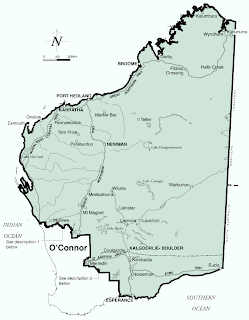 Such a practice is followed in most parts of the world. The Division of Kalgoorlie (to the right) is not well known in the UK. If it were people would be amazed to learn it has a single MP. For this constituency in the Australian Parliament covers most of the non-Perth & environs area of Western Australia - a "mere" 2,295,354 km². At the last election it had 80,773 voters. Representing the seat must be an onourous task and perhaps this is why despite regularly being held by the government of the day it has not been represented by a minister since 1949.
 The Division of Lingiari (to the left) has fared better, with the present member currently sitting in the Cabinet. But Lingiari is another monster seat, covering the entire of the Northern Territory except for the city of Darwin, and also includes the Christmas and Cocos (Keeling) Islands. It has an area of 1,347,849 km² and still has one of the smallest electorates, only 60,341 at the last election. And it's not just Australia with such large constituencies - Canada has the Nunavut electoral district covering the entire of the territory of the same name. It has an area of 2,093,190 km² and just 17,088 voters.
And there are many others. Whilst some of the earlier biases have benefited urban areas, and thus Labour, this one is anti-Labour. The extra seats in Northumbria and Cumbria are both Conservative, whilst all five seats, and thus the two extra, in the Scottish Highlands and Islands, are not held by Labour. It's also interesting to note that, as with some of the other causes of grievances in the system, this is also one that was agreed in recent times. In 1944 when the rules for the current system of reviews were agreed, proposals for a greater equality of constituency size resulted in many natural communities being broken up. It was agreed that a greater level of discretion would be allowed to cover natural communities and rural areas. (I don't think it's a coincidence that a large part of the complaints about the current set-up come from people in urban areas where this is less of an issue.)
Perhaps the biggest myth is that Scotland is still overrepresented compared to England. Since 2005 this has no longer been the case as Scotland now has seats based on the English quota. The reason it has a slightly lower number of voters per constituency is because of the extra seats in the Highlands and Islands, but as this rule also applies to England there is no imbalance.
There is however an imbalance when it comes to Wales. Firstly legislation gives Wales a minimum of thirty-five constituencies when on the same numbers as England it would have only thirty-two. Unlike Scotland this provision has not been repealed. Secondly Wales also has geographically sparse areas, with most of its smallest seats in the north and west (not the Labour the heartland in the south). Thirdly because each part of the UK has a separate Boundary Commission, the quota for each part is calculated separately and imbalances are rarely explicitly reset, and Wales has been operating on separate figures since 1944 (although amendments to both the Scottish and Northern Irish provisions in the last thirty years have had a reset effect).
This has been quite a detailed post so far but I hope it has shown that the imbalances in the system are not deliberate and are instead the by-product of several individual factors designed to make the system easier to use. There is, however, one area where political influence can make a difference.
As part of the public accountability of the review, the proposals must be subjected to a public enquiry if there is sufficient demand. At these reviews local parties and individuals will comment on the proposals and sometimes argue alternative proposals. Some of this is with an eye to partisan benefit, but argued on the basis of what the natural ties in an area are. Others are simply concerned with local ties, such as having a village in the same constituency as its main town, or matching the seat to things such as school catchment areas, bus routes and local newspapers and so forth. Unfortunately if one side makes a fantastic effort and the other a dire one it can have a distorted outcome. And during the 1990s review the Labour Party devoted central resources to supporting and co-ordinating responses to the individual sections of the review. By contrast the Conservatives left it to local parties who often wound up arguing against each other, with some in safe seats seemingly prioritising having the largest majority in the area over all other concerns! But to blame the Commission for accepting the better argued Labour cases is like an amateur who knows nothing about law arguing in court with a top QC and accusing the judge of bias for accepting the latter's outcome.
My very last point on this is the whole notion that there should be equity in the "number of votes it takes to elect an MP from a particular party". Such a concept is totally alien to a constituency based electoral system. If a party has a weak and scattered vote (as the Conservative vote has been in recent elections for reasons that having nothing to do with the boundaries) then it will find it difficult to win seats. By contrast if the vote is strong and concentrated it becomes easier. The first past the post electoral system has always carried this risk, regardless of constituency size, and trying to rig the boundaries to make the seats deliver a predetermined outcome would be a gerrymander that produced hideously unnatural seats. If people want "fairness" and "equality" in this area, the logical solution is a change in the voting system (though few proportional systems deliver absolute "equality" either), not a boundary fix. But I doubt many want to take that leap into the dark just yet.
I hope this post has helped enlighten what is a very complicated process. I don't believe there is any simple solution in this area because the problem is in the detail. The simplistic changes proposed in some quarters would produce awkward alternatives that no-one is actually advocating in and of themselves. And the differences are hardly on the grand scale of some of the grand malapportionments around the world in the past. The way to get more seats is to get more people voting Conservative.
So I'd like to try and have a go at looking at what the various issues and confusions are, to see if there really is a bias in the system and whether it's deliberate or not.
Firstly a note on a few terms. "Gerrymandering" is the deliberate fixing of political boundaries to secure results. "Malapportionment" is when some people/areas have more representation than others. Although the two can be combined they can also occur separately - the United States has taken the principle of exactly equal sized constituencies to ridiculous extremes (with courts rejecting even a difference of just 19 voters) but has amongst the worst gerrymandering in the democratic world, whilst Australia has seen virtually no gerrymandering in its history but has a long history of malapportionment.
The other key terms are the "Boundary Commission", one of four impartial bodies that amend parliamentary boundaries, and the "quota", which is both the average number of voters per constituency in the existing constituencies and the desirable target size for each constituency on the new boundaries. I'll say upfront that I don't believe the Boundary Commissions have an inbuilt bias. Rather they are trying to apply the various rules and precedents to a situation that is far more complicated than its critics often realise, but are coming from a non-partisan background.
This brings us neatly to the first key distinction. All too often the population, the total electorate and the people who actually turn out to vote are used almost interchangeably. But these are three distinctly defined groups. One of the biggest confusions comes because constituencies in the UK are designed on the basis of the total number of registered voters and not just those who turn out. Since the turnout varies across the country this often means that even if the constituencies have exactly equal numbers of registered voters there will still be some seats with more people voting than others. And because turnout in safe Conservative seats is invariably higher than in safe Labour seats this is the start of the numbers appearing to show a bias.
(A further factor in this is the accuracy of the electoral register. In urban areas in particular there is often a high turnover of population with the result that there are many people still listed on the register at both an old and new address, thus reducing the nominal turnout. Similarly many people with multiple addresses like students are registered at both addresses but can only vote once per election. The Boundary Commissions are presently not allowed to take either of these factors into account. Changes to the way voter registration is done in this country are likely to have a significant effect on the numbers.)
The second distinction is the point in time at which equality must occur. The Boundary Commissions are required by law to use only the numbers on the electoral register at the start of the review. But reviews often take a few years to complete and in turn the resulting boundaries are often used for several elections - for instance the boundaries produced in a review based on voter location in 1976 were not replaced until 1997 (bar a few minor local changes). The result is that by the time the boundaries come in they are already out of date and as time goes on the perceived problem worsens. It is no coincidence that this issue has arisen in the last few years, when the current boundaries date to 1991.
The obvious solution is to have more frequent boundary reviews, but this presents other problems, as discovered by the political parties at the 1955 election when the boundaries were changed after only five years. Several MPs found their seats disappearing, there was political chaos when new seats had two (or more) "sitting MPs" who battled for the nomination, local parties had to be reorganised and voters became confused by the sudden changeover. As a result of this it was agreed to have a longer period between reviews so as to minimise the disruption.
By far the most complicated set of number variations comes with the main stage. As you can probably guess an attempt to redraw boundaries for 533 constituencies in one go would overload the work of the Commissions, as well as make it very hard for members of the public to hold it to account. The result is that the review is broken into smaller amounts, usually at the level of the county. Invariably this forces some rounding - for instance Surrey in the most recent review has 11.43 quotas and so is rounded to the nearest whole, 11. Generally this effect balances itself out, though as urban unitary authorities tend to be smaller than provincial counties the rounding effect does create a slight urban bias.
A further bias comes in the use of the local government ward as the basic building block. Rather than face a potential infinite number of lines on the map that can be proposed and counter-proposed, the Boundary Commissions reinforces their neutrality by rarely going below ward level. This make the process much easier to follow, but once again the ward forces a rounding effect. Some wards in Birmingham have getting on for 20,000 voters and can leave the Commission facing either a 10,000 undersized seat or a 10,000 oversized one. Once again this effect is more urban as the wards usually have more voters there, though some rural wards are awkward combinations of several scattered villages. (And these can be further complicated if different villages in the same ward have different main towns.)
The cause of the most extreme variations is physical geography. Often there are some incredibly natural boundaries in existence, whilst in many rural areas it is difficult to represent the scattered voters if the seat is too large. The result is that some big variations come. As I've blogged before (A nice big seat) the constituency with the most voters is the Isle of Wight, because it's just too small to split in two and having a seat span the Solent is absurd. Similarly the smallest seat is Na h-Eileanan an Iar, formerly known as the Western Isles, where representing a scattered cluster of islands is already difficult enough without adding on the mainland as well. Mainland areas can also have undersized seats - the Scottish Highlands, Cumbria and Northumbria all get extra seats because of this.
 Such a practice is followed in most parts of the world. The Division of Kalgoorlie (to the right) is not well known in the UK. If it were people would be amazed to learn it has a single MP. For this constituency in the Australian Parliament covers most of the non-Perth & environs area of Western Australia - a "mere" 2,295,354 km². At the last election it had 80,773 voters. Representing the seat must be an onourous task and perhaps this is why despite regularly being held by the government of the day it has not been represented by a minister since 1949.
 The Division of Lingiari (to the left) has fared better, with the present member currently sitting in the Cabinet. But Lingiari is another monster seat, covering the entire of the Northern Territory except for the city of Darwin, and also includes the Christmas and Cocos (Keeling) Islands. It has an area of 1,347,849 km² and still has one of the smallest electorates, only 60,341 at the last election. And it's not just Australia with such large constituencies - Canada has the Nunavut electoral district covering the entire of the territory of the same name. It has an area of 2,093,190 km² and just 17,088 voters.
And there are many others. Whilst some of the earlier biases have benefited urban areas, and thus Labour, this one is anti-Labour. The extra seats in Northumbria and Cumbria are both Conservative, whilst all five seats, and thus the two extra, in the Scottish Highlands and Islands, are not held by Labour. It's also interesting to note that, as with some of the other causes of grievances in the system, this is also one that was agreed in recent times. In 1944 when the rules for the current system of reviews were agreed, proposals for a greater equality of constituency size resulted in many natural communities being broken up. It was agreed that a greater level of discretion would be allowed to cover natural communities and rural areas. (I don't think it's a coincidence that a large part of the complaints about the current set-up come from people in urban areas where this is less of an issue.)
Perhaps the biggest myth is that Scotland is still overrepresented compared to England. Since 2005 this has no longer been the case as Scotland now has seats based on the English quota. The reason it has a slightly lower number of voters per constituency is because of the extra seats in the Highlands and Islands, but as this rule also applies to England there is no imbalance.
There is however an imbalance when it comes to Wales. Firstly legislation gives Wales a minimum of thirty-five constituencies when on the same numbers as England it would have only thirty-two. Unlike Scotland this provision has not been repealed. Secondly Wales also has geographically sparse areas, with most of its smallest seats in the north and west (not the Labour the heartland in the south). Thirdly because each part of the UK has a separate Boundary Commission, the quota for each part is calculated separately and imbalances are rarely explicitly reset, and Wales has been operating on separate figures since 1944 (although amendments to both the Scottish and Northern Irish provisions in the last thirty years have had a reset effect).
This has been quite a detailed post so far but I hope it has shown that the imbalances in the system are not deliberate and are instead the by-product of several individual factors designed to make the system easier to use. There is, however, one area where political influence can make a difference.
As part of the public accountability of the review, the proposals must be subjected to a public enquiry if there is sufficient demand. At these reviews local parties and individuals will comment on the proposals and sometimes argue alternative proposals. Some of this is with an eye to partisan benefit, but argued on the basis of what the natural ties in an area are. Others are simply concerned with local ties, such as having a village in the same constituency as its main town, or matching the seat to things such as school catchment areas, bus routes and local newspapers and so forth. Unfortunately if one side makes a fantastic effort and the other a dire one it can have a distorted outcome. And during the 1990s review the Labour Party devoted central resources to supporting and co-ordinating responses to the individual sections of the review. By contrast the Conservatives left it to local parties who often wound up arguing against each other, with some in safe seats seemingly prioritising having the largest majority in the area over all other concerns! But to blame the Commission for accepting the better argued Labour cases is like an amateur who knows nothing about law arguing in court with a top QC and accusing the judge of bias for accepting the latter's outcome.
My very last point on this is the whole notion that there should be equity in the "number of votes it takes to elect an MP from a particular party". Such a concept is totally alien to a constituency based electoral system. If a party has a weak and scattered vote (as the Conservative vote has been in recent elections for reasons that having nothing to do with the boundaries) then it will find it difficult to win seats. By contrast if the vote is strong and concentrated it becomes easier. The first past the post electoral system has always carried this risk, regardless of constituency size, and trying to rig the boundaries to make the seats deliver a predetermined outcome would be a gerrymander that produced hideously unnatural seats. If people want "fairness" and "equality" in this area, the logical solution is a change in the voting system (though few proportional systems deliver absolute "equality" either), not a boundary fix. But I doubt many want to take that leap into the dark just yet.
I hope this post has helped enlighten what is a very complicated process. I don't believe there is any simple solution in this area because the problem is in the detail. The simplistic changes proposed in some quarters would produce awkward alternatives that no-one is actually advocating in and of themselves. And the differences are hardly on the grand scale of some of the grand malapportionments around the world in the past. The way to get more seats is to get more people voting Conservative.
Saturday, November 29, 2008
A nice big seat
I've just seen the piece BBC News: MP with... the biggest constituency about Andrew Turner, MP for the Isle of Wight.
The Isle of Wight is the constituency with the single largest number of electors of any in the United Kingdom and as such it frequently features in the numerous online discussions about constituency sizes that have appeared over the year. I've seen so many people make wild claims that the reason the Isle doesn't have two MPs is because of an inherent anti-Conservative bias amongst the Boundary Commission. So let's have a brief look at the facts.
When the Boundary Commission decides on the approximate number of constituencies in a review area (usually a county, unitary authority or London borough) it does so on the basis of a "quota" - the average number of voters per the current number of seats. It then either rounds the number to the nearest whole or combines two areas to avoid excessive disparity.
In the latest review the Isle qualified for 1.48 quotas. Rounded to the nearest whole that comes out as one seat not two. Now if this was a mainland area the solution would be to combine it with a neighbouring authority and have one seat straddling the two. But there's a big obstacle to this - the Solent. So the result is that the Isle problem must be solved entirely on the Isle.
Note Turner's comments about the possibility of giving the Isle two seats:
And so the Member of Parliament for the Isle of Wight is left with the single largest electorate to represent. But Andrew Turner doesn't mind. Numeric exactitude would be damaging to the British way of doing things. British constituencies are based on natural ties and recognisable areas, not the random clusters of favourable voters with little roads used to link them that one finds in the US Congress.
The Isle of Wight is the constituency with the single largest number of electors of any in the United Kingdom and as such it frequently features in the numerous online discussions about constituency sizes that have appeared over the year. I've seen so many people make wild claims that the reason the Isle doesn't have two MPs is because of an inherent anti-Conservative bias amongst the Boundary Commission. So let's have a brief look at the facts.
When the Boundary Commission decides on the approximate number of constituencies in a review area (usually a county, unitary authority or London borough) it does so on the basis of a "quota" - the average number of voters per the current number of seats. It then either rounds the number to the nearest whole or combines two areas to avoid excessive disparity.
In the latest review the Isle qualified for 1.48 quotas. Rounded to the nearest whole that comes out as one seat not two. Now if this was a mainland area the solution would be to combine it with a neighbouring authority and have one seat straddling the two. But there's a big obstacle to this - the Solent. So the result is that the Isle problem must be solved entirely on the Isle.
Note Turner's comments about the possibility of giving the Isle two seats:
With so many people living there, the Isle of Wight is, he says, only a few hundred voters short of being big enough to divide into two constituencies.To my knowledge neither the current nor the last boundary review saw a Conservative counter-proposal for two seats. In the mid 1990s the Liberal Democrats did make one very late in the day but apart from the timings (they were motivated by a realisation that the Isle could fall into their hands) there is no obvious way to divide the Isle naturally and equally. And it would divide the Isle's voice - something that is strongly valued as evidenced by Turner's comments. This time there was just one objection lodged to a single seat, and it wasn't by a party.
It is something he vehemently opposes.
"You need to have one MP for the island. It is important. Maybe they should reduce the overall number of MPs at Westminster instead.
"That would increase the number of constituents in each seat, and then it won't be a problem."
And so the Member of Parliament for the Isle of Wight is left with the single largest electorate to represent. But Andrew Turner doesn't mind. Numeric exactitude would be damaging to the British way of doing things. British constituencies are based on natural ties and recognisable areas, not the random clusters of favourable voters with little roads used to link them that one finds in the US Congress.
Tuesday, July 03, 2007
Time for a Constitutional Convention?
The announcements about constitutional debate and change (BBC News: Brown sets out reform proposals) and the immediate refusal to even consider addressing one of the biggest grievances (BBC News: PM says no to English-only votes; and yes, I do still oppose a two tier MP solution but think there has to be some change made) exposes the very poor way in which constitutional changes are made in this country. All too often one governing party rams through changes with few if any concessions to opposition concerns, creating long-term instability for the sake of short term gain. And it exposes defenders of perceived unfairness to the charge of self-interest - anyone who thinks Brown's attitude on the West Lothian Question does not have such a tinge probably thinks that Joh Bjelke-Petersen was only concerned about communication problems in rural areas when defending the "Bjelkemander". (Malapportionment - irritatingly often confused with gerrymandering - is something that is worryingly creeping into this country, albeit covertly and perhaps unintentionally, due to the Boundary Commission's rules.)
Currently we're in a transitional period where the problems of devolution are starting to rear their heads in earnest, where completing the reform of the second chamber has been dragging on for years, where local government remains a mess, where the rights and responsibilities of both citizen and state are not fully codified and so forth. Some solutions could tackle more than one problem - for example both the United States and Australian Senates are made up of an equal number of senators from each states (give or take the provision for territories). Could an "equal say" upper house make it easier to resolve the problems of voting power in the Commons?
So perhaps it's time there was a grand constitutional convention. Yes it'd be made up of the usual politicians and scholars. But to sit down, address many of the issues fully and openly, and try to find ways forward to resolve them would surely be a better way than relying purely on the government of the day. Whether we need a written constitution or not is an open question that could be debated as part of this process. But rather than calls for piecemeal tinkering, perhaps now is the time for a real examination of how this country is governed.
Currently we're in a transitional period where the problems of devolution are starting to rear their heads in earnest, where completing the reform of the second chamber has been dragging on for years, where local government remains a mess, where the rights and responsibilities of both citizen and state are not fully codified and so forth. Some solutions could tackle more than one problem - for example both the United States and Australian Senates are made up of an equal number of senators from each states (give or take the provision for territories). Could an "equal say" upper house make it easier to resolve the problems of voting power in the Commons?
So perhaps it's time there was a grand constitutional convention. Yes it'd be made up of the usual politicians and scholars. But to sit down, address many of the issues fully and openly, and try to find ways forward to resolve them would surely be a better way than relying purely on the government of the day. Whether we need a written constitution or not is an open question that could be debated as part of this process. But rather than calls for piecemeal tinkering, perhaps now is the time for a real examination of how this country is governed.
Subscribe to:
Posts (Atom)
LinkWithin
