Showing posts with label Labour Party. Show all posts

Wednesday, April 19, 2017

The Shadow Cabinet turnover

I prepared this post for the next Shadow Cabinet resignation as they've come so frequently, but with a new general election now looming it's best to post these statistics now.

Since the last general election there have been:
  • 5 Shadow Business Secretaries
  • 5 Shadow Culture, Media and Sports Secretaries
  • 5 Shadow Defence Secretaries
  • 5 Shadow Welsh Secretaries
  • 4 Shadow Communities and Local Government Secretaries with a fifth to come
  • 4 Shadow Attorney Generals plus a vacant period
  • 4 Shadow Chief Secretaries to the Treasury
  • 4 Shadow Education Secretaries
  • 4 Shadow Environment, Food and Rural Affairs Secretaries
  • 4 Shadow Health Secretaries
  • 4 Shadow Leaders of the House of Commons
  • 4 Shadow Ministers for Women and Equalities
  • 3 Shadow Home Secretaries
  • 3 Shadow International Development Secretaries
  • 3 Shadow Ministers for the Cabinet Office
  • 3 Shadow Ministers without Portfolio
  • 3 Shadow Northern Ireland Secretaries
  • 3 Shadow Transport Secretaries
  • 3 Shadow Work and Pensions Secretaries
  • 2 Shadow Chancellors
  • 2 Shadow Foreign Secretaries
  • 2 Shadow Housing Secretaries, plus a period of being vacant before the previous holder returned
  • 2 Shadow Justice Secretaries
  • 2 Shadow Scottish Secretaries
  • 2 Chief Whips in the Commons
  • 1 Shadow Leader of the House of Lords
  • 1 Chief Whip in the Lords
Posts created since the start of the current Parliament:
  • 2 Shadow Brexit Secretaries
  • 2 Shadow Ministers for Mental Health and vacant for a period in the middle
  • 2 Shadow Ministers for Voter Engagement and Youth Affairs
  • 1 Shadow International Trade Secretary
  • 1 Shadow Lord President of the Council
Posts abolished mid Parliament:
  • 3 Shadow Energy and Climate Change Secretaries
Posts created and (apparently) abolished mid Parliament:
  • 1 Shadow Minister for Diverse Communities
Posted without comment.

Monday, March 20, 2017

Labour - the new Jacobites?

Even today there are still people who assert that the rightful monarchs of Scotland and England are the heirs to James II & VII, the current heir being Franz, Duke of Bavaria. From time to time they can be found toasting the "rightful" king. A few have even popped up outside Parliament to protest the validity of all monarchs and laws passed since 1688. (I would not be surprised if a hard-line Eurosceptic had advanced this argument as a means to get us out of the European Union.) I've even seen opinion polls that ask if the Queen should be succeeded, either upon her death or in a separate Scotland, by a Stuart heir. Looking back to the heyday of Jacobitism in the first half of the 18th there is much to romanticise. It was a cause that had a lot of popular support and much hope that the silent masses would rise up at the right moment. Its followers were convinced it was right. It could well have succeeded but for events beyond their control. But it didn't succeed. And for two and a half centuries the cause has been little more than a romance of history with only a few present-day followers.

How long before the Labour Party goes the same way?

The idea that one of the UK's major political parties could collapse into complete irrelevance may seem incredible. After all the death of parties has been predicted before but both the Conservatives and Labour have come back after prolonged periods in opposition when many commentators and even some leading members began to wonder if the party would ever return to government. The Liberal Party had a more prolonged crash but managed to convert to and survive as a third party. But Labour seems to be in almost terminal decline:
It has taken batterings from all sides and seen heartlands evaporate. Its ratings suggest something bigger than mere short-term problems are afoot. Worse still it seems unable and unwilling to even try and break out of its mess.

That's not for want of trying by some Labour members. But it seems that the Corbynistas just will not be shifted, no matter what happens. And although Corbyn is clearly a contributor to Labour's problems they didn't start under him - they go back to Blair. The party members are bitterly divided - see YouGov: A tale of two parties – what we learned from our Labour membership surveys. One side seems unable to turn things around. The other seems unwilling to do so.

At what point is the Labour Party going to become a hopeless lost cause, which may still stir people's hearts but which is recognised as an utterly impractical prospect? The Jacobites' last real chance of winning power came in 1745. The last serious plan for a restoration came in 1759. But the last direct descendant of James II & VII, "Henry IX & I", still asserted his claim until his death in 1807. The Labour Party might carry on for many years as a shell of what it once was, with successive hard left leaders still hoping. But when will the moderates give up trying to recapture the party and turn it around? Is there a point of no return?

Saturday, September 12, 2015

When did Labour last depose a leader?

Today the Labour leadership result will be announced. And it's already clear a lot of people won't be happy with the outcome, whichever way it goes. But what can they do about it?

I'm not overly familiar with the current Labour Party Rule Book so I don't know the formal procedure for challenging a sitting leader. But I suspect many in the Labour Party don't know it off by heart either and some may be rapidly researching it.

But the problem is not how easy it is constitutionally to depose a leader but rather whether Labour has the culture and the will to do it. And past form suggests not.

When I've asked fellow politicos the question "Who was the last Labour leader to be formally deposed?" there have been three answers:
  • Ramsay MacDonald
  • George Lansbury
  • Pass
Neither of these men is the correct answer. Ramsay MacDonald abdicated rather than was deposed. When in August 1931 his second government was facing collapse over budget cuts he concluded that he could not credibly oppose the expected Conservative or Conservative-Liberal replacement government in implementing a policy he had pursued and so decided to relinquish the leadership. As it happened, he wound up as the head of a National Government that drew members from all three parties and implemented the policy himself but broke with Labour in the process. But that was walking away, not a deposal.

George Lansbury is the other popular answer but he also wasn't deposed. In 1935 Labour was torn over the issue of how to respond to European militarism in the wake of Italy's invasion of Abyssinia (now Ethiopia) with Lansbury opposing even sanctions. Other frontbenchers who held this position resigned, including both Sir Stafford Cripps, widely seen as Lansbury's political heir, and Lord Ponsonby, Labour's leader in the Lords, leaving Lansbury increasingly isolated. The party conference of that year was a turbulent affair with Lansbury opposing a pro sanctions resolution on pacifist grounds and then being shredded in a speech by the Transport & General Workers' Union leader Ernest Bevin.

But neither Bevin nor the conference toppled Lansbury. At the time, the power to elect and remove the Labour leader lay in the hands of the Parliamentary Labour Party alone. Lansbury tended his resignation but it refused by 38 votes to 7. This was no Nigel Farage style evasion of a promise but a genuine offer rejected, partially out of continued affection for Lansbury but also a fear that the next leader would be Arthur Greenwood, widely seen as Bevin's puppet. (Nowadays a trade union leader's mouthpiece is the heavy favourite for the deputy leadership.) However, Lansbury felt his position was untenable and insisted on stepping down. The MPs turned to the deputy leader Clement Attlee, expecting him to be a stop gap until the looming general election returned a wider choice but instead he proved to be the party's longest serving leader.

So just who is the last leader to have been deposed? It was the now little remember John Robert Clynes in 1922.

It may surprise people today but the concept of a "leader of a political party" didn't really emerge until many years after parties were established. There had long been leaders of parties in one of the Houses of Parliament but even then their authority didn't stretch over members in the other House unless they happened to be the current or ex Prime Minister. They had no position over the party in the country. Only slowly did parties come to create formal posts of a leader. (In other countries the "leader" is often still divided - e.g. in Germany three different people may be the chair of a party, the leader in the Bundestag and the candidate for Chancellor. And don't even try working out who is the "leader" of the US Republicans.) In the early years what we would now identify as the Labour leader was split across the chair of the parliamentary party, the chair of the party on the National Executive Committee and the party Secretary. The post of leader was created in 1922.

Clynes had been Minister of Food Control in the Lloyd George Coalition before Labour pulled out and then served as chair of the parliamentary party since 1921 in a Parliament where Labour was lacking many of its biggest names after the 1918 election. He led the party through the 1922 election at which it became undisputedly the leading Opposition party for the first time but then faced a challenge for the leadership from former parliamentary leader Ramsay MacDonald, who had returned to the Commons after a four year absence. In a close vote MacDonald defeated Clynes by 61 to 56. Clynes became MacDonald's deputy and served as Lord Privy Seal and Deputy Leader of the House of Commons in the first Labour government (as was then standard the Prime Minister was the Leader of the House but in practice MacDonald was busy, serving as his own Foreign Secretary) and then as Home Secretary in the second Labour government.

This was not the last time a big name was absent from Parliament when a leader was initially chosen. After the 1935 general election Herbert Morrison was one of the challengers to Clement Attlee but unsuccessful. (Attlee's 20 year long leadership was in part prolonged by a desire to age Morrison out of hope.) Tony Benn lost his seat in the 1983 general election and so missed the chance to stand to succeed Michael Foot; he returned in a 1984 by-election and eventually challenged Neil Kinnock in 1988 but was unsuccessful. David Miliband is currently out of Parliament but that hasn't stopped speculation about his returning to replace Jeremy Corbyn if the latter is elected. We can expect some similar speculation about an Ed Balls return at some stage in the next five years, no matter how silly it may seem or how much he denies it.

But for now Clynes remains the last Labour leader to have been deposed and that was 97 years ago. Labour do not have a culture of toppling leaders and that will make it hard to muster the effort to topple this one.

Sunday, July 19, 2015

Ten reasons why Jeremy Corbyn should be the next Labour leader

It may shock some but I think there are some good reasons why I think Jeremy Corbyn should be elected Labour leader:
  1. Age. If elected Corbyn will become leader at the age of 66, the oldest person to become a leader of a major UK wide party since Michael Foot at 67 for Labour and Neville Chamberlain at 68 for the Conservatives & Unionists (and he was almost the last senior figure for whom the full name was critical). A Corbyn leadership would be a marvellous antidote to the obsession with youth in certain quarters of politics and broaden the field for consideration in other parties.
  2. The beard. Beards have been out of fashion in politics in recent decades with New Labour especially practising a virulent degree of pogonophobia. To find a significant leader with a beard (well on their face) you have to go back to the Edwardian era when Lord Salisbury and Keir Hardie were the last leaders of their respective parties to sport them. By making Corbyn their leader, Labour would help bring beards back into the mainstream.
  3. The cap. Headgear is often absent in politics with only George Galloway's distinctive fedora (which now seems to have been surgically attached) and Paddy Ashdown's meals getting much comment lately. But Corbyn has a wonderfully distinct cap - I believe it's called a Breton Cap - that's a gift for the cartoonists. It's time to expand the range of caps and hats in politics.
  4. Clothes. Corbyn is a functional practical dresser. A tale is told of how burglars broke into his house and actually turned down his red blazer. Not for him the ridiculously expensive tailored suits worn by some Labour politicians. If he were leader the image consultants would have a nightmare - and that's no bad thing.
  5. Cycling. Boris Johnson's term as Mayor is coming to an end in less than a year and he'll either drop into a lower profile or end up in a more security conscious ministerial post of the kind that discourages such open access. There'll be an opening for the position of most prominent cyclist in politics. As Leader of the Opposition Corbyn would be perfectly placed to fill it.
  6. The polls. It can't be much fun being an opinion pollster at the moment. Everyone keeps bringing up the general election and won't listen to explanations about the difference between opinion polls and exit polls. Even away from politics "What would you know?" is a constant response and there's not much opportunity to rebuild reputations before the elections next year. A Corbyn victory would allow opinion polls a chance to get something right this year.
  7. Bookies. It's a sign of just how much the Corbyn bid has surged that initially he odds as low as 100 to 1 or even 200 to 1. If he becomes leader a lot of bookmakers are going to have to pay out rather more on this contest than they were expecting.
  8. Parliament. There is a long history of hardline socialist MPs having a greater impact outside Parliament rather than within it. They tend to go round the country making the most memorable speeches at rallies and protests instead of within the Commons. It's high time to change that and have the case for socialism made in the Commons, and from the despatch box to boot, where the immediate audience will be more diverse and where the arguments can be responded to directly.
  9. Islington. This borough has a reputation for metropolitan liberal chattering class politics practised by those sitting around at trendy dinner parties and looking down with undisguised contempt on the hard working classes. This reputation has not been helped by a number of political developments, including the borough's other MP being Emily Thornberry, and has even led to Newsnight investigations as to why the country is so out of touch with Islington (erm shouldn't that be the other way round?). But whatever else you can say about Corbyn his brand of socialism is not the chattering class dinner party champagne socialist style and his leadership would allow the borough to show it's more diverse than that.
  10. Taking leadership elections seriously. Corbyn was nominated because a bunch of Labour MPs felt it was important to have a debate with the hard left of the party and give it a ritualistic slaughter. They expect Corbyn to do about as well as Diane Abbott in 2010. (They also forgot that Abbott's candidacy attracted members to vote who would otherwise have not bothered and it was their transfers that ultimately gave Ed Miliband the edge.) They never expected a great surge to the point there are now groups organising around a simple Anyone-But-Corbyn line. Nobody expected the supporter option to attract all those #ToriesForCorbyn or #TrotsForCorbyn (and there are even Conservatives trying to sign up Trots for Corbyn). To a Conservative this looks bizarre - when we have our next leadership election nobody is going to think the process is somehow incomplete without the presence of an Edward Leigh, Philip Davies or Nadine Dories on the ballot paper. A Corbyn victory will be a wake-up call to take things seriously and only nominate candidates you actually want to see as leader.
So go on Labour, make him your next leader!

Monday, August 09, 2010

Labour and One Person One Vote

"One Person One Vote" is a slogan that has had multiple uses over the years. It has been used to call for universal suffrage, for the abolition of plural voting and for equal sized constituencies (also called "One Vote One Value" in places). But the basic principle is the same throughout.

So it's interesting to note that at the same time that the Labour Party is running around screaming fake moral outrage about steps to reduce malapportionment in this country, they are also conducting a leadership election where One Member One Vote is noticeably absent. Instead some members will be getting significantly more votes than others. In theory a member could get no less than 32 different ballot papers and cast every single one of them without breaking the rules.

So much for Labour's claims for equality and democracy!

Hattip to Cllr Iain Lindley's Diary: Unequal Votes and Tory Radio: Do Labour MPs advocate stuffing the ballot box?.

Thursday, May 13, 2010

David Miliband for Labour leader?

Whilst the new Coalition is finalising its ministers and getting down to business, the Labour Party is looking to elect a new leader. And already one front runner has emerged - David Miliband. In many ways he resembles Gordon Brown and that's not a good thing:
On several occasions so far Miliband came close to the Labour leadership but backed way from forcing his chances. In the game of musical chairs that was the Blarites' hunt to find a "stop Brown" candidate Miliband emerged as the last survivor, albeit more through the ineptitude of his rivals than any great moves by himself. But then he utterly failed to make a bid and challenge Brown when the leadership election came. He then compounded this error over the next few years by repeatedly laying the ground for a challenge but then never making it. As I've said before (Portilliband?), Miliband has failed to press home his chances time and again, instead awaiting his leader's fall and hoping to pick up the pierces afterwards. Very much like Gordon Brown.

Of course, as I commented before, Miliband has emerged as "the Great Hope of the future despite not really having done anything or been properly tested", and that is very much the position of William Hague in 1997. And Miliband has already come to resemble Hague in another way - the disastrous moment in front of the cameras that will reappear for years to come:
Still one bad photo shouldn't kill his leadership hopes. But will people realise he could well be another Gordon Brown?

Thursday, March 19, 2009

So will Labour try to take London backwards?

Ken Livingstone has announced what's been an open secret for ages now - he's going to run for Mayor in 2012. And if he can't get the Labour nomination he's going to run as an Independent. (BBC News: Livingstone seeks return as mayor)

Just imagine what the return of Livingstone would mean for London. It would mean London would no longer be run for the benefit of all Londoners but instead for a coalition of clientalist groups leeching funds whilst pretending to be representing sections of the community, in harness with a handful of select inner London boroughs. It would mean ever greater taxes on using a car, with no serious attempt to provide alternatives in outer London boroughs. It would mean directly insulting communities and countries. It will mean deals with dodgy dictators. It would mean proliferate waste at City Hall. It would mean a return to corruption investigations. It would mean taxes going up. It would mean needless fights with central government purely for the point of it. It would mean endless tokenism. It would mean promoting community division, not unity. It would mean disaster for London.

Last May Londoners voted to put an end to all that. To their credit the Labour Party leadership got the hint and are doing their best to stop it. (Evening Standard: Labour heavyweights plan mayoral bids to 'stop Ken') But will the London Labour Party members realise get the hint as well? And can't Livingstone get it?

Friday, March 13, 2009

Boris didn't win because of the BNP

In the last few weeks there's been some rather high profile discussion within the Labour Party about their London mayoral candidate for 2012, with invariably a focus on why they lost the 2008 election. I don't wish to intrude on a private war, but one point I feel cannot go unaddressed is the claim being thrown around by some Labour members that Boris Johnson won the Mayoralty in part because the British National Party called for its voters to give him a second preference over Ken Livingstone. (Under the Supplementary Vote system used, these were the only two realistic options.) It is unfortunately standard "damn by association" stuff. Whilst there are many in the Labour Party who are honourable and above such behaviour, in my experience there is an element who will all too freely fling around accusations of racism as a means to get votes, not giving a damn about either truth or the polarising effect this can have on the electorate. The argument goes that Johnson's final majority over Livingstone was 139,772 and as the BNP candidate Richard Barnbrook got 69,710 first preferences then more than half that majority came from the BNP.

As is often the case in politics claims are made with only partial reference to the actual results and the truth requires a greater deal of detail to explain and will often have trouble competing with simplistic assertions made frequently and aggressively. To explain things fully it's necessary to go through the details on this.

Now the Mayoral election results are frequently badly announced and reported, because of the way the vote is counted and the second preference reported. Consequently most tables will list three figures for a candidate - their total number of ballot papers with a first preference, the total number with a second preference and (if applicable) the final result. However as that second figure includes people who gave preferences for both of the top two candidates the figures don't always add up.

For instance the figures for Boris Johnson and Ken Livingstone usually appear as follows:

Johnson 1,043,761 - 257,792 - 1,168,738
Livingstone 893,877 - 303,198 - 1,028,966

In actual fact the more relevant figures for the second column are 124,977 and 135,089 - these are total second preferences cast for Johnson and Livingstone respectively by voters who voted for neither for their first preference.

The official results don't go into enough detail to tell us how every individual voter gave their first and second preferences, although it's relatively easy to use the totals given to calculate the number of Boris Johnson 1, Ken Livingstone 2 votes at 168,109, and Ken Livingstone 1, Boris Johnson 2 at 132,815 (see this forum post by David Boothroyd).

But for other candidates it's much harder to work out results. We'll come back to this later, but first lets look at the impact of the voting system on the result. Or rather the non-impact.

Advocates of preferential voting frequently argue that it breaks the "problem" of vote-splitting and can often deliver a different outcome to whoever would have won on first preferences alone. Now the Supplementary Vote is a limited model, and the voting system doesn't get much coverage, but it's notable that here the only difference to the outcome it made was to narrow Johnson's lead over Livingstone by just over 10,000 votes. This is far from unusual - in many preferential vote elections I have seen the transfers frequently make no difference to the order of elimination or who is elected, instead just dividing up in similar proportions to the first preferences. Outside of co-ordinated voting at conference, only when two strong candidates are chasing the same block of votes and both campaigns are savvy enough to appeal for second preferences and their main rival candidate has more homogenous support have there been significant changes to the outcome. (This is not to say that in a closely fought race the distribution of preferences doesn't sometimes tip the balance but it's rare. The only Mayoral election to date where this has happened was North Tyneside in 2005 when a 1400 Conservative lead on first preferences was converted into a 1002 Labour lead on transfers.)

It's true that some parties called for their voters to use their second preference a particular way, but how many voters actually follow such an instruction? Remember the UK is not Australia where use the "How-to-vote card" is perfected to a fine art (although even there vote leakage can and does occur). The Greens' candidate Sian Berry and Livingstone made a reciprocal transfer call, but how many Green voters followed through? Similarly how many BNP voters followed the party's call for a second preference for Johnson?

Well apparently Giles Edwards and Jonathan Isaby's book "Boris v. Ken" has some figures in this area. I don't have the book myself, but this post and this one gives the figures for transfers from the eliminated candidates:

Brian Paddick: Total votes 236,685. Livingstone 73,612, Johnson 70,157, someone else or blank 92,916.
Sian Berry: Total votes 77,374. Livingstone 36,365, Johnson 10,984, someone else or blank 30,025.
Richard Barnbrook: Total votes 69,710. Johnson 22,200, Livingstone 4,353, someone else or blank 43,157.
Alan Craig: Total votes 39,249. Livingstone 10,352, Johnson 10,328, someone else or blank 18,569.
Gerard Batten: Total votes 22,422. Johnson 6,671, Livingstone 1,681, someone else or blank 14,070.
Lindsey German: Total votes 16,796. Livingstone 6,661, Johnson 1,327, someone else or blank 8,808.
Matt O'Connor: Total votes 10,695. Johnson 2,485, Livingstone, 1,120, someone else or blank 7,090.
Winston McKenzie: Total votes 5,389. Livingstone 945, Johnson 825, someone else or blank 3,619.

Redone as percentages:

Brian Paddick: Livingstone 31.1%, Johnson 29.6%, someone else or blank 39.3%.
Sian Berry: Livingstone 47.0%, Johnson 14.2%, someone else or blank 38.8%.
Richard Barnbrook: Johnson 31.8%, Livingstone 6.2%, someone else or blank 61.9%.
Alan Craig: Livingstone 26.4%, Johnson 26.3%, someone else or blank 47.3%.
Gerard Batten: Johnson 29.8%, Livingstone 7.5%, someone else or blank 62.8%.
Lindsey German: Livingstone 39.7%, Johnson 7.9%, someone else or blank 52.4%.
Matt O'Connor: Johnson 23.2%, Livingstone 10.5%, someone else or blank 66.3%.
Winston McKenzie: Livingstone 17.5%, Johnson 15.3%, someone else or blank 67.2%.

Or taking just the active second preferences:

Brian Paddick: Livingstone 51.2%, Johnson 48.8%.
Sian Berry: Livingstone 76.8%, Johnson 23.2%.
Richard Barnbrook: Johnson 83.6%, Livingstone 16.4%.
Alan Craig: Livingstone 50.1%, Johnson 49.9%.
Gerard Batten: Johnson 79.9%, Livingstone 20.1%.
Lindsey German: Livingstone 83.4%, Johnson 16.6%.
Matt O'Connor: Johnson 68.9%, Livingstone 31.1%.
Winston McKenzie: Livingstone 53.4%, Johnson 46.6%.

Unsurprisingly a lot of votes transferred in line with ideology but there were some very significant leakages. Less than half the people who voted Green followed the call for a Livingstone second preference. Less than a third who voted BNP followed the call for a Johnson second preference.

The BNP transfer contributed only about 18,000 of Johnson's final majority of 139,772 - hardly a decisive factor. It was the strong campaigning by Johnson and outreach to the whole of London, as opposed the Livingstone strategy of just being a Mayor for certain inner London boroughs, that produced the massive increase in votes that won him the Mayoralty.

Monday, February 23, 2009

Labour stops being a British-only party

Another fantastic step for the politics of Northern Ireland took place today. The Labour Party has formally organised at last. (Belfast Telegraph: Labour Party to become official party in Northern Ireland) Congratulations to all those who have campaigned and argued for this over the years, finally overcoming the resistance there has been in the party. Now the Labour URL, labour.org.uk, is finally accurate.

Some of you might be surprised that a Conservative is so welcoming of a new rival party. I will not deny that in part this only helps Conservatives who wish to move the politics of Northern Ireland onto a traditional right-left axis by providing the left of it. But I have also long felt that proper organisation of the main parties can only help the politics of the province. If that means a few extra seats go Labour then that's a price worth paying.

Of course it will be a while before the party stands - the members are cautious about the next general election and clashing with the SDLP. I have a suspicion that this will only prove a temporary issue.

Sunday, May 25, 2008

Let's not get carried away...

Okay the Crewe & Nantwich by-election result brought many a cheer across the Conservative Party, is the first gain from Labour since 1982 or 1978 depending on what you count, etc... etc...

But let's also have some perspective. There have been sensational over-hyped by-election gains for opposition parties before. Often they haven't led to a dramatic change in the political landscape. Did the country go heavily Liberal after Orpington?

And the electorate is very volatile these days. Only a year ago people were talking about Gordon Brown leading Labour to a fourth election victory and heavily increasing the majority, whilst quite a few people in the Conservative Party and the media started talking doom and disaster. The opinion polls have practically yo-yoed for much of the past year. Who's to say that things won't swing back again and that in a few months time the media will be asking if the Conservatives can ever form a government again?

Predicting the next election result or proclaiming the Conservatives as the next government is far, far too premature. There are a lot of voters in the country who have become increasingly willing to listen to what the Conservatives have to say and even dabble with voting for us in council and by-elections. That is not the same thing as a mass scale winning them over. No vote can be taken for granted and many could well vote for Labour at the next election. A lot still needs to be done to win hearts and minds.

Does Labour need to replace Gordon Brown with an all-new & dynamic leader? It's a silly question because there's no obvious candidate. The fact that people are talking about the likes of James Purnell, who hardly anyone had heard of, shows how limited the pool of alternatives is. It's not good for a country's stability to constantly have the premiership in doubt.

If there is one clear fact to emerge from the by-election it's that the Liberal Democrats were not on their best form. They've come from third place to take seats off Labour before but this time they fell back. Is it just a failing in their by-election machine or is Nick Clegg proving the hard way that he's not the Great Young Hope that the party deposed Ming for?

Wednesday, July 25, 2007

The Brent Central Wikipedia war

One of the main dangers of Wikipedia is that when it comes to elections it can be very hard to verify much of the information added to articles, especially those that cite offline "local paper" sources. Sometimes it seems as though opposing sides are trying to get their own spin on it all.

The latest war concerns the new constituency of Brent Central. (Wikipedia: Brent Central (UK Parliament constituency)) With the boroughs of Brent and Camden losing a seat between them, sitting Brent South and Brent East MPs, Dawn Butler and Sarah Teather, will be facing off against each other. And already it seems each's workers in Parliament are editing Wikipedia to put misleading statements about the other. (The Times Online: Pushing the boundaries and The Independent: Pandora - Westminster war over Wikipedia) For what it's worth the main articles are at Wikipedia: Dawn Butler and Wikipedia: Sarah Teather.

This is not the first time I've seen Liberal Democrats taking campaigning onto Wikipedia - during the Bromley & Chislehurst by-election the main article and many individual pages went through numerous reverts, particularly on the issue of the Liberal Democrat candidate not living in the constituency despite passing himself off as a local man. (Wikipedia: Bromley and Chislehurst by-election, 2006) It doesn't surprise me that they still feel the need to peddle lies. Liberal Democrats wouldn't know honest clean campaigning if it bit them on the arse.

Monday, June 25, 2007

No change there then!

So what is one of the first announcements by the All New, All Different Gordon Brown the New Leader?

He's going to seek to reduce the role of trade unions in the Labour Party. (BBC News: Brown aim 'to reduce union power')

Just what Tony Blair did in his early days.

Nice to see such new ideas!

Sunday, May 13, 2007

Michael Meacher's flawed history

One of the worst things about being a history researcher is that it can be very difficult to ignore statements in the media that you know to be incorrect. Take, for example, this one by Michael Meacher, reported in BBC News: Brown takes on rivals in debate :

Mr Meacher was keen to stress the importance of having a debate within the Labour Party.

"The Labour party, throughout the hundred years of its history, has elected its leader every single time, except in 1931, which was very exceptional circumstances," he said.
This is wrong on several levels.

Prior to 1922 the position was "Chairman of the Parliamentary Labour Party", which was something of a different position. I forget exactly how many contests there were for the post (the first one in 1906 saw Keir Hardie elected with a one vote majority over David Shackleton), but a glance at David Marquand's Ramsay MacDonald suggests that the 1907 election was unopposed (Hardie stood down under pressure, Shackleton declined to run and Henderson was elected - page 102). Wikipedia so far doesn't list any contests before 1922 - see Wikipedia: Category:Labour Party (UK) leadership elections.

1922 saw the position redefined as "Leader of the Labour Party" and "Chairman of the Parliamentary Labour Party", although the latter post eventually became separate. Even then there were unopposed elections - 1931 was not as dramatic as Meacher makes out, for Ramsay MacDonald was still a member of the Labour Party at the point when Arthur Henderson became leader. As the leader was elected by Labour MPs only, it would have been entirely possible to hold a ballot. Instead for some time as the Second Labour Government limped to its resignation it had been clear that MacDonald's leadership was coming to an end and Henderson was the only likely successor - shades of this year.

Then in 1931/32 the leadership was again elected without a contest. Henderson lost his seat, together without about 80% of Labour MPs, in the 1931 election but remained leader for another year. In the interim George Lansbury, the one former Cabinet Minister to survive, was elected to head the Parliamentary Party - without a contest. When Henderson stepped down in 1932 (to focus on the Disarmament Conference), Lansbury was elected full leader without a contest.

Then in 1935 when Lansbury insisted on resigning, even in spite of a unanimous resolution urging him to stay passed by a meeting of the Parliamentary Labour Party, Clement Attlee was elected as leader unopposed. True he was regarded as a stop-gap until after the forthcoming general election (and he did indeed face a contest later that year), but he was still elected unopposed.

Plus at various times throughout Labour's history the leadership has been elected automatically at the start of each Parliament or even every year (when in Opposition). Numerous leaders have been re-elected unopposed - did Michael Meacher not notice these?

So ignore sweeping statements that unopposed leadership elections are alien to Labour - after all one produced their longest serving leader ever.

Thursday, May 10, 2007

The best thing Tony Blair has ever done

Goodbye. Good riddance.Sadly we've got another few weeks of him but the end is finally in sight. (BBC News: Blair will stand down on 27 June)

Everyone is scrambling to write the political obituaries and finding the same question - just what are Blair's achievements as Prime Minister?

Now a lot will rush and say "independence for the Bank of England" and "years of a strong economy", but I question whether these are Blair's achievements rather than Gordon Brown's. Scottish devolution? I would credit that to Donald Dewar. Indeed many of these supposed achievements seem to originated elsewhere from Downing Street.

The obvious exception is peace in Northern Ireland. Whilst others played their part (and have been rightly rewarded), it cannot be denied that the time Blair invested in the peace process (the area of government policy he gave more attention to than any other) has been essential for pushing the process forward.

And the other achievement is political. Blair transformed the Labour Party into a strong fighting force. He also destroyed the complacency that had built up in the Conservative Party. Indeed many of the changes made to the party in the last few years have been in direct response to the impact of New Labour. Ironically in the long run Blair's true political legacy may scarily be closer to the Conservative Party than the Labour Party.

And of course there have been failures. But rather than list them all, let's stick to just one - his own definition:

"My project will be complete when my party learns to love Peter Mandelson."

So he leaves with the project unfulfilled...

Friday, October 20, 2006

No Short shock

Clare Short has left the Parliamentaty Labour Party. Given how she's been out of sync with Labour for so long now, including her call for a hung Parliament at the next election, the only surprising thing is that she stayed in the party for so long.

There was a time when Short was a serious force in the Labour Party one that could threaten to detrain the New Labour project. A decade ago as Shadow Transport Secretary she earned the wrath of Blair when during a tube strike she walked out of an interview on camera because she didn't want to say she supported the right to take the public hostage in industrial disputes. She was rapidly sidelined but could not be easily sacked.

Once she was seen as a probable future Deputy Leader - but her bizarre actions over the Iraq War put paid to that. One of the great ironies is that ten years ago it was Short who was one of the fiercest Shadow Cabinet critics of Harriet Harman's decision to send her son to a good school. Today it is Harman, not Short, who is the contender for the Deputy Leadership.

I doubt anyone in the Labour Party is losing sleep tonight over Short's departure. She has long alienated her support base and failed to replace it. She will join a long list of MPs who ended their days in Parliament whipless and forgotten.

Saturday, May 20, 2006

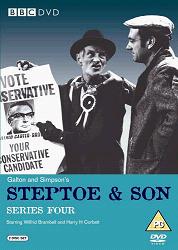
Steptoe and Son - "My Old Man's a Tory"

Steptoe & SonToday I received the latest Steptoe and Son DVD, containing all the episodes from the fourth series. And amongst them is the classic My Old Man's a Tory where Albert and Harold clash over their political views. Ironically the first Conservative of the day that Albert mentions is Enoch Powell, some years before his most famous moment. All in all it's one of the best episodes of the series I've seen, with fun such as the usual Albert and Harold fight as well as the Labour branch meeting (with both Harold and the agent sporting a mackintosh and pipe in the style of Harold Wilson!). There's also an interesting prediction when Harold is told that despite having lived in the ward all his life he is not considered a suitable candidate as the Labour Party wants to move away from the cloth cap working class image and be more appealing to the middle classes. It seems there was Blairism before Blair. Also look for the picture of Harold Wilson at the meeting, adorned with Union Jacks. When would we see Labour members today doing that to Tony Blair's picture?

(Also note the rosettes that Albert and Harold are wearing. Although it's black and white, they are clearly not wearing the blue and red ones familiar today. The 1960s was the fag end of the days when party colours varied widely across the country - the historian John Barnes has recalled that when he went out for his first canvass as prospective candidate for Walsall North in 1963 he was wearing a blue rosette - and was immediately kissed by a lady who had been waiting thirty years for a Liberal candidate! In that seat the Conservatives traditionally used red, the Liberals blue and Labor yellow, later yellow and red. Shortly after Barnes' adoption the local Conservatives chose a red, white and blue rosette.)

The whole DVD is full of delights. This series pioneered the classic sitcoms of today and I urge you all to take a look for yourselves.

Friday, April 21, 2006

No to state funding of hairdos

Our taxes should never pay for thisThe row about Cherie Blair's hair has caught the imagination of the blogosphere. Amongst the many points discussed, perhaps the most concerning are the continuing poor quality of the Labour Party's spokespersons and the current proposals for state funding of political parties.

The official Labour reaction to the story has been "So what? Mrs Blair worked fantastically hard during the election and visited more than 50 constituencies during the campaign. She is enormously popular with the party and, don't forget, we won the election." Does anyone honestly believe Labour was returned to power because of Cherie Blair's hair?!?! And is she really so popular with the Labour Party? Especially now?

Far more concerning are the proposals in current circulation for state funding of political parties. Is this really the sort of thing that tax payers' money should ultimately be spent? It's twice as much as Peter Kilfoyle (who nominated Tony Blair to be Labour leader in the first place) spent on his local election campaign. He also made the following comment:

This is the problem. We are almost accepting by stealth a First Lady.
There is only one First Lady in this country and today she is 80 years old. The way the Blair behave like a President and First Lady is a total embarrassment for the country. For the sake of us all they must go now.

Amongst the blogs discussing this story are Tom's Little Thoughts, alastair's heart monitor, A Big Stick and a Small Carrot, Ian Plumbley's Thoughts Blog, The Nether-World, On a quiet day, I can hear her breathing, old enough..., An Englishman's Castle, Earlsdon Greens 2006, A Tangled Web, »-(¯`v´¯)-».: Kita's Blog :.»-(¯`v´¯)-», The Officially Original Loch Ness Monster Blog, Charlton Hofie, Conan Vancy - The Voice Of Treason, donbert, Anorak: Voting Booth, Choice Cuts, Isabel and Ryan Klint and itisi.

Is this what the loans were needed for?

The official spending figures for the election campaign reveal that the Labour Party spent £275 a day on Cherie Blair's hair, coming to a total of £7,700. So is the culture of extravagance that generates spending like this one of the reasons why the Labour Party needed to borrow so much money?

Here's some advice for the Blairs in future: Use an ordinary hairdresser. At the same time as getting a good service for a much more reasonable rate, they might actually come in contact with ordinary people and understand how government policy is operating on the ground.

Still the Blairs could have been even more extravagant. Tony could have nominated his wife for a peerage. But no self-respecting political leader would ever do that would they?

LinkWithin

Related Posts Plugin for WordPress, Blogger...