In the last few weeks there's been some rather high profile discussion within the Labour Party about their London mayoral candidate for 2012, with invariably a focus on why they lost the 2008 election. I don't wish to intrude on a private war, but one point I feel cannot go unaddressed is the claim being thrown around by some Labour members that Boris Johnson won the Mayoralty in part because the British National Party called for its voters to give him a second preference over Ken Livingstone. (Under the Supplementary Vote system used, these were the only two realistic options.) It is unfortunately standard "damn by association" stuff. Whilst there are many in the Labour Party who are honourable and above such behaviour, in my experience there is an element who will all too freely fling around accusations of racism as a means to get votes, not giving a damn about either truth or the polarising effect this can have on the electorate. The argument goes that Johnson's final majority over Livingstone was 139,772 and as the BNP candidate Richard Barnbrook got 69,710 first preferences then more than half that majority came from the BNP.
As is often the case in politics claims are made with only partial reference to the actual results and the truth requires a greater deal of detail to explain and will often have trouble competing with simplistic assertions made frequently and aggressively. To explain things fully it's necessary to go through the details on this.
Now the Mayoral election results are frequently badly announced and reported, because of the way the vote is counted and the second preference reported. Consequently most tables will list three figures for a candidate - their total number of ballot papers with a first preference, the total number with a second preference and (if applicable) the final result. However as that second figure includes people who gave preferences for both of the top two candidates the figures don't always add up.
For instance the figures for Boris Johnson and Ken Livingstone usually appear as follows:
Johnson 1,043,761 - 257,792 - 1,168,738
Livingstone 893,877 - 303,198 - 1,028,966
In actual fact the more relevant figures for the second column are 124,977 and 135,089 - these are total second preferences cast for Johnson and Livingstone respectively by voters who voted for neither for their first preference.
The official results don't go into enough detail to tell us how every individual voter gave their first and second preferences, although it's relatively easy to use the totals given to calculate the number of Boris Johnson 1, Ken Livingstone 2 votes at 168,109, and Ken Livingstone 1, Boris Johnson 2 at 132,815 (see this forum post by David Boothroyd).
But for other candidates it's much harder to work out results. We'll come back to this later, but first lets look at the impact of the voting system on the result. Or rather the non-impact.
Advocates of preferential voting frequently argue that it breaks the "problem" of vote-splitting and can often deliver a different outcome to whoever would have won on first preferences alone. Now the Supplementary Vote is a limited model, and the voting system doesn't get much coverage, but it's notable that here the only difference to the outcome it made was to narrow Johnson's lead over Livingstone by just over 10,000 votes. This is far from unusual - in many preferential vote elections I have seen the transfers frequently make no difference to the order of elimination or who is elected, instead just dividing up in similar proportions to the first preferences. Outside of co-ordinated voting at conference, only when two strong candidates are chasing the same block of votes and both campaigns are savvy enough to appeal for second preferences and their main rival candidate has more homogenous support have there been significant changes to the outcome. (This is not to say that in a closely fought race the distribution of preferences doesn't sometimes tip the balance but it's rare. The only Mayoral election to date where this has happened was North Tyneside in 2005 when a 1400 Conservative lead on first preferences was converted into a 1002 Labour lead on transfers.)
It's true that some parties called for their voters to use their second preference a particular way, but how many voters actually follow such an instruction? Remember the UK is not Australia where use the "How-to-vote card" is perfected to a fine art (although even there vote leakage can and does occur). The Greens' candidate Sian Berry and Livingstone made a reciprocal transfer call, but how many Green voters followed through? Similarly how many BNP voters followed the party's call for a second preference for Johnson?
Well apparently Giles Edwards and Jonathan Isaby's book "Boris v. Ken" has some figures in this area. I don't have the book myself, but this post and this one gives the figures for transfers from the eliminated candidates:
Brian Paddick: Total votes 236,685. Livingstone 73,612, Johnson 70,157, someone else or blank 92,916.
Sian Berry: Total votes 77,374. Livingstone 36,365, Johnson 10,984, someone else or blank 30,025.
Richard Barnbrook: Total votes 69,710. Johnson 22,200, Livingstone 4,353, someone else or blank 43,157.
Alan Craig: Total votes 39,249. Livingstone 10,352, Johnson 10,328, someone else or blank 18,569.
Gerard Batten: Total votes 22,422. Johnson 6,671, Livingstone 1,681, someone else or blank 14,070.
Lindsey German: Total votes 16,796. Livingstone 6,661, Johnson 1,327, someone else or blank 8,808.
Matt O'Connor: Total votes 10,695. Johnson 2,485, Livingstone, 1,120, someone else or blank 7,090.
Winston McKenzie: Total votes 5,389. Livingstone 945, Johnson 825, someone else or blank 3,619.
Redone as percentages:
Brian Paddick: Livingstone 31.1%, Johnson 29.6%, someone else or blank 39.3%.
Sian Berry: Livingstone 47.0%, Johnson 14.2%, someone else or blank 38.8%.
Richard Barnbrook: Johnson 31.8%, Livingstone 6.2%, someone else or blank 61.9%.
Alan Craig: Livingstone 26.4%, Johnson 26.3%, someone else or blank 47.3%.
Gerard Batten: Johnson 29.8%, Livingstone 7.5%, someone else or blank 62.8%.
Lindsey German: Livingstone 39.7%, Johnson 7.9%, someone else or blank 52.4%.
Matt O'Connor: Johnson 23.2%, Livingstone 10.5%, someone else or blank 66.3%.
Winston McKenzie: Livingstone 17.5%, Johnson 15.3%, someone else or blank 67.2%.
Or taking just the active second preferences:
Brian Paddick: Livingstone 51.2%, Johnson 48.8%.
Sian Berry: Livingstone 76.8%, Johnson 23.2%.
Richard Barnbrook: Johnson 83.6%, Livingstone 16.4%.
Alan Craig: Livingstone 50.1%, Johnson 49.9%.
Gerard Batten: Johnson 79.9%, Livingstone 20.1%.
Lindsey German: Livingstone 83.4%, Johnson 16.6%.
Matt O'Connor: Johnson 68.9%, Livingstone 31.1%.
Winston McKenzie: Livingstone 53.4%, Johnson 46.6%.
Unsurprisingly a lot of votes transferred in line with ideology but there were some very significant leakages. Less than half the people who voted Green followed the call for a Livingstone second preference. Less than a third who voted BNP followed the call for a Johnson second preference.
The BNP transfer contributed only about 18,000 of Johnson's final majority of 139,772 - hardly a decisive factor. It was the strong campaigning by Johnson and outreach to the whole of London, as opposed the Livingstone strategy of just being a Mayor for certain inner London boroughs, that produced the massive increase in votes that won him the Mayoralty.
Showing posts with label David Boothroyd. Show all posts
Showing posts with label David Boothroyd. Show all posts
Friday, March 13, 2009


Saturday, March 07, 2009
Car crashes in African politics
I've been reluctant to post this but as others have pointed it out (see David Boothroyd's comment on Iain Dale's Diary: Sad News from Zimbabwe) I'll go ahead and say my reaction to the sad news from Zimbabwe.
I have been reminded of one of the first ever articles I read on African history as an undergraduate: "Remembering Du: An Episode in the development of Malawian political culture" in African Affairs 97:369-396 (July, 1998). For those without access to the article it looks at the death of Dunduzu Chisiza and how "car accidents" involving significant political rivals have become a significant factor in the politics of not just Malawi but in many other African countries. Coincidence can be all too convenient.
Zimbabwean politicians who have died this way include (again, thanks to a comment by David Boothroyd):
I have been reminded of one of the first ever articles I read on African history as an undergraduate: "Remembering Du: An Episode in the development of Malawian political culture" in African Affairs 97:369-396 (July, 1998). For those without access to the article it looks at the death of Dunduzu Chisiza and how "car accidents" involving significant political rivals have become a significant factor in the politics of not just Malawi but in many other African countries. Coincidence can be all too convenient.
Zimbabwean politicians who have died this way include (again, thanks to a comment by David Boothroyd):
* Josiah Tongogara (December 1979), single car crash in Mozambique. He was the leader of the anti-Mugabe faction in ZANU which wanted to run a joint election campaign with ZAPU.Understandably the Movement for Democratic Change are launching their own investigation into this incident. (BBC News: MDC to examine Tsvangirai crash) Many will be hoping that this was a genuine and tragic accident, but I hope this does not lead to the investigation being fudged. Truth must not be sacrificed to convenience.
* Rufaro Gwanzura (August 2000), car crash in Zimbabwe. MP for Marondera West.
* Border Gezi (April 2001), single car crash on the Masvingo road. Minister for Gender, Youth and Employment with a large following among young members of ZANU-PF.
* Moven Mahachi (May 2001), single car crash in Zimbabwe. Minister of Defence and popular among the armed forces.
Friday, November 21, 2008
Liberal Democrat Run Tower Hamlets Borough Council - never ever again?!
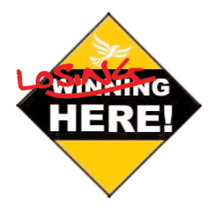 Yesterday there was a by-election in the Mile End East ward in the London Borough of Tower Hamlets. The result was as follows:
Rachael Mary Alice SAUNDERS (Labour) 1208 47.3354232% (+15.11246805)
Motiur RAHMAN (Conservatives) 630 24.68652038% (+12.46136646)
Hafiz CHOUDHURY ("RESPECT") 604 23.6677116% (-3.794909334)
Jainal CHOWDHURY (Liberal Democrats) 110 4.310344828% (-17.94119431)
TOTAL 2552
(A word of caution. There are several different ways to calculate party percentages in multi-member wards, each with their own advantages and drawbacks, and I've used the method that assumes all voters used all their votes in 2006 - see Croydon Official Monster Raving Loony Party: Croydon 2006 for a summary of methods, mine is "Method B". At the last regular election not only did Mile End East have a huge amount of ticket splitting by normal standards but also Hafiz Choudhury ran as an independent, getting 5.837730871% of the vote. One could in theory add that to the "RESPECT" share, but it's not standard practice.)
It has been a good by-election to campaign in - our candidate, Motiur Rahman, is one of those people who can inspire activists to stay out far longer than they planned. The Conservative result is the best in living memory in the ward in both absolute and % terms (see Wikipedia: Tower Hamlets local elections and also Tower Hamlets Borough Council Election Results for earlier results - Mile End East takes in most of the old Limehouse ward with some of the old Bromley ward).
Now there's a lot that can be said about the various candidates and parties (and I was semi-surprised to see Rachael Saunders, a familiar name from Labour Students from years past in the NUS) but whilst the "RESPECT" vote has continued to fall (a decline even sharper when you consider the votes Choudhury got as an independent in 2006) as flash parties invariably do, perhaps the most significant long term sign is that Liberal Democrats in the borough are crashing and burning, after a long history here.
Tower Hamlets has a long Liberal/Liberal Democrat tradition - before Simon Straight Choice Hughes's victory it was the last part of Inner London to elect a Liberal MP when Sir Percy Harris held the Bethnal Green South West seat in the 1935 general election and although he lost the seat after the war he successfully returned to the London County Council, with Bethnal Green sending the only Liberals. Harris's campaign methods were in many ways the forerunner of "community politics" used in the borough. Even in the 1950s Bethnal Green had a respectable Liberal share.
More recently the Liberals/Liberal Democrats grew electorally in the borough, controlling it for eight years and producing one of the most notorious administrations in recent local government history, including being served notice by the Commission for Racial Equality. The tensions stirred up saw the first ever British National Party electoral victory in the borough. Fortunately both the BNP councillor and the Liberal Democrat administration were thrown out in the 1994 elections. But "Liberal Democrat Run Tower Hamlets Borough Council" still remains a dirty term.
The Liberal Democrats briefly reversed their decline in 2002, but then crashed again in 2006, losing nearly 2/3 of their seats to Labour (the one shift in the borough the media failed to spot) and now have just four councillors. They are the smallest party on the council and look to be in terminal decline. Does anyone believe they will one day again ru(i)n the borough?
Subscribe to:
Posts (Atom)
LinkWithin
