Showing posts with label opinion polls. Show all posts

Saturday, May 09, 2015

Some thoughts on the election

During this election I was mainly focused on the local West Ham constituency where I was the agent for Festus Akinbusoye, our brilliant local Conservative candidate, and also on the Stratford and New Town by-election, where Matthew Gass ran a strong campaign. Both recieved more votes than any previous candidate I have records for. And that includes me.

Of the national picture I had no clear idea with the polls seemingly all over the place or showing more margin of error than usual but an underlying tiny Conservative lead.

Come the count my priorities were local, especially in the first couple of hours. So when I saw the exit poll showing us as the largest party with an increase in seats I just dismissed it as wildly inaccurate and went off to watch the ballot box openings. As it turned out the poll was inaccurate - but in the other direction.

Politics students up and down the country can now write essays on the question "Who had a worse election result in 2010 - Ed Miliband or Peter Kellner?" The polling industry is clearly going to have to reassess its methodology - the UK is just one of a number of countries ranging from Canada to Israel where polls have spectacularly got it wrong in recent elections.

I will not deny it, getting an overall majority was an expected joy. Seeing particular politicians defeated also brings a cheer, especially Ed Balls. For any Conservative who had to endure Portillo's defeat this was balance.

And Nigel Farage and George Galloway have proved to be great national unifiers. People across the whole political spectrum united in delight at their defeats.

Amongst the smaller parties it was a shock to see the Ulster Unionists return to Westminster. It's even more amazing that the Revd. Willie McCrea lost his seat to a pro gay marriage candidate. Let's hope this is the start of something in Northern Ireland.

The SNP surge in Scotland is one of the biggest shocks and a reminder that there is no such thing as a safe seat when such huge majorities crumbled. It's odd to think that my grandparents' old home in Edinburgh is now in the only Labour seat in Scotland. But Scotland has spoken firmly and cannot be ignored.

And the Lib Dems have had a spectacular crash. There are many mistakes they made, and I may blog on them separately, but one thought spring to mind. It seems that the only people who thought the Lib Dems made a pro Liberal Democrat difference in government were either Lib Dem activists or frustrated Conservatives. Many have pointed to disillusion left-leaning Lib Dem voters deserting the party for Labour, the Greens or the SNP. But equally some right-leaning Lib Dem voters felt that the government was more to their liking than they expected and they didn't think the Lib Dems had much influence. So they concluded that it was down to David Cameron. So Nick Clegg has achieved the detoxification of the Conservative Party.

When David Cameron first became leader he set out to see off the Lib Dem threat. First he tried direct appeals, hoping for mass defections, but it didn't work. Then he tried dismissing and ridiculing them, but it didn't work. Finally he tried bearhugging them. And it crushed them.

We now have five years to complete the rebuilding of the economy and society. We must not shirk the task.

Wednesday, May 26, 2010

Diane Abbott and polls

One of the first opinion polls on the Labour leadership election has been topped by Diane Abbott prompting Silver Surfer Today (amongst others) to ask Could Diane Abbott be next Labour leader?

It's an interesting idea but it overlooks two key factors. The first is that the opinion poll is of the electorate as a whole, whereas the Labour leader will be elected by a combination of Labour Party and trade union members. Of course they may be swayed by the findings of such opinion polls but I doubt by ones at this stage. For the second key factor is that this leadership election has barely begun and the candidates have got little exposure. So the opinion polls are finding nothing more than name recognition. (See for instance UK Polling Report: New ComRes and ICM polls and, for the equivalent for the Conservatives in 2005, 2005 Tory Leadership.) And it has to be said that Abbott has quite a high level of name recognition, especially compared to the likes of Andy Burnham, who seems to be the Chris Whone of the Labour Party.

The key question about Diane Abbott at the moment is not whether she can win the leadership election but whether or not she can even get successfully nominated. So far according to Labour Party: Candidates Abbott has yet to receive a single formal nomination. Meanwhile both Milibands have crossed the threshold and, like Gordon Brown, are in the process of getting more than they need, presumably so they can try and carve other candidates out of the race altogether. The presence of John McDonnell also seeking nominations from the far left of the party isn't helping Abbott either.

Tuesday, May 25, 2010

How to rig an opinion poll

Another classic clip from Yes Prime Minister; this time where Sir Humphrey explains how to produce the opinion poll result one wants:

Thursday, November 05, 2009

Is Europe important to the electorate?

With dozens of commenters and hundreds of pseudonyms roaming the internet to express fake moral outrage about the Conservatives' policy on the European Union, invariably many are claiming that a huge portion of the electorate are concerned with this. But does the evidence stack up?

Late last month Ipsos MORI conducted their "issues index" opinion poll and the results are available online. This opinion poll asks two questions:
  1. What would you say is the most important issue facing Britain today?
  2. What do you see as other important issues facing Britain today?
One of the entries is for "Common Market/EU/Europe/EURO" (the multiple labels allow for ease of tracking over time). So how what percentage identified this as the most important issue facing Britain today?

1%

Yes it's clearly an issue a huge chunk of the electorate prioritises above all else. Greater percentages selected each of the following:

Economy/economic situation, Crime/law & order/violence/vandalism/ASB, Race relations/immigration/immigrants, Unemployment/Factory Closure/Lack of Industry, National Health Service/Hospitals/Health care, Defence/foreign affairs/international terrorism, Education/Schools, Inflation/prices, Morality/individual behaviour/lifestyle, Pollution/environment, Poverty/inequality and Other

Ah but what about the second question, about other important issues? Well yes this did increase the total. The combined responses to questions 1 & 2 for Europe were:

3%

Still an issue of huge concern to a vast chunk of the electorate! As well as all of the above, this time it was also beaten by: Pensions/social security/benefits, Housing, Drug abuse, Low pay/minimum wage/fair wages

Still the Euro-obsessives can take comfort that Europe scored equally to Local government/council tax and higher than: Public services in general, Taxation, Petrol prices/fuel, Nationalisation/Government control of institutions, Bird flu/Pandemic Flu/Swine Flu, Transport/public transport, Pound/exchange rate/value of pound, Nuclear weapons/nuclear war/disarmament, Countryside/rural life, Trade Unions/Strikes, Scottish/Welsh Assembly/Devolution/Const. reform, Privatisation, Animal welfare, AIDS, GM/GM (Genetically Modified) foods, Northern Ireland (this poll is Great Britain only) and Foot and mouth outbreak/farming crisis.

But I expect people to still make the same old unsubstantiated claim.

Saturday, October 24, 2009

The BNP and polling

In the aftermath of Nick Griffin's Question Time appearance the BNP have soared ahead in the opinion polls. Or have they?

A poll done yesterday found they have 3% support, up a grand total of 1%. But 3% is what they got at the end of September. (UK Polling Report: YouGov verdict on BNP's Question Time) And 2-3% is how they've been generally doing in polls anyway. So despite all the outrage about the polls (see BBC News: BNP support in poll sparks anger) have we got nothing more than a standard statistical fluctuation?

Small parties are rarely the focus of opinion polls so there isn't a great deal of data to compare this one to. And the way a poll is asked can have a greater effect on a small party's result than on the larger ones - people are more likely to say they're voting BNP, UKIP or Green if the party is named in the initial list available than a generic "others" that leads to a further list. A specific poll focusing on a small party will bring similar name recognition.

The other results in the YouGov poll include a headline "22% of people questioned would "seriously consider" voting BNP". Actually it's 7% "definitely or probably" and 15% who said it's "possible". And the latter probably includes some "never say never" respondents. There is a poll from 2006 that lacked the "possible" option and found 20% would consider voting for the BNP.

There was also a question about positive/negative attitudes to the BNP, which can be compared to one taken after the Euro elections. Then it was 11% with a positive attitude compared to 72% negative. Now those figures are 9% and 71% - another statistical fluctuation.

Is there a "shy BNP factor" that makes people reluctant to admit to voting for the party? Probably - but one would expect it to be present in previous polls. And YouGov's online polling has frequently managed to penetrate the wall of embarrassment on other questions in ways that face-to-face and phone polling hasn't.

So what does any of this show? Well the overnight reaction is that despite a few headline claims there hasn't been any significant effect either way from Nick Griffin's appearance on Question Time. So far it doesn't appear to have been a major boost for the party, but neither has it delivered a knock-out blow.

But this is only so far. For a long time the BNP have benefited from the way opposition to them has been divided on several points, mainly over whether to challenge them directly or pretend that No Platform policies work in this day and age. (And although more minor, the way that some on the mainstream right seem to spend more time demanding the BNP be described as a left-wing party than anything else is really not doing any good at all.) Even now people are still arguing over whether it was right to have the BNP on Question Time and I fear the confront or marginalise debate will continue, to the BNP's advantage.

Wednesday, September 17, 2008

Is this poll serious?!

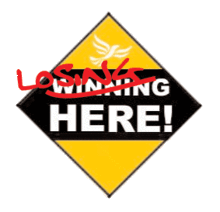
A truthful poster for the Lib DemsUK Polling Report: Conservatives break 50%? has the latest figures from MORI and they are incredible:

Conservatives 52% +4
Labour 24% N/C
Lib Dems 12% -5

Yes the Liberal Democrats are polling less than a quarter of the Conservative share. According to an internal party group document Liberal Vision - The Cameron Effect (pdf) the Lib Dems are facing a huge drubbing at the next election and this poll could take them to their worst result since 1970.

Meanwhile Labour is flatlining, down to just the rock solid core vote. This is an even worse level than they got in 1931 (see When Labour was even more flappable).

But is this poll realistic? I've long wondered if the polling companies have taken on board that it is no longer considered embarrassing to admit voting Conservative, and potentially embarrassing to admit to voting Labour. So the poll may be badly weighted. Whilst it's nice to imagine the effect of these results, the next election will only be won through hard work and convincing the public. I don't think it's settled yet.

Friday, August 22, 2008

Obama stops walking on water

The latest opinion polls are not looking good for Barack Obama. The Boy Wonder is slipping into a dead heat despite having far more campaign finance and far more television coverage than John McCain. (BBC News: Why has Obama's poll lead slipped?) McCain's legendary underdog ability to triumph over superior odds is coming to the fore and at a time of rising fuel prices Obama is starting to run on empty.

So he needs to pull a rabbit out of a hat, aka choose a Vice Presidential nominee who can boost him. Times have changed since the days when delegates at party conventions got drunk over dinner and laughed about who to nominate, then carried forward the joke to the vote, resulting in people like William Wheeler going from one form of obscurity to another whilst Presidential nominees were left wondering just who their running mate was. (Rutherford Hayes famously said to his wife "I am ashamed to say: Who is Wheeler?")

Nowadays the choice is treated more seriously but is there really a stunning Democrat who can join the ticket and magically turn around Obama's chances? I somehow doubt the choice announced today (BBC News: Obama set to reveal running-mate) will do that.

Tuesday, June 10, 2008

Are the polls believable?

Normally any partisan beast or supposedly "neutral" commentator will have one of two attitudes to opinion polls. When they show the result one wants it becomes a stick to beat others with. When they don't show the result there is no end of nonsense about the way in which polls are compiled, together with that classic statement "The only poll that matters is the general election," which is politician-speak for "We are going to lose big time."

But I have to say I am finding some of the current opinion polls to be too good to be true. Maybe that means on election night I'm going to enjoy the result, maybe it means I'll be able to say "Told you so," to anyone who can't strangle me. The latest poll suggests that Gordon Brown has a worse approval rating now than Iain Duncan Smith did. (The Times: Gordon Brown slides to record poll low as crucial vote looms)

Now I can remember the two years of Iain Duncan Smith's leadership and I have to say I don't recall being particularly depressed by the whole affair. Maybe that's because after four years of William Hague, when things did get very depressing, just doing about the same was at least familiar. Certainly I viewed the events of Halloween 2003 with a degree of dread that changing the leader could get the party into an even worse mess than it was already in. As it happened I was proved wrong. But I can understand why Labour are scared to even consider a new leader, quite apart from a rulebook that makes a leadership challenge less likely than Downing Street being invaded by Elvis Presley and Lord Lucan riding on the back of the Loch Ness Monster.

But will Gordon Brown see it that way? I think Iain Dale puts it well: I Wouldn't Want to be a Mobile Phone in No 10 Tonight.

Sunday, May 25, 2008

Let's not get carried away...

Okay the Crewe & Nantwich by-election result brought many a cheer across the Conservative Party, is the first gain from Labour since 1982 or 1978 depending on what you count, etc... etc...

But let's also have some perspective. There have been sensational over-hyped by-election gains for opposition parties before. Often they haven't led to a dramatic change in the political landscape. Did the country go heavily Liberal after Orpington?

And the electorate is very volatile these days. Only a year ago people were talking about Gordon Brown leading Labour to a fourth election victory and heavily increasing the majority, whilst quite a few people in the Conservative Party and the media started talking doom and disaster. The opinion polls have practically yo-yoed for much of the past year. Who's to say that things won't swing back again and that in a few months time the media will be asking if the Conservatives can ever form a government again?

Predicting the next election result or proclaiming the Conservatives as the next government is far, far too premature. There are a lot of voters in the country who have become increasingly willing to listen to what the Conservatives have to say and even dabble with voting for us in council and by-elections. That is not the same thing as a mass scale winning them over. No vote can be taken for granted and many could well vote for Labour at the next election. A lot still needs to be done to win hearts and minds.

Does Labour need to replace Gordon Brown with an all-new & dynamic leader? It's a silly question because there's no obvious candidate. The fact that people are talking about the likes of James Purnell, who hardly anyone had heard of, shows how limited the pool of alternatives is. It's not good for a country's stability to constantly have the premiership in doubt.

If there is one clear fact to emerge from the by-election it's that the Liberal Democrats were not on their best form. They've come from third place to take seats off Labour before but this time they fell back. Is it just a failing in their by-election machine or is Nick Clegg proving the hard way that he's not the Great Young Hope that the party deposed Ming for?

Friday, May 09, 2008

When Labour *lost* Jarrow

I've blogged about this before (When Labour was even more flappable) but the news that the Conservatives are 26% ahead in the opinion polls (ConservativeHome's ToryDiary: Tories 26% ahead) and predictions of a 288 seat majority has reminded me of the all time greatest landslide election this country has ever seen - the 1931 general election.

This election saw the Conservatives and their National Government allies win all over the country, carrying seats such as Jarrow (so anyone who's read Things Can Only Get Better should be aware that the "Labour holds Jarrow" 1983 election could have been so much worse), and took not a mere set of Labour scalps but virtually the entire front bench - National Labour members aside, only one member of the ex Labour Cabinet (George Lansbury) and two other ex ministers (Clement Attlee and Sir Stafford Cripps) held their seats. The Labour leader, Arthur Henderson, lost Burnley by over 8000 votes and overall Labour lost nearly 4/5ths of their seats.

It was also the high water mark for the Liberals that they have still to reach, securing 72 seats. Historians like to separate the Liberals into three different groupings but such divides were not so clear cut at the time. And indeed one Lib Dem MP to this day can't make up his mind about this matter (see An inability to get the figures right or just whatever will benefit?).

So will the next election be such a walkover? I doubt it - but it would be a fun night if the election graphics are unable to cope with such an overwhelming avalanche. And it would be a blow against complacency that would be felt on all sides.

Tuesday, February 19, 2008

Liberal leadership problems

He was very narrowly elected as Liberal leader late last year, with his opponent casting doubt over his potential for success. Now he's facing abyssmal poll results and a new Prime Minister who seems impossible to dent. Few believe he will ever be Prime Minister, and naturally further leadership speculation is growing.

So is it time for another leadership election?

Or is Brendan Nelson safe?

What, you thought I was talking about someone else?

The Australian: Nelson defends 9 per cent poll rating has the full story of the latest woes for the Liberal Party of Australia.

Thursday, May 04, 2006

77% of students oppose the marking boycott

Following on from my earlier posts about the AUT/NATFHE marking boycott and the NUS leadership supporting the action without consulting their members, not to mention the Petition against the AUT assessment boycott, the issue has hit the headlines today. A poll commissioned jointly by London Student and the Times Higher Education Supplement has found that 77% of students oppose the boycott.

What's interesting has been the reaction of the National Union of Students' leadership:
NUS president Kat Fletcher said: "Clearly there are strong opinions circulating on both sides of the debate across the two million members that we have in higher education.

"We know that some students are unhappy with the lecturers' decision to boycott assessment and we also have clear evidence of support for the teaching unions and the actions they have been forced to take."

Ms Fletcher said the survey might have elicited a different response if it had set out all the facts.
Those who have seen Yes Prime Minister will recall the classic scene when Humphrey explains to Bernard just how to rig a survey. Presumably Kat Fletcher would have liked such a survey to be conducted instead of an opinion poll.

(Some may wish to claim the poll was rigged. However it was commissioned by London Student whose editorial line has been one of support for the boycott. The actual questions asked were "Do you support the lecturers' demands for higher pay disregarding their industrial action?" and "Do you support the lecturers boycotting the setting and marking of exams and coursework as part of their campaign for higher pay?" Furthermore the polling organisation has been identified and is one with a reputation, not a dodgey "private poll" of the kind in the Yes Prime Minister example.)

I should also note the rest of Kat's comments:
However, like all students I am concerned about the impact of the industrial action especially with the exam season under way.

I am particularly concerned that some students aren't even able to take their exams, because of the AUT policy not to set them," she said.

"We are really pleased that both sides will be getting back round the table, something which should have happened much earlier than this."
But from her comments overall it seems doubtful that the NUS leadership will respond to this clear expression of student opinion. One must seriously question whether the NUS mission values statement is being adhered to when it states:
NUS will constantly improve the lives and experiences of students in the UK: by ensuring their voice is heard and effectively represented; by developing democratic and strong students’ unions; and by providing collective benefits and access to information for all students.
Now the NUS leadership may want to argue for the trustee model of representation rather than the delegate model of representation. But traditionally NUS has gone with the delegate model of representation and it's rather suspicious to change stance just when the existing model happens to deliver a different result from the one wanted.

As well as my earlier post about Adam Sloan's experience of the boycott, here are two more individual accounts. Firstly The Independent Online Edition has Portia Hart: Why I would fight the AUT to get my degree whilst BBC News has Jacqueline Berry's account of her waiting game. Here at Queen Mary we've been lucky that the deadline for submitting exam papers fell before the boycott started, but many students are still concerned that they will not be able to graduate and take up graduate jobs and postgraduate places. At other universities students don't even know if they'll be able to sit their exams.

Let's hope this poll helps bring the action to a conclusion very soon.

LinkWithin

Related Posts Plugin for WordPress, Blogger...