Showing posts with label Nick Clegg. Show all posts

Thursday, July 16, 2015

The problems of the Lib Dems

With the Liberal Democrats declaring their new leader today, it's time to take a look at the mess they're in.

Five years ago, I asked "Nick Clegg - Sir John Simon or Sir Herbert Samuel?" It is now possible to provide an answer. And it is neither, though more Samuel than Simon.

In one regard, Nick Clegg has succeeded incredibly by holding his party together. There were a total of 58 MPs in the last Parliament - 57 elected in 2010 and a replacement in a by-election. At this past general election just one of those MPs stood as a non-Lib Dem - Mike Hancock who was expelled in a scandal and whose re-election bid was unrelated to a coalition split. A scandal also accounted for the only Lib Dem MP to resign mid-Parliament, Chris Huhne. Ten MPs stood down at the election, mostly long standing and/or elderly members, though Sarah Teather's retirement on political grounds was a sign that all was not well.

This is an impressive achievement compared to previous coalitions that saw the Liberals shed MPs either through defections to non-government parties (this happened even during the Churchill coalition in the Second World War) or due the party's departure failing to take all its members with them. There was no grand split with MPs forming an anti-coalition faction around someone like Simon Hughes, Tim Farron or Charles Kennedy. In this regard, Nick Clegg succeeded better than all his predecessors.

However, in nearly every other regard Clegg has taken the Lib Dems to a catastrophic failure.

(In one though, that's not necessarily a bad thing for the Lib Dems. He had an ambition to make the Lib Dems like the German Free Democrats. The FDP have since been wiped out of the Bundestag.)

Many explanations have been put forward but the fundamental problem is simple - the Liberal Democrats do not have a clearly identified distinctive raison d'être and a core vote based on that. I know someone will start posting the preamble to the Lib Dem constitution, but such position statements are fairly generic and in any case the preamble is not exactly widely known.

Over the years the Lib Dems have been all over the place, ranging from asserting a centrist position on the political spectrum to being to the left of Labour to radical free marketers. At a local level the situation is even worse with the party's trumpeted "localism" manifesting as a "whatever gets your vote gov" approach that has meant the party has become even more incoherent, with Lib Dems varying wildly across the country and sometimes even in the same district. Tristram Hunt is clearly biased but his piece from six years ago The Lib Dem power failure reflects how many from other parties look on in utter bewilderment as to what the Liberal Democrat vision in local government is.

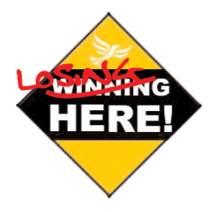
And then there are two tactics that yes they are used by all parties but which the Lib Dems have turned into a fine art form. There's the demonisation of rival candidates for being insufficiently local, even when the Lib Dem candidate's own local credentials are questionable (e.g. a councillor from the far end of the borough from the constituency claiming to be more local than the sitting London Assembly Member). And there's the resort to tactical pleas with the whole "can't win here" that have squeezed rival parties. Both may deliver in the short term but neither have really converted the voters into long term Lib Dem supporters.

If the Lib Dems are to survive in the long term (and many in other parties hope they don't) they need to articulate a clear vision of what their party stands for to the public at large and grow a core vote around this vision. Their new leader has to start somewhere...

Wednesday, March 26, 2014

Clegg vs Farage - more please

In less than an hour it will happen. The leaders of the two biggest UK wide minor parties will go head to head to argue about Europe. And it could set a useful precedent.

In just about every country that has election debates - and that's an awful lot - there are regularly rows over who should be included and excluded. But they don't all have to be in one messy crowd. In New Zealand, amongst other countries, there are separate debates for major and minor party leaders and it brings greater clarity.

So come 2015 we could put Clegg and Farage, and probably also Natalie Bennett, George Galloway and the Westminster leaders of the SNP/Plaid Cymru (no Alex Salmond, it should be someone actually aiming for Westminster) in their own debate to slug it out, and have a separate one with the two major party leaders. Tonight is just a starter.

Monday, July 11, 2011

Know thine enemy "partners" - the Liberal Democrat MPs

I've recently been doing some statistics compilation about the electoral record of the Liberal Democrat MPs to help some others answer various questions about how much the traditional image of the party is still true. The findings are surprising and I thought I'd share them here.

Of the current 57 Lib Dem MPs, only one has had a break in their Commons service. Mike Hancock was first elected in a 1984 by-election, lost in 1987 & again in 1992, but returned in 1997. (For all these statistics bar continuous ones I use Hancock's 1984 election.)

Just five first entered Parliament at a by-election - and only two since the merger, one in a Lib Dem held seat.

The traditional image of Lib Dem MPs gaining their seat after multiple attempts now covers only the minority of the parliamentary party. No less than thirty-two of the fifty-seven MPs won their seat on their first attempt there. Eighteen had not stood for Parliament at all before, eleven had stood once before in other seats and just three had had two previous unsuccessful candidacies.

Out of the twenty-five who first won their seat after multiple attempts, fifteen had only stood in that seat. Eighteen won their seat on the second attempt, four on the third attempt, two on the fourth attempt and one on the fifth attempt.

On average then a Lib Dem MP has won their seat after 1.63 attempts in that seat and 2.19 attempts overall.

Only fifteen MPs were first elected in an already Lib Dem held seat; the other forty-two gained theirs from other parties. The Lib Dem Cabinet Ministers disproportionately represent the "inheritees", with Nick Clegg, Chris Huhne and Michael Moore all having inherited their seats. (So too did David Laws, whom Moore net replaced.)

The inheritees are very much at the newer end of the parliamentary party. The longest serving was first elected in 1997, the rest were all in the last decade - 6 in 2001, 5 in 2005 (including one in a by-election), 3 in 2010.

Lib Dem MPs have on average been in Parliament for nearly eleven years. The mid point for election falls at the end of the 2001 intake.

The intakes by general election break down as follows: 1983 - 2, 1987 - 1, 1992 - 2, 1997 - 13, 2001 - 8, 2005 - 17, 2010 - 10. The five by-election entrances were in 1973, 1983, 1984, 2003 & 2005. Only one MP remains from the pre-Alliance era, and only five more from the Alliance days (with two having come from the SDP).

A slightly different picture emerges when looking at how long the party has held each seat since. Lib Dems seats have on average been held continuously for fourteen and a half years. The mid point is within the cluster gained in 1997. The longest continuously held seat is Orkney & Shetland (since 1950).

The breakdowns by general election are as follows: 1950 - 1, 1955-1979 - none, 1983 - 4 (2 Lib, 2 SDP, only one of whom was the sitting MP), 1987 - 2 (both Lib), 1992 - 4, 1997 - 18, 2001 - 3, 2005 - 13, 2010 - 7. Five seats were gained in by-elections in 1965, 1973, 1983, 1994 & 2003.

Three MPs have had parliamentary careers elsewhere - John Thurso was in the Lords for four years before the hereditaries were expelled and both Nick Clegg and Chris Huhne served in the European Parliament for 5 & 6 years respectively.

What all this shows is that overall the Lib Dems are slowly moving out of their traditional niche of local campaigners wining after repeat attempts or at by-elections, and towards a more standard party model and breed of politicians; with in particular MPs who make their name in the party nationally before selection and who can get picked in seats different to their locality on merits other than their local record. But it is a slow process, with many of the older style of Lib Dems still in the parliamentary party, and one that may be reversed if the Lib Dems' see a major collapse at the next general election. Nevertheless the party is changing and the old ways of reacting to it are becoming obsolete.

It's also striking how Nick Clegg is very much at the extreme in this shift. He is the first Liberal or Liberal Democrat leader to have entered the Commons in an inherited seat since Clement Davies (leader 1945-1956). He is also one of very few of his party's MPs to have arrived in the Commons with a established parliamentary record. Clegg's election to the European Parliament was entirely due to the party list system whilst he inherited a strong majority and he has not contested any other constituency meaning that at no stage in his career to date has he really had a tough electoral fight amongst the voters at large. This lack of a background in the traditional Lib Dem frontline of street level politics may also explain the growing sense of detachment between the Lib Dem leader and his party; a detachment that could grow to be the Coalition's biggest vulnerability.

Monday, June 07, 2010

The Hughes Plan

Tom Harris has the detailed gist of it. (And another thing...: Looking enviously at the opposition benches) Over on Liberal Democrat Voice a post lists Simon Hughes’ 10 proposals for Lib Dem MPs under Coalition . It looks suspiciously like a programme for organising a party in opposition, just one that happens to be sitting on the government benches. At a glance it seems Simon Hughes wants the Liberal Democrats to be neither one thing nor the other but somewhere in between. How very Liberal Democrat.

There's a vague historical precedence for this (there nearly is for everything!). In 1932-1933 the Liberals sat on the government benches for a year after they had resigned their ministerial posts over the introduction of Imperial Preference on tariffs. But that was stage three of a four stage process by which the Liberals extracted themselves from the National Government and settled into opposition in as intact a position as possible. (The other stages were - separate manifestos in the general election; formal agreement to suspend collective responsibility on an area where the governing parties simply did not agree; and finally moving to the opposition benches. The second stage isn't that different from some of the elements of the coalition agreement and of course the coalition being formed after the election rather than before removes the need for the first.)

I have no idea if Simon Hughes is even aware of that brief period in his party's history (even amongst Liberal historians it is one of the more neglected periods) or if he's consciously trying to mimic it. But it feels like he wants to create a position whereby the Liberal Democrats can evade responsibility for everything that the coalition does that's unpopular - and with the necessary tax cuts boy are there going to be unpopular things done - whilst Liberal Democrat ministers can cream off credit for popular successes. It's not exactly a party fully participating in government but rather a recipe for opportunistic mess. I give full credit to Nick Clegg for not (yet) having implemented an opposition within a government but if Hughes wins the deputy leadership election (as seems increasingly lightly), will Clegg bin or implement the Hughes Plan?

Sunday, May 16, 2010

Nick Clegg - Sir John Simon or Sir Herbert Samuel?

What happened the last time there was a peacetime coalition in the UK? The Liberal Party enthusiastically entered it but badly split between two dominant personalities, dividing the party for generations.

Sir John Simon had served successively as Solicitor General, Attorney General and Home Secretary under Asquith and then had emerged in the 1920s as the main heir to the Asquith wing of the party in the clashes with Lloyd George. He was also appointed as the chair of the "Simon Commission" to study constitutional reform in India.

Sir Herbert Samuel had also held high office under Asquith, including as Home Secretary, but then spent most of the 1920s out of Parliament and instead served as the first High Commissioner for Palestine for five years, then returning to the United Kingdom and heading the "Samuel Commission" that investigated the coal industry and sought to solve its problems before the General Strike. He returned to active Liberal politics and was re-elected to Parliament in 1929.

The 1929-1931 Parliament saw the Liberals hold the balance of power between Labour and the Conservatives and like today the party found itself divided over what course of action to follow and which party to back, complicated further by the harsh economic climate. A minority Labour government was formed which tried to govern and made some concessions to the Liberals, including introducing a Bill to change the voting system to the Alternative Vote, but the Liberals still badly divided with Simon and Lloyd George at the head of rival factions. Eventually in the summer, Simon and some followers resigned the Liberal whip.

The events of August 1931 (see Coalition forming for more details) totally changed the situation. The Labour government fell over proposals to cut public spending and a special "National Government" that drew together politicians from all three parties was formed. Lloyd George was ill so Samuel was acting leader of the party and entered the Cabinet as Home Secretary once more. Although the Liberal ministers were all drawn from the loyalist wing of the party, unity broke out in support of the government. But it couldn't last.

The Conservatives in the National Government proposed to seek an electoral mandate to introduce protectionist tariffs to help British industry and the Liberals split three ways over this. Lloyd George and a few followers (mainly his family) completely withdrew their support from the National Government and sought an informal alliance with the Labour Party over free trade. Meanwhile the bulk of the Liberals split in two. One group under Samuel were opposed to tariffs but wished to fight the battle within government. The other group under Simon were prepared to accept tariffs. The "Samuelites" retained control of the official party apparatus and a formal faction called the "Liberal Nationals" emerged under Simon. The government won an enormous majority in the November 1931 election and in the following government reshuffle, Simon became Foreign Secretary, with both factions of Liberals now represented.

The split continued over the next two years as the Samuelites tried to resist being part of the implementation of tariffs. First the government suspended the principle of collective responsibility to allow Liberal ministers to openly oppose government policy (something we might see again in the coming years), then the Liberal ministers resigned their posts whilst still sitting on the government benches in the Commons, and then finally in November 1933 they moved to the opposition benches. In the course of these events the Samuelites and Simonites became ever more divided with the result that the Liberal Nationals had become a separate party from the Liberals.

There were attempts to reunite the various strands of the Liberal family over the next few years but apart from Lloyd George's followers rejoining the Samuelites (now the "Sinclairites" after Samuel lost his seat and was succeeded as leader by Sir Archibald Sinclair) it was not to be. The Samuelites became established as The Liberal Party and served in the wartime coalition, then went through a long history in the wilderness, eventually merging with the Social Democrats to form the Liberal Democrats. The Simonite Liberal Nationals remained strong allies of the Conservatives, formalising their alliance in 1947 before finally merging completely into the Conservatives in 1968.

The fate of the Liberal Nationals has haunted the Liberals for decades and made them wary of too closely allying with one party or another without changing the voting system. Now they’ve entered another coalition but already there are signs that some senior Liberal Democrats are not entirely happy with the new arrangements (e.g. BBC News: Charles Kennedy refused to back Lib Dem-Tory pact). Could we see the Liberal Democrats once more permanently divide over a coalition? And which side of the divide will Nick Clegg be on?

Wednesday, April 01, 2009

Shock horror as Nick Clegg learns he's not considered a potential Prime Minister

One of the amazing things about Liberal Democrat leaders is their ability to take themselves so seriously when all around them see them for what they are. Nick Clegg has just had the latest shock. For he has realised he will not be meeting with Barack Obama.
I am really annoyed... As it was not a state visit I understood I wouldn't get to see him. But when I found out Obama was meeting the Queen and David Cameron I got on the phone to David Miliband to ask him what was going on.

(Source of quote: Daily Mail: Nick Clegg's in a spin over Obama visit)
You see Obama is meeting with the present and prospective future Prime Ministers. Not with the perpetual leader of a minor opposition party. What interest has he in wasting his time?

Liberal Democrat Voice: Clegg 'annoyed' not to be meeting Obama notes that Liberal Democrat frontbenchers are allowed to consult with departmental civil servants, in the same way the Shadow Cabinet are, but that is because there is a realistic possibility of the Liberal Democrats serving in a coalition. Not that they may form a government. Both the White House and the Foreign Office realise this. Nick Clegg clearly still has delusions of grandeur.

Tuesday, December 30, 2008

Lib Dem activists don't like their negativity!

An internal Liberal Democrat report into the London Mayoral election has leaked. And the findings are damning for the Liberal Democrat method of campaigning. (Evening Standard: Paddick was a turn-off for voters, say Lib-Dems) Highlights of the coverage include:
...activists were so upset with "negative campaigning" that they refused to deliver lealfets...
And the report itself says:
The present system often appears to incentivise candidates to promote themselves above all else... Many candidates have too often come across almost as if they were independents...
It's not just referring to Brian Paddick but to Liberal Democrat candidates in general. One of the most devious campaign tactics some have adopted is to basically run against their own Liberal Democrat run council where necessary.

If Nick Clegg, or whoever's the Lib Dem leader next week, really does believe in "a new type of politics", "an end to tribalism" and all the other stuff they usually spout then they could do no worse that actually clamping down on their local campaign organisers who are addicted to negativity. Every Conservative and Labour activist has a stock of stories of negative Lib Dem campaigning to trade and despises the Lib Dems precisely because of this two-facedness. If Clegg wants to make any impact as all as leader he could do no worse than make this a priority.

Thursday, December 18, 2008

A year of Nick Clegg

Apparently Nick Clegg has been leader of the Liberal Democrats for exactly one year today. (Hattip to Iain Dale's Diary: Nick Clegg: A Year of Progress or A Year of Disappointment? as I wouldn't have noticed otherwise.) So what has happened in his year as leader?

Well to be honest not much. The Liberal Democrats have stabilised, have managed to have a year without a leadership election (the first since 2004) but generally have been rather obscure. Their biggest news story was the massive splits when Clegg decided to oppose calls for a referendum on the EU Constitution "Treaty", when they are the party that has called for referendums on such treaties before. (Liberals continue ditching democracy and And so continues the Lib Dem Muppet Show) So that's one strike against democracy. (However I'm not sure that Clegg himself is responsible for the party's youth wing ditching students and democracy - see Young Liberals abandon students and democracy.) Otherwise the party has continued to be all over the place when it comes to tax cuts and that's about it really.

What about Clegg himself? Well he hasn't really made a great political impact and he's best known for the admission of sleeping with thirty women. It confirms that there are times when the public have the right not to know but has otherwise made him into a figure of fun. (However Jeremy Vine came off even worse - see Never again!) Then there was the revelation and attempted cover-up about the fact that Clegg was a member of the Conservatives at Cambridge. (Clegg's murky past) But beyond that Clegg hasn't made any real impact.

Still he can take some consolation when compared to the Liberal Democrats's counterparts in other countries. In the last twelve months their Canadian counterparts have suffered their worst election results since federation and seen their attempts to pervert democracy backfire big time with the leader deposed (When was this put to the electorate?), Has Canadian democracy triumphed?, "Forest Gump as a Prime Minister will not go over well in Quebec" and Harper 1, Dion Nil), their Australian counterparts have disappeared from parliament and their Irish counterparts have voted to dissolve themselves (The end of the Progressive Democrats).

Wednesday, December 03, 2008

When was this put to the electorate?

Two months ago the people of Canada went to the polls (Canadian federal election, 2008) and the Conservative government increased its number of seats, whilst the Liberals got their worst result since federations. And not offered to the people at all was the prospect of a Liberal-New Democratic Party coalition.

Since then Liberal leader Stéphane Dion has announced his resignation (No end of Liberal leadership elections!) but it takes months to replace a Canadian political leader. The Conservative government has been getting on with the key task of running the country, whilst other politicians have been making deals in smoke filled rooms to produce a cynical deal to produce a Liberal-NDP coalition, with support from the separatist Bloc Québécois. The whole affair is already provoking a constitutional crisis in Canada that will test several straining points of the Westminster system. (2008 Canadian political dispute)

It is this kind of deal making and contempt for the voters that demonstrates why coalitions are government at their worse. The Liberals and New Democratic (sic) Party are playing the numbers game, claiming a majority of voters supported them at the last election. But nobody supported this proposed coalition - it wasn't put to the electorate! Voters, not political leaders, should decide who governs them.

No doubt there will be lots of Liberal Democrats (another sic) popping up to defend the situation. But I hope the UK never ends up in the same situation. Who governs this country after the next election should be decided by the voters, not by Nick Clegg's ambitions.

Sunday, May 25, 2008

Let's not get carried away...

Okay the Crewe & Nantwich by-election result brought many a cheer across the Conservative Party, is the first gain from Labour since 1982 or 1978 depending on what you count, etc... etc...

But let's also have some perspective. There have been sensational over-hyped by-election gains for opposition parties before. Often they haven't led to a dramatic change in the political landscape. Did the country go heavily Liberal after Orpington?

And the electorate is very volatile these days. Only a year ago people were talking about Gordon Brown leading Labour to a fourth election victory and heavily increasing the majority, whilst quite a few people in the Conservative Party and the media started talking doom and disaster. The opinion polls have practically yo-yoed for much of the past year. Who's to say that things won't swing back again and that in a few months time the media will be asking if the Conservatives can ever form a government again?

Predicting the next election result or proclaiming the Conservatives as the next government is far, far too premature. There are a lot of voters in the country who have become increasingly willing to listen to what the Conservatives have to say and even dabble with voting for us in council and by-elections. That is not the same thing as a mass scale winning them over. No vote can be taken for granted and many could well vote for Labour at the next election. A lot still needs to be done to win hearts and minds.

Does Labour need to replace Gordon Brown with an all-new & dynamic leader? It's a silly question because there's no obvious candidate. The fact that people are talking about the likes of James Purnell, who hardly anyone had heard of, shows how limited the pool of alternatives is. It's not good for a country's stability to constantly have the premiership in doubt.

If there is one clear fact to emerge from the by-election it's that the Liberal Democrats were not on their best form. They've come from third place to take seats off Labour before but this time they fell back. Is it just a failing in their by-election machine or is Nick Clegg proving the hard way that he's not the Great Young Hope that the party deposed Ming for?

Friday, May 02, 2008

Never again!

For those who aren't watching the BBC News coverage of the election results you have been lucky to escape one of the most hideous pieces of television I've ever seen, making even the numerous entries by Richard Madeley seem bearable.

Jeremy Vine dressed as a cowboy with a Texan accent telling us how Calamity Clegg is doing compared to his predecessors, by shooting cans of whatever can get 30 in. Even by the standards of funny BBC night election graphics this sinks to new lows.

Tuesday, April 15, 2008

Clegg's murky past

Nick Clegg has hardly been reticent in his admissions about his past life - many would think he should have been more reticent! But it's curious that whilst he has no qualms about exposing himself to public ridicule as "Cleggover", he feels the need to lie about other events in his past.

Stories have abounded that when at university Nick Clegg was a member of the Conservatives. He has denied this - see The Daily Telegraph: Three Line Whip: 'Tory mystery' in Nick Clegg's past where:

...Clegg's spokesman denies it.

"Nick is one hundred per cent adamant that this isn't true".
However over on CentreRight: Nick Clegg's Tory past, Greg Hands produces evidence showing that Clegg was indeed a member of the Conservative Association in his first year at Cambridge. There is no other Clegg it could have been.

So why does Nick Clegg feel the need to lie about this? It's not remotely as damaging as his Cleggover revelations, and he's not the first leading Liberal Democrat to have had a past in other parties - Vincent Cable went from being a university Liberal to being a Labour activists before becoming a Social Democrat. And he's talked about believing in honesty - so why does he feel the need to lie about this?

Monday, April 07, 2008

Another Liberal Democrat leadership election farce

Is this the rightful leader of the Liberal Democrats...December is always a difficult time for the postal system, so one has to wonder who thought it was a good idea to have a Saturday December 15th deadline for returning postal ballots in the most recent Liberal Democrat leadership election. The latest damning revelation is that over a thousand ballot papers arrived between the 15th and the declaration on the 18th. And these ballots would have given the election to Chris Huhne. (The Independent: Meet the real leader of the Liberal Democrats)

...or this?It gets worse. The returning officer asked both candidates if they wanted the late ballots counted, and it was Nick Clegg who was firmest against this.

So Nick Clegg isn't even the choice of his party to lead them. How long before Cleggover becomes Cleggunder?

Thursday, March 06, 2008

And so continues the Lib Dem Muppet Show

So many Muppets!When Sir Menzies Campbell was forced out many Lib Dems were privately rejoicing at the prospects of a firmer leader and a more organised party. Yesterday those hopes were well and truly shattered.

Not a particularly memorable MuppetOver 20% of the parliamentary party rebelled on a three line whip and three members of the most senior part of the frontbench team resigned over the issue. The only reasons there weren't more resignations is apparently due to some rule that allows junior spokespersons to rebel and keep their post. Well the Liberal Democrats are a party that like to pretend you can have your cake and eat it.

A rather more effective oneIt's strange because the Lib Dems are the party for whom all the arguments over whether or not the Lisbon Treaty is pretty much the same thing as the EU Constitution should be utterly irrelevant. They called for a referendum on the Maastricht Treaty and have long called for government to trust the people. Then they turned round and decided that the people can't be trusted.

Is it any surprise that the Liberal Democrat blogosphere is now in uproar? (Dizzy Thinks: Is the Lib Dem blogosphere rebelling too?, Norfolk Blogger: Suddenly you realise you are not so different after all, New Model Army: Send in the clowns... and more.) On this first major test of Nick Clegg's leadership he has flunked it and shown that he is more concerned with promoting European centralism than in leadership. The EU is not known for being the most democratic of organisations and is it unsurprising that an ex MEP seeks to block the people having a say and instead makes only tokenistic gestures trying to divide the referendum movement?

Tuesday, January 22, 2008

Liberals continue ditching democracy

As well as the party's youth wing changing the name and ditching "Democrats" (see Young Lib Dems to become a lie?), the party is retreating from democracy in other areas. Nick Clegg has announced that his party will vote against letting the people of this country have their say on whether or not political power should be transferred.

Many often argue against referendums, making the case that we elect Parliament to make decisions for us. And this is true. But that is a very different thing from whether or not Parliament should have the right to give powers away; powers that will be very hard to retrieve. There is an unwritten agreement between Parliament and the people, and any changes to that agreement should be assented to by both.

Nick Clegg seems scared of a referendum - does he think he wouldn't win one? Doesn't he have the self-confidence to put the case for the treaty to the people? If so then he truly is a yellow politician. Instead he's calling for a basic referendum on whether or not we should be in the European Union at all - a worthy thing in itself but since such a vote is currently unlikely he is merely using it to appear to support democracy whilst in actual fact undermining it.

And at the last general election all three parties promised a referendum on the Constitution. That the treaty is very similar is a conclusion reached by even the committees of the House of Commons, so the nomenclature is no excuse for backing away from one. As Austin Mitchell said in the Commons:

If it looks like a constitution, if it smells like a constitution, if it reads like a constitution, so far as I'm concerned it's a constitution.
(Source: BBC News: In quotes: EU treaty debate
One of the reasons for the great alienation from the European Union in this country is the way that politicians have sought to keep the debate amongst themselves, telling the people that it was all about free trade as an ends in itself and then claiming the project was just about "modernisation" and "expansion", rather than being open about the goal of European unity. A referendum would give pro Europeans the opportunity to put their case to the people and seek to re-engage the public on this issue. Instead politicians like Nick Clegg (a former Member of the European Parliament) choose instead to perpetuate and extend the democratic deficit.

Tuesday, December 18, 2007

The new Liberal DemocRAT leader

A truthful poster for the Lib DemsAnd so it's "Calamity Clegg". So the Liberal Democrats look set to get into yet another mess.

Watch out for the hordes of anonymous comments claiming that it's a glorious moment and calling anyone who disagrees names (in spite of the claims of the Liberal Democrats to be "above tribalism" and all that other self-righteous hypocrisy they spew out).

So when's the next Liberal Democrat leadership election?

I don't knowI know nothingAs I type this the result of the Liberal Democrats leadership election, 2007 is about to come through. It's not exactly a contest that's set the world on fire with the candidates squabbling with each other, whilst the one Liberal Democrat who's come out of the last few months with his stature raised is Vincent Cable (see Shock of the week). No wonder people are already regretting that Cable didn't stand himself (BBC News: Vince Cable: Acting like a leader).

But let's not disguise the truth - whoever wins will be the fourth leader the Liberal Democrats have had in a single parliament. They've meandered all over the place, been utterly unable to give a consistent answer on what they'd do if there was a hung parliament which is, after all, the likely outcome of their wet dream of proportional representation! What do Liberal Democrats stand for? Other than leadership elections.

And whoever wins will be at the head of a fractious party that's used to squabbling and back & frontstabbing. The Liberal Democrats are now truly the nasty party - well they are the ones with "rats" in their name.

So when will the next leadership election be?

Monday, November 19, 2007

Razors at 10 paces!

The other Muppet is uselessThe other Muppet is uselessI've just seen the clip of Chris Huhne and Nick Clegg at loggerheads (available from BBC News: Lib Dem sorry for 'calamity' slur) and I'm left wondering why either of these men thinks they're an appropriate person to lead the Liberal Democrats.

One is attacking the other for not being very clear about what he stands for. But these are Liberal Democrats after all! The other is complaining about an inability to keep one's campaign team under control. Consistency is to Liberal Democrats what chastity is to a prostitute.

And in the past two years the Liberal Democrats have deposed two leaders, had public row after public row, failed to find a clear direction instead meandering over the place even more than usual and now both their "leadership" candidates prove that this really is The Nasty Party of UK politics.

Thursday, November 08, 2007

Well Clegg's a gonner

Not a very memorable muppetI missed this one earlier this week. Nick Clegg's leadership ambitions took a serious blow this week and it's possible he may never recover.

The supporter nobody wants...Yes he has received the backing of Lembit Öpik. (icWales: Öpik sides with Clegg on Lib-Dem vote)

Clegg has shrugged off the "Curse of Lembit" (see my past post Lembit Öpik's chance to sink yet another candidate's hopes) but others may not agree. Mike Ion: Message to Lembit Opik carried a warning a month ago; whilst Liberal England: The Curse of Lembit now reports a flurry of bets on Chris Huhne.

Sunday, October 21, 2007

So what is this contest all about?!

One random Muppet......after anotherOne of the common complaints about the Liberal Democrats is that overall it's utterly unclear what they stand for, wit numerous ambiguities and a reluctance to engage in heavy philosophical debate. It's a reputation that both Chris Huhne and Nick Clegg seem determined to maintain, with the announcement that there are no policy disagreements between them and the election is all about presentation! (BBC News: Lib Dem race 'about presentation')

So do the Liberal Democrats want their policies to be presented by a Cameron clone public school Oxbridge educated politician or by erm a Cameron clone public school Oxbridge educated politician? I have nothing against anyone misfortunate enough to have been sent to a public school, but there are times when I do think it would help to have a broader mix of backgrounds in politics.

So for once we genuinely do have the Liberal Democrats involved in a two-horse race but with very little of note. What is this party for again?

LinkWithin

Related Posts Plugin for WordPress, Blogger...