In the past week I've had two reminders, one minor and one major, about
Enoch Powell's most famous speech. Both in their way seem to miss the point.

The first, and minor, was last week when I got the final
Steptoe and Son DVD - The Christmas Specials. In one of them we see Albert Steptoe singing "Enoch's dreaming of a white Christmas..." and the implication could not be clearer. (Albert, incidentally, was shown to be a fan of Enoch as early as 1965 - see my previous post
Steptoe and Son - "My Old Man's a Tory".) But the implication also seems false to what Powell actually said.
The second, and more major, has been the row about Nigel Hastilow's article. There are those in the blogosphere arguing that he should have been discipline discretely. Clearly they fail to comprehend that in this day and age of the media watching everywhere a discrete disciplining would have left the party open to the charge it was doing nothing.
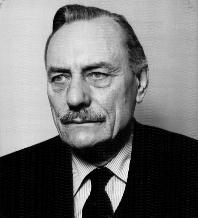
But what's also telling is that people still cling to the idea that Powell made a "racist" speech. As Simon Heffer points out (
Daily Telegraph: When will Tories admit that Enoch was right?) "there is a long tradition in the party of not reading the speech." It is a tradition widely shared outside the party. Indeed I remember back in 1998 when Channel 4 ran
The Trial of Enoch Powell on the thirtieth anniversary of the speech (and two months after Powell died) and many, including Darcus Howe (who wrote about it afterwards in the
News Statesman), encountered the actual words of the speech for the first time. Since Howe was the leading "prosecutor" this speaks volumes about how Powell is remembered. (But then "the Trial" was not exactly impartially composed - it was adjudicated by Trevor Phillips, who in the week of Powell's death had denounced him as a racist on
Question Time.) "Evidence" that Powell was "a racist" was mixed, with Howe at one stage falling back on a story of how one of Powell's teenage daughters invited a friend and her boyfriend round for tea. When Powell answered the door to a six foot black man he is said to have "blanched" - defined as "turned white" - and retreated to the kitchen throughout the visit. It was a story firmly denied by Powell's widow and daughters in a letter afterwards. (Though I suspect many a teenage girl would be only too glad if their father gave them freedom of space when they had friends round!) Despite such a loaded attack, "the Trial" found Powell "not guilty".
Since the speech itself seems to be so unknown, the
Telegraph amongst others have reproduced the entire text at
Enoch Powell's 'Rivers of Blood' speech and I would urge people to read it before commenting.
Many of the comments about poor integration are comments that numerous politicians in all parties are making today (and, as Powell pointed out, were made by Labour ministers at the time). Powell was deeply sceptical of the workability of integration, something I think he was wrong about, but his comments about the numbers, the sense of resentment and the divisive effects of what we now call "positive discrimination", and how all these were detrimental to community relations are not that dissimilar to what many are saying today.
Heffer also writes:
This was a man who loved India and Indians so much that he reached interpreter standard in Urdu, and who in 1959 had made what by popular assent was one of the great speeches ever heard in the Commons, in which he attacked the government of which he was a supporter for the brutal treatment of Mau Mau detainees in Kenya. Powell was about as much of a racist as Mother Teresa of Calcutta, and his warnings in the Birmingham speech have proved grounded.
There are many aspects of Powell that surprise those only familiar with the popular, misleading caricature. Powell was very much a social liberal, voting to abolish the death penalty and co-sponsoring a 1965 bill to legalise homosexual intercourse. As the UK retreated from Empire Powell was amongst the first to admit that it was no longer the power it once was. His opposition to the UK getting dragged into American wars and the "world policeman" attitude of some of our leaders, such as over Iraq, are views that many in this country share today. His calls for reform of the Conservative Party to be more professional and businesslike, where merit and not birth or old boy networks determine promotion have been at the forefront of calls for party reforms for a long time, if currently submerged beneath focus on gender and race in candidate selection. And his predictions that devolution would lead to the break-up of the United Kingdom - that's hardly an unvoiced view now is it?
But unfortunately Powell is primarily remembered not for one speech but for the misconceptions of that one speech. As Tony Benn said the day Powell died, Powell was not a racist himself but his speech unleashed a lot of racist expression from others.


