Showing posts with label Slugger O'Toole. Show all posts

Thursday, March 19, 2009

"A peace process too far"?

Thanks to Iain Dale's Diary: The Daley Dozen: Wednesday for pointing me too Slugger O'Toole: Fianna Fail's European dilemma..., which in turn points to Irish Examiner: FF's Euro wing is trying to wriggle between a rock and a hard place.

Can anyone tell me which party produced the Irish Taoiseach who wrote the following? And which party produced the UK Prime Minister he was writing to?
I would like to testify that you did more than any former British Statesman to make a true friendship between the peoples of our two countries possible, and, if the task has not been completed, that it has not been for want of goodwill on your part.
The answers are, surprisingly, Fianna Fáil and the Conservatives. (The men in question were Éamon de Valera and Neville Chamberlain.)

As I've noted before, the Conservatives are not the only party who have had problems relating to alliances in the European Parliament. The Irish party Fianna Fáil have had similar. Even the recent announcement that they are going to join the European Liberals has provoked criticism and internal rows. But Fianna Fáil can't stay where they are forever as the Union for a Europe of Nations is in danger of dropping below the rules for being a recognised group in the parliament, not least because the Conservatives are seeking recruits for their new group from it.

The Examiner makes an interesting hint:
The Tories and FF might have more in common than they both realise. Both consider themselves natural parties of government and both are instinctively suspicious of ideology.
Indeed there is so much in common that there are many Conservatives who admit they would strongly consider voting for them if they were voting in Ireland. Might a linkup in the European Parliament be a solution to both parties' problems here?

Unfortunately there are some rather major stumbling blocks on this possibility:
Trouble is the Tories want to be with Europe but are not of it, to use Churchill's phrase.

And then there's the issue of the North. Everyone's for the Agreement these days but there's about a century's worth of bad blood between the two parties. It would be a brave Fianna Fáiler who made the case for a Tory link-up. It's probably a peace process too far.
There's also the not insignificant problem of Fianna Fáil's support for the Lisbon Treaty in spite of the Irish "No" vote last year, which would be the major stumbling block at the Conservative end - would the grassroots be happy.

But the latter problem is a temporary one that will fade with time - who now even remembers which parties were for and against Maastricht? The former - well other past bad blood has certainly been overcome, but this isn't exactly an insignificant one, even for a notoriously pragmatic party like Fianna Fáil. There have been times when the two parties' leaders have been close, as shown above, but it would take so much more.

And yet... the European Parliament has certainly thrown up other strange alliances. How many years will pass before this one doesn't seem so unthinkable?

Sunday, March 04, 2007

Ex leaders behaving badly

Anyone who thinks that Edward Heath and Margaret Thatcher, to name but two, behaved badly in the years after being deposed as leader might want to consider that they could have been even worse.

Slugger O'Toole highlights the recent appearance of the campaign trail by former Ulster Unionist leader Lord Molyneaux of Killead. Only he's been canvassing for Ian Paisley's Democratic Unionists! (Slugger O'Toole: Oops he did it again!) Worse still he's been campaigning for them in Belfast North - where the UUP is facing a tough fight to hold its final seat against the DUP.

This is, of course, not the first time Molyneaux has publicly undermined his party - in the 2005 general election he joined with outgoing UUP MP for Belfast South Martin Smyth to endorse the DUP candidate for the seat, resulting in neither Unionist party winning. But one has to wonder why Molyneaux does this. His own position on the province was long that it should be integrated with the rest of the United Kingdom and that a local assembly would just keep the border question open. And he fiercely opposed power sharing, even with constitutional nationalists. So why is endorsing the DUP on their quest to go into government with Sinn Fein? Is the man so bitter that he's thrown all principles to the wind merely to spit his old party colleagues?

Saturday, February 17, 2007

Comedy from the Northern Irish elections

The latest elections for the Northern Ireland Assembly have begun. At some point soon I'll post my early constituency by constituency predictions.

In the meantime I'm struck by two pieces of comedy in the blogosphere. The first is this comment posted on the Slugger O'Toole thread Splitters!:

I don’t know if the “fault” lies with my browser, but the News Letter also seems hellbent on creating dissention (or worse) in the DUP ranks.

Here’s how a side bar items appears on their Belfast Today page:

Free
Presbyterian
minister backs
Berry
A SENIOR
member of the
Free Presbyterian
Church is backing
former DUP
member Paul
Berry in the
Asse…
more »

What can it all mean? :0)

Posted by Dawkins on Feb 16, 2007 @ 02:02 PM
I'm sure that one will go down well!

Then there's The Online Journal of the Jacob S Mills Collective - Serious politics question:

Do you feel that, while the Alliance party, in adopting the slogan "Don't send us back through the time warp!" in their party political broadcasts, may appeal to the Whovian and indeed the Trekkie communities, they run the risk of alienating the core Rocky Horror constituency?
Indeed! How will this affect their chances of gaining a seat in studentville Belfast South?

Friday, July 21, 2006

Yet more Paisley hypocrisy

This time it's Ian Paisley Jnr hitting the headlines. Slugger O'Toole reports on Paisley's reaction to a proposed dissident Republican march in Ballymena. He claims it is...
"intended to provoke public disorder and tension around this protestant town."
Perhaps he can explain how this is different from Orange Order marches provoking public disorder and tension in predominantly Roman Catholic areas. What ever happened to the right the DUP is always demanding for citizens (so long as they're straight) to be able to "march the Queen's highway"?

When it comes to consistency, it seems Ian Paisley Jnr is very much his father's son.

Tuesday, July 11, 2006

Is this what it's all about?

Since Slugger O'Toole is seeking to build better relations with the blogosphere, I thought I'd write a post in response to their 'Bonefire of the vanities'... about the bonfires lit every 11th of July. But first I've been asked by a few, even by those who've studied British politics, if I can explain what the annual celebrations are about.

Perhaps the best starting point is with the reign of James VII & II. The seventeenth century saw ferocious struggles between King and Parliament, with assertions of popular sovereignty and the Divine Right of Kings flying backwards and forwards, whilst elsewhere states such as France were reaching the height of their power under absolutist monarchs. In the three kingdoms in the British Isles events came to a head with James's reign. Many were prepared to tolerate James's conversion to Roman Catholicism in the short term as he was already in his 50s when he ascended to the throne and his heir presumptive was married to William of Orange, one of the leading Protestant rulers of the day.

There was a strong element of anti-Roman Catholicism involved, but it would be wrong to see the events of 1688-1691 purely as a religious conflict. In the eighteenth century there was a lot of political hypocrisy - a rejection of Protestant dissenters from Anglicanism co-existed with an establish Presbyterian church in Scotland; distrust of foreigners co-existed with first a king who also ruled the Netherlands and later with successive kings who also ruled a leading state in Germany; and a staunch anti-Roman Catholicism co-existed with alliances with Austria (and sometimes conflict with Prussia). Maybe the anti-Roman Catholicism was really a code for Francophobia and Spanophobia.

In 1688 James had a son who seemed likely to continue the Roman Catholic reign and many of the controversial policies and a result matters came to a head. Although there was division between those who wished to replace James and those who merely wished to see his actions curtailed, soon many came together to invite William of Orange over to England with his armies. Landing on November 5th 1688, William soon garnered much support and after a series of minor skirmishes and desertions James eventually fled (throwing the Great Seal in the Thames) to France.

The following year the Convention Parliament deemed James's actions to be abdication. The throne of England was jointly offered to William and Mary, with succession to James's daughter Anne. James's son was disregarded and many a story circulated about him being smuggled into the palace in a bedpan.

Part of the settlement in England was the passing of the Bill of Rights which remains to this day one of the fundamental constitutional laws of the country. The Estates (Parliament) of Scotland passed the separate but similar Claim of Right. And for many the "Glorious Revolution" was all about what the Bill stands for.
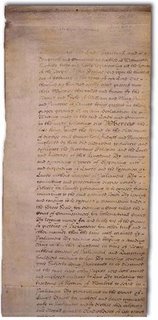
The Bill of RightsWikipedia sums up the basic tenets of the Bill of Rights as follows:
*Englishmen, as embodied by Parliament, possessed certain immutable civil and political rights. These included:
**freedom from royal interference with the law (the Sovereign was forbidden to establish his own courts or to act as a judge himself)
**freedom from taxation by royal prerogative, without agreement by Parliament
**freedom to petition the King
**freedom from a peace-time standing army, without agreement by Parliament
**freedom [for Protestants] to have arms for defence, as allowed by law
**freedom to elect members of Parliament without interference from the Sovereign
**the freedom of speech in Parliament, in that proceedings in Parliament were not to be questioned in the courts or in any body outside Parliament itself (the basis of modern parliamentary privilege)
**freedom from cruel and unusual punishments, and excessive bail
**freedom from fines and forfeitures without trial
*Certain acts of James II were specifically named and declared illegal on this basis.
*The flight of James from England in the wake of the Glorious Revolution amounted to abdication of the throne.
*Roman Catholics could not be king or queen of England since "it hath been found by experience that it is inconsistent with the safety and welfare of this protestant kingdom to be governed by a papist prince". The Sovereign was required to swear a coronation oath to maintain the Protestant religion.
*William and Mary were the successors of James.
*Succession should pass to the heirs of Mary, then to Mary's sister Princess Anne of Denmark and her heirs, then to any heirs of William by a later marriage.
*The Sovereign was required to summon Parliament frequently, later reinforced by the Triennial Act 1694.
Note that once again basic principles that few today would dispute (the sovereignty of Parliament, the restricted role of the crown, regular Parliaments, freedom from punishment without trial and so forth) co-exist with anti-Roman Catholicism.

Not everyone accepted the Glorious Revolution with open arms. For some Jacobitism was merely about the personal restoration of James VII & II, and later his heirs ("James III & VIII" and Bonnie Prince Charlie) to the throne. Indeed there are a fringe few today who still assert that all monarchs since 1688 have ruled illegitimately and that the rightful ruler of the country is Francis of Bavaria. For others Jacobitism was a vehicle for the restoration of rights and privileges, especially those who lost out in the Glorious Revolution or its successors.

In 1689 James landed in Ireland with French troops and backing, seeking a counter-revolution and restoration, drawing upon the especial support he had amongst Roman Catholics and also in Scotland. The "Williamite war" lasted two years, but the turning point was the Battle of the Boyne on July 1st 1690 (because of the later change to the Gregorian calendar it is now celebrated on July 12th). James deserted Ireland not long afterwards, although the struggle with his supporters seeking better treatment lasted another year.

Today the Orange Order claims to celebrate the Glorious Revolution and the Bill of Rights every year - though as shown above not every single thing in it commands universal support. How the annual celebrations became politicised is another story and one that is deeply controversial to tell.

Turning back to the 'Bonefire of the vanities'..., one of the points it raises is that the bonfires don't just alienate the nationalist community but also the middle class unionists are offended. "Burning tyres could create more of a stink in North Down than West Belfast."

Seeing the bonfires as a sign of working class manhood, with the competitions to have the area's best bonfire demonstrating skills and giving a clear message:
"Women of Ulster, be ye impressed by these tall, phallic objects, for yea, thou shalt be needing cupboards put up shortly, and ye are now witnessing the ultimate manifestation of our manly DIY skills."
But the bonfires themselves are frequently environmental hazards, made up of tires and old furniture and pile up in communal areas. One has to seriously wonder if this is quite how the Glorious Revolters would wish to be remembered.

So much has been said and written both for and against the July 12th Orange Order parades and whether or not they should walk down certain routes that I doubt there's much to add. The one thing that I do think is clear is that the Orange Order hasn't always been very good at promoting itself outside of Northern Irish Protestants. Images of riots against the RUC/PSNI over the right to march down a street where the residents do not wish to have the marchers do nothing to support for not just the Orange Order but for Unionism as a whole (although, as Slugger notes, Drumcree passed off peacefully this year). Hypocrisy from politicians, especially the DUP, in demanding the right to "march the Queen's highway" for the Orange Order but object to Gay Pride marches that wish to "march the Queen's highway", does little to endear their cause to the liberal minded.

And is there any obscure clause in the Bill of Rights that gives people to Right To Stink Out The Neighbourhood?

Sunday, July 09, 2006

Apparently I'm "Euro friendly"...

Slugger O'Toole has a post about its poor links with the blogosphere, including a list of the top twenty referring blogs. It seems I'm number 12 on the list, one hit above Iain Dale!

I'm described as "Euro friendly" - presumably not meaning my stance on the EU!

For those who haven't yet encountered Slugger O'Toole, it's one of the best combined news/blog sites on the net, with discussions across the field of Northern Irish politics and culture and highlights of many news stories from across the media.

Friday, July 07, 2006

One year on

Inevitably there's one event dominating the blogosphere today. Amongst the many blogs discussing it are, in no particular order, Anorak, Keeping the tab on the tabloids, Slugger O'Toole, Dodgeblogium, An Englishman's Castle, Politics through the eyes of a teenager, Jo's Journal, Mars Hill, Kerron Cross - The Voice of The Delectable, Take back the voice, Paul Linford and Iain Dale.

My own memories of the day are mixed. The night before a friend had been crashing at my flat as he had been working too late to return home to Coventry. I think this was the first time I alerted him to existence and usefulness of the Gospel Oak to Barking Line which allowed him to travel from Holloway Road to Forest Gate (the stations are Upper Holloway and the misleadingly named Wanstead Park). Otherwise his route would have taken him via the Piccadilly through King's Cross and the Circle Line at Liverpool Street. The next morning he set off at about 08:20 and I got a bite to eat, then flicked on the television at about 09:00 to catch up with what was going on. Later I planned to go down to Mile End to do some work in the library.

It was around this time that reports were coming in of widespread problems across the tube due to "power surges". I thought to myself how lucky it was that I'd told Joe about the railway line, otherwise he might get caught in a tunnel (the GOBLIN mainly runs on viaducts above the street). I then went to tell my flatmate there were problems as, unusually, he had to go into central London that day en route to a course somewhere in Reigate and he might need to leave some extra time. Then I heard the television announce the problems were more serious and there had been explosions.

I sat down at my computer (next to the television) and opened up a mass MSN window with every single contact I had online. For the next few hours I just stayed in the flat, alternating between catching up on the television, making phonecalls to check friends were okay and sharing information online.

Maybe it's my degree, but I think I'd realised before the announcement that this was a terrorist attack. The "power surge" story just rang hollow - I couldn't understand why several explosions had occurred in very different parts of the network all at once. No this was clearly a co-ordinated attack by terrorists on London.

Much of the rest of the day passed in a blur. My flatmate and I set things up to use one phoneline for the internet and the other for phonecalls so we could keep in contact. I received a few "are you okay?" calls and sent out some emails. My flatmate had his course rescheduled because of the travel problems.

The thing that worried me the most was the number of people I knew who either worked in Bloomsbury or who could have been on one of the trains hit. Whilst the actual attack hadn't shocked me as I could remember the last IRA campaign all too well (at the time I was at school in the City and we regularly had bomb alarm drills), the possibility of those I knew being caught in them was concerning. Fortunately I was able to reach everyone eventually, but the difficulties of ringing to and from mobiles that day made many anxious.

It was one of those days when one felt London had pulled together. The emergency services were magnificent in their response and there was a real sense that all communities were united. What was saddening was to hear people like George Galloway being given airtime so they could dance on the victims' graves and use the event as an excuse to make their usual rants. Fortunately very few listened.

One year on I'm not sure much has changed. Maybe people are a little more cautious about abandoned packages and cases but has London stayed together? Current tensions and fears, especially both towards and amongst the Muslim community, enhanced by the notorious innocent shootings, have shown that the metropolis is still deeply divided and there are times when I think things are getting further apart. That would be to let the terrorists win.

Sunday, April 02, 2006

Is there no end to this?

Two blogs expose further areas of financial irregularity in the current party funding row. Iain Dale highlights Labour breaking spending limits in the South Staffordshire deferred election - technically not a by-election and thus with a campaign spending limit of £10,000 not £100,000. Meanwhile Slugger O'Toole has details of a cover-up in Belfast, with the Ulster Unionists shunting a large donation around the Union Research Group. The story raises the question as to how many more large donations have been discretely received by parties?

LinkWithin

Related Posts Plugin for WordPress, Blogger...