Saturday, December 29, 2007

Time to acknowledge the Anglosphere?

I've just read an interesting article in the Telgraph by John O'Sullivan
about A British-led Anglosphere in world politics?. "Anglosphere" is a word slowly gaining in usage and the concept seems very appealing. As O'Sullivan notes:

If you want to know which countries the British feel really close to, check which ones they telephone on Christmas Day (Australia, Canada, New Zealand, America... but you knew that).
Indeed. I do a lot of selling on eBay and it is very telling where my overseas sales go - by far and away most go to the USA, Australia, Canada, Ireland and New Zealand. The cultural connections of the Anglosphere are never far away - just look at this week's Doctor Who, set on a vessel mimicking a trans Atlantic liner and co-starring a popular Australian singer and actress. And it was the second highest watched show of the week. The UK's culture has many external influences and look where they come from.

Politically it's similar as shown by the pattern of alliances and friendships. Nor are the links rooted through a single country:

The idea, lagging well behind the reality, is now seeping into politics. Last year Canada's prime minister, Stephen Harper, delivered an eloquent speech to the Australian parliament that praised the common British heritage linking both nations.

Even more significantly India's PM, Manmohan Singh, gave a speech at Oxford in 2005 that neatly stole the entire concept for New Delhi: "If there is one phenomenon on which the sun cannot set, it is the world of the English-speaking peoples, in which the people of Indian origin are the largest single component."

That raises a painful question. If Australians, Indians, Canadians, and even Americans can recognise the Anglosphere as a new factor in world politics, why is it something from which the Brits themselves shy?
Too often those who've talked about the Anglosphere in the past have been accused of being reactionaries dreaming of the old days of Empire. The idea that Manmohan Singh fits that bill is plain absurd. There are ties in so many fields - family, culture, business, politics and so many more - that reinforce the bonds between the nations of the Anglosphere. Why not take the next bold step and reinforce those ties on the world stage as a force for good? The idea is gaining more and more credibility:

Its academic foundations are rooted in work demonstrating that England always had a more individualist culture than continental Europe, that the "civil society" tools of this culture were transmitted to the colonies settled from England, and that those countries have since not only prospered unusually, but also established a world civilisation rooted in liberalism.

Bennett in The Anglosphere Challenge makes unmistakably clear that it is English cultural traits - individualism, rule of law, honouring contracts, and the elevation of freedom - rather than English genes that explain this success.

These traits enable a society to pull off the difficult trick of combining trust with openness. Nations with different genetic backgrounds that adopt such traits seem to prosper more than their similar neighbours. Hence the Anglosphere includes India and the West Indies, as well as the "old Commonwealth".
So is now perhaps the time to take the plunge?

Friday, December 28, 2007

Bye Bye Netscape

I have just seen the news that from the start of February Netscape Navigator will no longer be supported and will be cast adrift to sink in the sea of obscure outdated software. The announcement can be found at Netscape Blog: End of Support for Netscape web browsers.

People will say this is the end of an era, but something like only 0.6% of web users are now using Netscape (source: BBC News: Web icon set to be discontinued). For readers of my blog it's even lower - in the stats for November only 0.24% of readers were using Netscape. The era seems to have already passed.

Why has this happened? I haven't followed the technical and corporate politics of the AOL takeover and everything, but looking back as a user I stopped using Netscape when version 4 could no longer support most websites and version 6 had system requirements that were too advanced for my laptop (which was then only three years old). Consequently I switched to Opera after recommendations. About this time my then university dropped Netscape altogether in an upgrade of the network login (which up to that point was still on Netscape 3). For a long time I was reluctant to take the plunge with Internet Explorer but I eventually succumbed, primarily because for a year it was the only available browser for the sole computer with internet access that I regularly used.

More widely I guess the big part of the problem was the continued expansion of internet usage came at a time when Internet Explorer was automatically included with new versions of Windows, whilst Microsoft websites were near impossible to use with any other browser to say nothing of other applications that are internet compatible and link to websites. So for the average user Internet Explorer did all that was required and there was no need to get another browser. In turn more and more websites were designed with IE primarily in mind - and on some versions of Netscape many a website looks ugly.

This of course doesn't explain the mass switchover amongst existing users, though miscalculations and unstable new browsers from Netscape in the crucial period whilst competing with a more aggressive drive by other browsers might. Much as some of us would like otherwise, most computer users do not have an obsessive hatred of Microsoft to the point of overriding all other considerations. And thus in a market driven by those who are always trying to be new and which scorns those who can't move with the times (see my past post Bye bye Windows 98) Netscape appeared old fashioned, clunky and undesirable. And so it failed.

Perhaps the biggest loss is not the browser itself but the email reader. One thing that I always liked about Netscape is that when replying to a message, at least on the versions I used, the default setting was to place the cursor below the quoted text, encouraging the sender to quote properly when sending email. I find lengthy emails full of bottom quoting tedious in the extreme, especially when they evade key points which proper email quoting targets. Here endeth the Rant.

Thursday, December 27, 2007

Benazir Bhutto

I'm not sure what to write about the events today. We turned on the news at lunchtime to see the story of the attack just breaking and then news of her death came through.

This is a sad day not just for Pakistan but for much of the world. Bhutto had proved a key force of moderation and was one of those who seemed able to bridge the often turbulent gap between western-style democracy and the Islamic world.

Bhutto was no stranger to political violence - she knew the risks to her personally when she returned to Pakistan, but was determined to stand firm in the face of them. She showed true courage, her assassins none.

Monday, December 24, 2007

Merry Christmas!

Wishing all my readers a very Merry Christmas and a Happy New Year!

Sunday, December 23, 2007

So Cable wasn't even original!

I take back what I said about Vincent Cable doing something good for once. (Shock of the week) He wasn't very original, as this BBC News round up of the press from August shows:

BBC News: Newspapers dub PM 'Gordon Bean'

Gordon Brown is returning from holiday because of the foot-and-mouth outbreak, news of which came too late for early editions.
Instead, the papers focus on the prime minister's trip to Weymouth which prompts several to liken him to Rowan Atkinson's comedy character, Mr Bean.

The Daily Mail compares the PM's dark trousers and beige jacket to Mr Bean's outfit on his seaside visit.

The Daily Telegraph publishes a picture of Mr Brown striking a pose which it says is "not dissimilar to Mr Bean".
So minus points for Vincent Cable - he couldn't find his own joke. Here's a hint Mr Cable - the biggest joke is your party.

Tuesday, December 18, 2007

The new Liberal DemocRAT leader

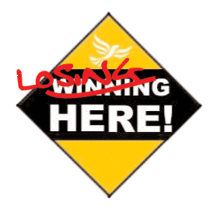
A truthful poster for the Lib DemsAnd so it's "Calamity Clegg". So the Liberal Democrats look set to get into yet another mess.

Watch out for the hordes of anonymous comments claiming that it's a glorious moment and calling anyone who disagrees names (in spite of the claims of the Liberal Democrats to be "above tribalism" and all that other self-righteous hypocrisy they spew out).

So when's the next Liberal Democrat leadership election?

I don't knowI know nothingAs I type this the result of the Liberal Democrats leadership election, 2007 is about to come through. It's not exactly a contest that's set the world on fire with the candidates squabbling with each other, whilst the one Liberal Democrat who's come out of the last few months with his stature raised is Vincent Cable (see Shock of the week). No wonder people are already regretting that Cable didn't stand himself (BBC News: Vince Cable: Acting like a leader).

But let's not disguise the truth - whoever wins will be the fourth leader the Liberal Democrats have had in a single parliament. They've meandered all over the place, been utterly unable to give a consistent answer on what they'd do if there was a hung parliament which is, after all, the likely outcome of their wet dream of proportional representation! What do Liberal Democrats stand for? Other than leadership elections.

And whoever wins will be at the head of a fractious party that's used to squabbling and back & frontstabbing. The Liberal Democrats are now truly the nasty party - well they are the ones with "rats" in their name.

So when will the next leadership election be?

The absurdities of monarchical succession

I have just seen the news that the Countess of Wessex (where's that?!) has given birth to a baby boy (BBC News: Countess gives birth to baby boy). The new boy has not yet been named, though he automatically receives the courtesy title of Viscount Severn. That's fair enough, his family can call him what they want (and indeed it's doubtful he'll be called "Prince So and So").

But what is utterly absurd is that he immediately jumps his sister in the queue that is the line of succession to the throne. For some reason that I am unable to grasp, having a Y chromosome means that Viscount Severn is inherently superior to his sister. It's not just here - somehow Viscount Severn is considered superior to his father's elder sister. Even Lady Louise Windsor ranks above Princess Anne in the line of succession!

Normally I would despise any system that suggests that someone is inherently superior merely because of when they happened to be born. However when something is inherited and indivisible then clearly there has to be some method of prioritisation. But the "male preference" rules in the succession for the monarchy are utterly out of date and defy consistency. It says that a woman can inherit the throne but only if she has no living brothers. It doesn't say that women are not suitable to inherit the throne (which would be reprehensible but at least consistent) but nor does it say that they are equal. In effect it says that both Elizabeths and Victoria were not good enough to be monarch. Who would agree with that?

Indeed if some simultaneous tragic misfortune were to strike down the Queen, her three sons, William, Harry, Beatrice & Eugenie then Viscount Severn would immediately become King despite being less than 24 hours old. This is hardly a good system for producing a head of state. Whatever happened to the idea that each individual should advance as a result of their own decisions and efforts?

Thursday, December 13, 2007

You can't have your cake and eat it Gordon!

In search of a bottleThe EU Constitution "Treaty" has been signed, making sweeping changes to Europe "just tidying a few things up" (BBC News: EU leaders sign landmark treaty) and look who's the only leader not at the signing ceremony.

Will this one do?Yes Gordon Brown, once again bottling out. He's used some committee at the House of Commons as an excuse for not attending, when committees are rescheduled all the time. He just doesn't have the bottle to be seen signing such an important document when he won't honour Labour's election pledge to hold a referendum on it. The argument that the "Treaty" is too different from the Constitution just doesn't wash.

If Brown wants to be taken seriously, he's got to learn that a Prime Minister can't simply hide every time there's something controversial, the way he often did when he was Chancellor. And if he wants the county to adopt the "Treaty" he should be willing to sign it in public. Even Tony Blair had more courage than this.

Or did he just skip the ceremony so he could avoid running into Peter Mandelson?

Wednesday, December 12, 2007

Do the Lib Dems need a real leader at all?

Will the real Charles Kennedy please stand upNot some Liberal Democrats it seems! Nick Assinder relays an anecdote from Charles Kennedy himself (BBC News: Commons Confidential: December 2007) about how he once made a surprise visit to a constituency, only to find that the candidate didn't need him for an obligatory joint photo.

The unnamed candidate had instead resorted to other means - by using a photo of himself with the Madame Tussauds waxwork of Kennedy.

So do the Lib Dems really need a living leader? They could always just get an immobile lifeless object to stand in instead.

LinkWithin

Related Posts Plugin for WordPress, Blogger...