David Campbell Bannerman MEP today defected from UKIP to the Conservatives. And cue the standard script whenever someone changes party:
The Losing Party: "The people didn't vote for this; there should be a by-election. This defection is just a spot of personal pique! Good riddance to good rubbish!"
The Gaining Party: "Our new recruit is a formidable politician who shows our party is a broad church able to reach out to all. And only a few partisan politicians want a by-election."
Etc etc...
Has anyone ever known a serious political party tell a would be recruit that they cannot join until they first have a by-election?
Showing posts with label by-elections. Show all posts
Showing posts with label by-elections. Show all posts
Tuesday, May 24, 2011


Friday, May 28, 2010
The General Election is finally over
Thirsk & Malton polled yesterday, three weeks after the rest of the country. Anne McIntosh has been returned, but I know I'm not alone in being uncomfortable about the way elections can be postponed this way. As Tom Harris highlights at And another thing...: No need for a delayed verdict, there is a real danger of problems if a party leader or Speaker found their own poll delayed; especially if fanatics were to try and exploit this rule for malign ends. But also it's unfair on the voters to not be able to give their verdict at the same time as the rest of the country. And what if this one result were to determine which party was the largest?
In other countries the procedure is that if a candidate dies the poll goes ahead but their party/agent can nominate a replacement up to the production of ballot papers; otherwise the dead candidate still stands and if elected there is a by-election. I think a constituency could handle that more easily and let's be honest - how many people are going to not vote for a party simply because they will be guaranteed the circus of by-elections if that party wins? It's a much simpler solution and frankly fairer all round.
So fancy proposing a bill to amend the law Tom?
In other countries the procedure is that if a candidate dies the poll goes ahead but their party/agent can nominate a replacement up to the production of ballot papers; otherwise the dead candidate still stands and if elected there is a by-election. I think a constituency could handle that more easily and let's be honest - how many people are going to not vote for a party simply because they will be guaranteed the circus of by-elections if that party wins? It's a much simpler solution and frankly fairer all round.
So fancy proposing a bill to amend the law Tom?
Monday, June 30, 2008
Are the Lib Dem starting to see their faults?
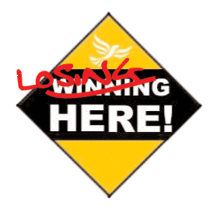 There have been some interesting posts on Liberal Democrat Voice in the aftermath of the Henley by-election. Several of the posters there seem to have finally decided they don't like their party's way of campaigning. This is, of course, not a new complaint from activists - see Another Lib Dem speaks out. But they're being spoken with an even louder voice. And of course the recent run of Liberal Democrat failures in Ealing Southall (the first time they failed to take a government held seat from second place since 1989), Crewe & Nantwich and Henley has shown it's not always the best strategy.
We can leave aside the bar charts based on any old numbers that make it look like they're "winning here" (although when knocking up in Henley I met a Lib Dem activist delivering leaflets who very kindly let me have one and she didn't like the bar charts either) and also the very "Winning Here" signs which aren't always the most popular and focus on one issue - local candidacies. When the Liberal Democrats have picked a local candidate they will go all out to demonise other parties' candidates for not being from the constituency. When the boot is on the other foot they'll use their other face to complain about "living here" slogans and attack the rival candidate as an "unpopular decision maker". And then we get candidates who literally take up residence after being selected just to pretend they're local.
Yes other parties have picked up these tactics as well. But the reason they do so is in order to counter the Liberal Democrat By-election Machine and it creates a vicious circle. Only when the need to counter is removed can this, and other problems in by-elections for both parties and voters, can things get better.
Liberal Democrat Voice: But Mr Gladstone, are you local enough? addresses the issue of locality head on, both in terms of what it means for Parliament if it's full of parish pump politicians (indeed one of the reasons I'm sceptical of STV) and also for the Lib Dem campaigns.
Now will the Lib Dem leadership take things on board or will they carry on being the same old Lib Dems? Unfortunately I think we already know the answer.
Wednesday, June 18, 2008
Who wants to be Gordon Brown?
The search for a person who will stand again David Davis on the government's position of forty-two days internment continues, with the news that the Labour Party has declined to put up a candidate and Kelvin MacKenzie is now unlikely to run either.
One interesting suggestion is for a Conservative who is in favour of forty-two days to stand, with ConservativeHome's own Tim Montgomerie being suggested. (Blaney's Blarney: A viable opponent for David Davis?) I believe this would result in Tim's expulsion from the party and it could also turn the whole election into a wider debate about the role of ConservativeHome in the modern party, which is not what most people want to see.
But if no major candidate is forthcoming, there is always the possibility of a paper candidature. As I previously blogged in I am seriously impressed with David Davis, in some of the by-elections over the Anglo-Irish Agreement when no-one would come forward to challenge a sitting Unionist (and yes, it was disgraceful that at the time the Conservative Party was not organised and contesting elections there and thus did not put up to defend the government policy, however bad that policy was) a Unionist activists changed his name by deed poll to "Peter Barry", the name of the Irish foreign minister, and stood as a paper candidate in four seats on a pro Agreement platform. Thus voters were able to choose between pro and anti-Agreement options.
So would anyone like to be Gordon Brown for an election?
I also note that someone I'd never heard of before called Andy Burnham, who is apparently the Secretary of State for Culture, Media and Sport, has managed to get a headline saying Davis 'should fund by-election' (BBC News). Would it be too much to hope for that Andy Burnham is also calling for Gordon Brown to personally reimburse the country all the public money that was spent in persuading enough MPs to support this measure?
One interesting suggestion is for a Conservative who is in favour of forty-two days to stand, with ConservativeHome's own Tim Montgomerie being suggested. (Blaney's Blarney: A viable opponent for David Davis?) I believe this would result in Tim's expulsion from the party and it could also turn the whole election into a wider debate about the role of ConservativeHome in the modern party, which is not what most people want to see.
But if no major candidate is forthcoming, there is always the possibility of a paper candidature. As I previously blogged in I am seriously impressed with David Davis, in some of the by-elections over the Anglo-Irish Agreement when no-one would come forward to challenge a sitting Unionist (and yes, it was disgraceful that at the time the Conservative Party was not organised and contesting elections there and thus did not put up to defend the government policy, however bad that policy was) a Unionist activists changed his name by deed poll to "Peter Barry", the name of the Irish foreign minister, and stood as a paper candidate in four seats on a pro Agreement platform. Thus voters were able to choose between pro and anti-Agreement options.
So would anyone like to be Gordon Brown for an election?
I also note that someone I'd never heard of before called Andy Burnham, who is apparently the Secretary of State for Culture, Media and Sport, has managed to get a headline saying Davis 'should fund by-election' (BBC News). Would it be too much to hope for that Andy Burnham is also calling for Gordon Brown to personally reimburse the country all the public money that was spent in persuading enough MPs to support this measure?
Thursday, June 12, 2008
I am seriously impressed with David Davis
I turned on the television to see the news that David Davis is resigning to fight a by-election on the issue of 42 days detention. (BBC News: David Davis resigns from Commons) This is one of the most impressive moves I've seen in politics in a long time.
I've been searching my memory (and a very good book co-edited by my supervisor) for previous cases where MPs resigned to fight by-elections and the precedents are mixed. Here are all the ones I can find from the last seventy years:
Kinross and Western Perthshire by-election, 1938. This by-election saw the Duchess of Atholl, who had resigned the Conservative whip earlier in the Parliament, resign her seat in protest at the government's European policy. She was unopposed by Labour or the Liberals (after their leadership intervened) but lost the seat to the new Conservative candidate in a two candidate fight.
Not Gravesend by-election, 1955! Sir Richard Acland resigned from the Labour Party and the Commons in protest at the party's support for nuclear defence. He was going to fight as an independent but the 1955 general election overtook events. In a contest against Labour and Conservative candidates the Conservatives gained the seat.
Lincoln by-election, 1973. Dick Taverne had been fighting a battle with militants in his Constituency Labour Party and took it to the wider electorate. In a six candidate contest (although with no Liberal candidate), Taverne won standing as "Democratic Labour".
Mitcham and Morden by-election, 1982, a by-election that a lot of people talked about recently in the run-up to Crewe and Nantwich. Bruce Douglas-Mann changed from Labour to the Social Democratic Party and opted to ask the electorate. The Conservatives gained the seat and people still wonder why defecting MPs always resist calls for by-elections.
The 15 Northern Ireland by-elections, 1986. All fifteen Unionist MPs resigned their seats in protest at the introduction of the Anglo-Irish Agreement. However getting the other parties to contest the seats proved difficult - the SDLP and Sinn Féin only ran in the four seats with a Nationalist majority and although the Alliance and Workers' Party reluctantly stood candidates across another seven seats, in four a paper candidate had to be found. This led to a man changing his name to "Peter Barry", the name of the Irish Foreign Minister, who polled a poor vote. Maybe someone wants to stand against Davis as "Gordon Brown"? The most significant outcome was in the Newry and Armagh by-election where Jim Nicholson lost to the SDLP's Seamus Mallon.
And that's it. I suppose Davis's position is closest to the Northern Irish by-elections although he has made a personal decision whereas the Unionists were making a party decision.
So how will Haltemprice and Howden go? I don't know. But Davis is taking a very strong principled stance on the issue, maybe even making a courageous decision, and that is good for politics in general.
Oh and with the news the Liberal Democrats aren't fielding a candidate means this will be the first by-election without a candidate from one of the three largest UK parties since South Antrim in 2000. For those who want to cry that's Northern Ireland then the next previous was Newham North East (the other side of my home borough) in 1994 when the Liberal Democrats nominated their only local councillor, Alec Kellaway, who defected to Labour during the campaign! (Kellaway appears to have always been a Social Democrat who decided Labour rather than the Lib Dems were his natural home. At the time of the SDP-Liberal merger he had originally joined the David Owen "continuing" Social Democratic Party.) But lest anyone cry foul on that then it was Glasgow Centralin 1980. A Young Liberal thought not standing a candidate was a bad move and so stood as a maverick, but only got 1.7% of the vote.
Now a lot of the history books will have to be rewritten...
I've been searching my memory (and a very good book co-edited by my supervisor) for previous cases where MPs resigned to fight by-elections and the precedents are mixed. Here are all the ones I can find from the last seventy years:
Kinross and Western Perthshire by-election, 1938. This by-election saw the Duchess of Atholl, who had resigned the Conservative whip earlier in the Parliament, resign her seat in protest at the government's European policy. She was unopposed by Labour or the Liberals (after their leadership intervened) but lost the seat to the new Conservative candidate in a two candidate fight.
Not Gravesend by-election, 1955! Sir Richard Acland resigned from the Labour Party and the Commons in protest at the party's support for nuclear defence. He was going to fight as an independent but the 1955 general election overtook events. In a contest against Labour and Conservative candidates the Conservatives gained the seat.
Lincoln by-election, 1973. Dick Taverne had been fighting a battle with militants in his Constituency Labour Party and took it to the wider electorate. In a six candidate contest (although with no Liberal candidate), Taverne won standing as "Democratic Labour".
Mitcham and Morden by-election, 1982, a by-election that a lot of people talked about recently in the run-up to Crewe and Nantwich. Bruce Douglas-Mann changed from Labour to the Social Democratic Party and opted to ask the electorate. The Conservatives gained the seat and people still wonder why defecting MPs always resist calls for by-elections.
The 15 Northern Ireland by-elections, 1986. All fifteen Unionist MPs resigned their seats in protest at the introduction of the Anglo-Irish Agreement. However getting the other parties to contest the seats proved difficult - the SDLP and Sinn Féin only ran in the four seats with a Nationalist majority and although the Alliance and Workers' Party reluctantly stood candidates across another seven seats, in four a paper candidate had to be found. This led to a man changing his name to "Peter Barry", the name of the Irish Foreign Minister, who polled a poor vote. Maybe someone wants to stand against Davis as "Gordon Brown"? The most significant outcome was in the Newry and Armagh by-election where Jim Nicholson lost to the SDLP's Seamus Mallon.
And that's it. I suppose Davis's position is closest to the Northern Irish by-elections although he has made a personal decision whereas the Unionists were making a party decision.
So how will Haltemprice and Howden go? I don't know. But Davis is taking a very strong principled stance on the issue, maybe even making a courageous decision, and that is good for politics in general.
Oh and with the news the Liberal Democrats aren't fielding a candidate means this will be the first by-election without a candidate from one of the three largest UK parties since South Antrim in 2000. For those who want to cry that's Northern Ireland then the next previous was Newham North East (the other side of my home borough) in 1994 when the Liberal Democrats nominated their only local councillor, Alec Kellaway, who defected to Labour during the campaign! (Kellaway appears to have always been a Social Democrat who decided Labour rather than the Lib Dems were his natural home. At the time of the SDP-Liberal merger he had originally joined the David Owen "continuing" Social Democratic Party.) But lest anyone cry foul on that then it was Glasgow Centralin 1980. A Young Liberal thought not standing a candidate was a bad move and so stood as a maverick, but only got 1.7% of the vote.
Now a lot of the history books will have to be rewritten...
Subscribe to:
Posts (Atom)
LinkWithin
