As a slight epilogue to my previous post Alterative Vote: What does 50% mean? I've remembered at least one unusual version of AV from my days of counting students' union elections which had its own definition of 50%.
Back in my days at the University of Kent the students' union (known as "Kent Union") used a version of the Alternative Vote with some quite unusual features. I got the impression that the rules used had been written by someone who either didn't really understand the system or else was trying to impose their own philosophy onto the voters.
By far the most inexplicable rule related to the "Re-Open Nominations" (or "RON") option. In almost all other versions of AV I've seen, RON is treated like any other candidate. But in the old Kent rules someone decided that it was wrong to transfer votes to and from RON - you could either select the RON option or express preferences for candidates but not both. RON's fate was decided in the first round of the count and it merely had to outpoll the candidate with the highest number of first preferences, regardless on the numbers involved. Otherwise all RON votes were set aside and the rest of the election proceeded without it. This nonsense has long since been abolished.
In the rest of the count it was not unusual for a lot of votes for excluded candidates to fail to transfer (or "exhaust") and so the winning candidate could get elected with less than 50% of valid post-RON exclusion votes. And there were even times when a candidate had an unassailable lead before the final two - they might have 45% of all the votes, one opponent 20%, another 15% and 20% exhausted. Under any other AV system they would be declared elected there and then, but for some never explained reason the Kent rules (or the person interpreting them) required the count to continue until the candidate had achieved 50% (even with two or more opponents) or all other candidates were excluded. This could result in pointless additional rounds in a count that added nothing to the outcome.
The idea seems to have been to ensure the eventual winner had the support of at least 50% of those voting (excluding the RON voters) but it made no difference to the outcome and in any case very few people paid attention to the actual voting figures. It also didn't really address what would happen if the winner didn't have the backing of 50% of those voting, and a new election would have made little sense when that very option was on the ballot paper and rejected. In practice in a close final two on transfers the winner indeed lacked 50% but this made no difference anyway.
Fortunately in a subsequent constitutional rewrite attempts to re-invent the wheel were abandoned and standard rules imported.
One other bizarre case came in elections for the University of London Union. These saw frequent problems and frustrations despite (or more likely because of) a permanent returning officer and the rules followed could often change from year to year. In general the ULU rules treated the RON option like any other candidate but in one year someone decided that RON could not be excluded and thus the entire count was run with other candidates eliminated in succession until the last candidate standing, who had significantly more votes than RON. Maybe someone was trying a system to see if the winner was acceptable to all voters, but it's another recipe for a mess, and when it had been arbitarily imposed with no discussion whatsoever it added to the impression that the running of ULU elections was a complete farce. In subsequent elections this impression has not dispersed.
Showing posts with label University of Kent. Show all posts
Showing posts with label University of Kent. Show all posts
Sunday, August 08, 2010


Wednesday, June 09, 2010
Ben Duncan on Big Brother
Normally I steer well clear of Big Brother but this year I've had a few enquiries already about one of the contestants and whether or not they are a contemporary from my undergraduate days.
A few years ago I wrote a post about The Tory Monday Club that was set up at the University of Kent a decade ago. Yes the chair and founder of that group was Ben Duncan.
Student politics can get ridiculously over the top and bitter at times and there are things a lot of people said, shouted and did that they later come to regret. This was true at the time of many of us, including myself (I gave my apologies to those involved for the worst of it).
I knew Ben in the 1999 to 2002 period but I can't honestly remember a single conversation about Big Brother with him, although his general attitude suggests to me that if he was even aware of the show back then he would have absolutely disapproved of it existing.
Maybe I'll find myself watching some of Big Brother after all...
A few years ago I wrote a post about The Tory Monday Club that was set up at the University of Kent a decade ago. Yes the chair and founder of that group was Ben Duncan.
Student politics can get ridiculously over the top and bitter at times and there are things a lot of people said, shouted and did that they later come to regret. This was true at the time of many of us, including myself (I gave my apologies to those involved for the worst of it).
I knew Ben in the 1999 to 2002 period but I can't honestly remember a single conversation about Big Brother with him, although his general attitude suggests to me that if he was even aware of the show back then he would have absolutely disapproved of it existing.
Maybe I'll find myself watching some of Big Brother after all...
Saturday, January 03, 2009
Has anyone seen Dr Brown?
One of the often commented facts about Gordon Brown is that he is the first British Prime Minister to have a PhD. As it's in History this is something that historians can take a special pride in regardless of our politics.
But has anyone ever seen an image of Brown in his doctoral robes? Or even in whatever robes of office he wore when he was the Rector of the University of Edinburgh? Off hand I can't think of any and it's evaded others on a mailing list discussing academic dress. Does anyone know of one?
In the meantime we'll have to make do with a picture from one of his honorary degree ceremonies. Here, courtesy of Daylife, is Brown receiving a Doctor of Letters last January from the University of Delhi:

(Original Photo from Getty Images by AFP/Getty Images)
Academic dress can be fascinating in its own right and can throw some interesting examples up, though unfortunately for me the worst degree hoods in the UK are widely considered to be in the Academic dress of the University of Kent. I don't know of anyone, whether student, alumnus or just interested, who has anything good to say about those monstrosities. Hopefully one day the university will switch to a more traditional design for them.
For those interest in more there is the Burgon Society, founded to promote the study of academical dress.
But has anyone ever seen an image of Brown in his doctoral robes? Or even in whatever robes of office he wore when he was the Rector of the University of Edinburgh? Off hand I can't think of any and it's evaded others on a mailing list discussing academic dress. Does anyone know of one?
In the meantime we'll have to make do with a picture from one of his honorary degree ceremonies. Here, courtesy of Daylife, is Brown receiving a Doctor of Letters last January from the University of Delhi:

(Original Photo from Getty Images by AFP/Getty Images)
Academic dress can be fascinating in its own right and can throw some interesting examples up, though unfortunately for me the worst degree hoods in the UK are widely considered to be in the Academic dress of the University of Kent. I don't know of anyone, whether student, alumnus or just interested, who has anything good to say about those monstrosities. Hopefully one day the university will switch to a more traditional design for them.
For those interest in more there is the Burgon Society, founded to promote the study of academical dress.
Tuesday, December 19, 2006
Aren't university marketing departments fantastic? 2
My attitude to university marketing departments goes through various cycles - see my previous post Aren't university marketing departments fantastic?. Currently I'm feeling rather critical after learning that my alma mater the University of Kent is to change its logo to this:
 The only good thing I can say is that at least they didn't arbitarily retitle it to "Kent University".
Thanks to Marksed - an education officer and his blog for tipping me off (see the post New Kent logo exclusive).
 The only good thing I can say is that at least they didn't arbitarily retitle it to "Kent University".
Thanks to Marksed - an education officer and his blog for tipping me off (see the post New Kent logo exclusive).
Monday, November 20, 2006
On Christian Unions and Students' Unions
As both a Christian and a Students' Union officer it was almost inevitable that I'd write something on the current row in the media and the blogosphere about the current clash between several university Christian Unions and their Student's Unions.
One of the things that stands out the most is that this issue has been very badly reported and I suspect some have misrepresented the position they are in to increase their apparent "victim status". I can't comment on the individual cases without further knowledge (although as a colleague and friend works at Birmingham I have heard some of the details of the situation there) but some of the issues are quite commonplace across the board.
First off these are not cases of "banning" but rather the Students' Unions are disaffiliating the Christian Unions from the union. Society affiliation is basically the formal means by which a society at a university applies and qualifies for access to students' union society resources, which variously include funding, cheap or free room bookings, the SU acting as a guarantor on booking rooms from the university, a website on the SU server, maybe a voting member of the Societies' Forum or Union Council (depending upon how the Students' Union governance is structured) and so forth. In order to qualify for this, there are often a number of requirements set down by the Students' Union that societies must meet. These invariably include:
*The society must be open to membership by all students
*Conformity to equal opportunities and non-discriminatory practices
*The society officers (who are the ones who will be determining how the students' union resources are being used) must be democratically elected by the members of the society
*A minimum number of members (sometimes more than one minimum, related to the levels of funding available)
*Not substantially duplicating another society already in existence
And often some or all of the first three cause problems for Christian Unions. If one comment I've seen on a blog today is true then for years the Universities and Colleges' Christian Fellowship (the national body for Christian Unions) used to have a policy that Christian Unions would not affiliate to Students' Unions. In a somewhat ironic position given the current row, the UCCF would disbar any Christian Union that did.
When I was at the University of Kent the Christian Union there was not affiliated to the Students' Union and, as far as I could see, had no intention to. Whether they had tried to in years past I do not know, but in my day the attitude of the CU was that affiliating would be incompatible as they did not wish to elect their officers, instead having the outgoing officers and some outsiders select the new ones, they would have to drop the requirement for members to sign the UCCF Doctrinal statement (see here for more details, albeit from a critical source) to be open to membership by all students and some other reasons relating to the way they raised and spent money. Also they weren't the only Christian group on campus - others such as the Anglican Society (later "Christian Focus") and the (Roman) Catholic Society were in strong existence and were open to membership by all students. Indeed there were a number of students (mainly reading Theology but also some with friends in several societies) who were members of both, as well as of the Islamic Society.
It seems the Kent problems weren't unique - at Reading it appears there were tensions between the SU and CU, not helped by some in the UCCF apparently spreading scare stories and encouraging confrontation. However an agreed relationship between the two bodies was worked out that is now praised by both UCCF staff members and the current Reading SU President.
Unfortunately not all have pursued a constructive policy and I suspect that much of the current uproar stems from confrontationalists once again spreading misleading advice and encouraging a hardline stance.
The other issue that comes up the most in clashes between CUs and SUs is equal opportunities. Many have felt the Christian Union is not always preaching tolerance - I can recall reports of moments when they have said "We pray against Muslims" and many have found their position on homosexuality to be deeply and proactively intolerant. This is a much harder issue to comment on without knowing the facts, but if true then the societies are promoting intolerance and it is right for the students' union to deny affiliation, funds and resources because of this.
One other point that has been raised is that the actions against Christian Unions are somehow "anti-Christian". But many critics of CUs are to be found amongst Christians. Indeed when the Warwick CU was disaffiliated from the SU some years ago, it was members of Christian Focus who were amongst the most prominent supporters of the move. Many Christians at universities find the CU to be very narrow in their doctrine, being only evangelical protestant but claiming to be a body for "all Christians".
Unfortunately much of the media seems to be spinning the story as one of secular fanatics persecuting innocent Christians. Will they ever get their facts straight?
One of the things that stands out the most is that this issue has been very badly reported and I suspect some have misrepresented the position they are in to increase their apparent "victim status". I can't comment on the individual cases without further knowledge (although as a colleague and friend works at Birmingham I have heard some of the details of the situation there) but some of the issues are quite commonplace across the board.
First off these are not cases of "banning" but rather the Students' Unions are disaffiliating the Christian Unions from the union. Society affiliation is basically the formal means by which a society at a university applies and qualifies for access to students' union society resources, which variously include funding, cheap or free room bookings, the SU acting as a guarantor on booking rooms from the university, a website on the SU server, maybe a voting member of the Societies' Forum or Union Council (depending upon how the Students' Union governance is structured) and so forth. In order to qualify for this, there are often a number of requirements set down by the Students' Union that societies must meet. These invariably include:
*The society must be open to membership by all students
*Conformity to equal opportunities and non-discriminatory practices
*The society officers (who are the ones who will be determining how the students' union resources are being used) must be democratically elected by the members of the society
*A minimum number of members (sometimes more than one minimum, related to the levels of funding available)
*Not substantially duplicating another society already in existence
And often some or all of the first three cause problems for Christian Unions. If one comment I've seen on a blog today is true then for years the Universities and Colleges' Christian Fellowship (the national body for Christian Unions) used to have a policy that Christian Unions would not affiliate to Students' Unions. In a somewhat ironic position given the current row, the UCCF would disbar any Christian Union that did.
When I was at the University of Kent the Christian Union there was not affiliated to the Students' Union and, as far as I could see, had no intention to. Whether they had tried to in years past I do not know, but in my day the attitude of the CU was that affiliating would be incompatible as they did not wish to elect their officers, instead having the outgoing officers and some outsiders select the new ones, they would have to drop the requirement for members to sign the UCCF Doctrinal statement (see here for more details, albeit from a critical source) to be open to membership by all students and some other reasons relating to the way they raised and spent money. Also they weren't the only Christian group on campus - others such as the Anglican Society (later "Christian Focus") and the (Roman) Catholic Society were in strong existence and were open to membership by all students. Indeed there were a number of students (mainly reading Theology but also some with friends in several societies) who were members of both, as well as of the Islamic Society.
It seems the Kent problems weren't unique - at Reading it appears there were tensions between the SU and CU, not helped by some in the UCCF apparently spreading scare stories and encouraging confrontation. However an agreed relationship between the two bodies was worked out that is now praised by both UCCF staff members and the current Reading SU President.
Unfortunately not all have pursued a constructive policy and I suspect that much of the current uproar stems from confrontationalists once again spreading misleading advice and encouraging a hardline stance.
The other issue that comes up the most in clashes between CUs and SUs is equal opportunities. Many have felt the Christian Union is not always preaching tolerance - I can recall reports of moments when they have said "We pray against Muslims" and many have found their position on homosexuality to be deeply and proactively intolerant. This is a much harder issue to comment on without knowing the facts, but if true then the societies are promoting intolerance and it is right for the students' union to deny affiliation, funds and resources because of this.
One other point that has been raised is that the actions against Christian Unions are somehow "anti-Christian". But many critics of CUs are to be found amongst Christians. Indeed when the Warwick CU was disaffiliated from the SU some years ago, it was members of Christian Focus who were amongst the most prominent supporters of the move. Many Christians at universities find the CU to be very narrow in their doctrine, being only evangelical protestant but claiming to be a body for "all Christians".
Unfortunately much of the media seems to be spinning the story as one of secular fanatics persecuting innocent Christians. Will they ever get their facts straight?
Wednesday, October 04, 2006
From Vision to Reality
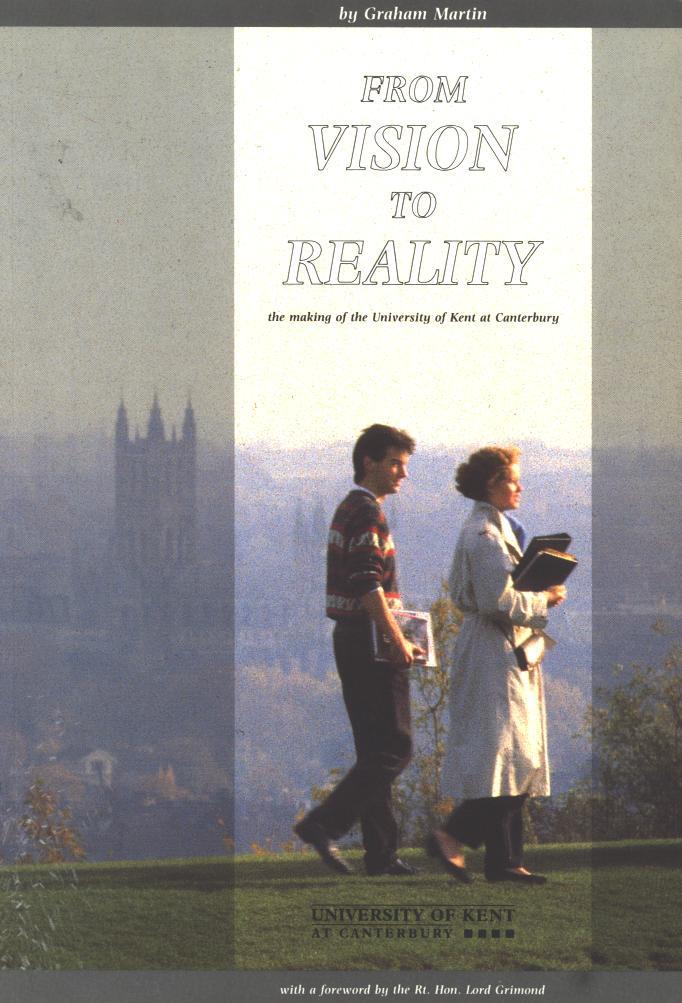 Recently whilst commuting to and from the campus I've been reading the history of my alma mater, From Vision to Reality: The Making of the University of Kent at Canterbury by Graham Martin (the University's first Dean of Natural Sciences and second Deputy Vice Chancellor). The book is a fascinating insight into the origins of the University and some of its distinctive ideas, several of which had either been modified or fallen away by the time I first started there (nearly a decade after it was published).
Much of the focus is understandably on the 1960s, showing how the plans came together, how Canterbury was one of several proposed sites, all with ardent backers and developing plans. When Martin writes that the proposal for a University of Thanet was "furthest along the road" my reaction is that so is Thanet! One of the reasons why I opted for Kent in the end is its location - the view of Canterbury is gorgeous (especially at night when the Cathedral is lit up) and I wonder if I would have wound up going to Thanet had it been sited there instead. The university's original strange name is also explained - at the time the practice in the UK was to name universities after the town whose boundaries they were located in, but the Canterbury campus straddled the border between the-then county borough (a unitary authority in case you're wondering) of Canterbury and the jurisdiction of Kent County Council. With sponsors of the project coming from both "town" and "county" there was much debate and the Executive Committee of the Sponsors was split 50:50 between "University of Canterbury" and "University of Kent at Canterbury". (The chairperson declined to use the casting vote as he was clearly from the county - I wonder if this is the origin of the cautious attitude to casting votes that is particularly strong at the University.) Then it became clear that it would not be possible to have the same name as another university in the Commonwealth. The name persisted for decades even when expansion opened up a site at Chatham, but was finally officially changed to the simpler "University of Kent" three years ago (I think my MA graduation was the last under the old name) when the Medway campus was established. By this time local government changes had replaced the county borough of Canterbury with a much larger district, but Medway is now within a unitary authority! One wonders if this caused any headscratching...
One of the more radical ideas that stands out is the original academic plan to have no Departments below the Faculties and to make all degrees to an extent inter-disciplinary, with the first year by and large being a faculty wide program of study. The idea soon fell to pieces because of problems in individual subjects - for instance new students reading Maths often hadn't taken Chemistry at A-Level and vice versa, meaning that a lot of catch-up work would be required - and eventually the drift towards individual Departments for each subjects and specialised first years developed. Martin speculates that it would take a fundamental restructuring of the way A-Levels are operated for such an inter-disciplinary approach to work. That said the idea is not totally dead - in my first year we were only required to pick half our modules in our subjects and encouraged to take wilds in the other half. And the Open University has a similar interdisciplinary drive in at least the Humanities with most of its BA degrees including the course An Introduction to the Humanities as a core element.
It's also interesting to note that the University's Classics and Theology teaching seems to have come about because of external decisions rather than a specific desire to offer those subjects at the outset. The man recruited to be the first Dean of Humanities, Guy Chilver, was a Classicist from Oxford and so that committed the university; whilst similarly the first appointed Master of Eliot College, Alec Whitehouse, was a Theologian from Durham. I found it surprising that there was ever any doubt about teaching Theology, given the location, but it seems that from the start there was a strong secular drive in certain quarters. The University's religious connections have never been great - the choice of the Archbishop of Canterbury as Visitor was more in mimic of Durham (the University that Kent seemed to copy the most) whilst the view of the Cathedral from Eliot and Rutherford dining halls that was once cited as "evidence" that the institution as anti-semitic by an article in the Jewish Chronicle was frankly the obvious only choice and clearly preferable to the alternative of a gasometer. Holding the graduation ceremonies in Canterbury Cathedral has provided their main redeeming feature.
One of the interesting, and at times controversial, aspects of Kent has been its "collegiate" system. Of all the UK universities that I'm aware of with "colleges" (the others being Wales, London, Cambridge, Oxford, Durham, Lancaster, York), Kent has always struck me as having the weakest. Reading this book it's easy to understand what went wrong. The original idea was to combine accommodation and teaching in single buildings as a means to cut down on dead space, and at the same time to create vibrant academic communities. As note above there were planned to be no Departments, so the College would be unrivaled as the right sized unit for students' loyalties. Each was expected to have about 600 students and equivalently proportioned staff, with about half living in the college itself (and the rest in local accommodation arranged by the university) and all eating and studying there. Every student would be allocated a tutor to oversee them (remember that in 1965 most undergraduates would be legally below the age of majority) and the Master of the College was expected to be a significant figure in their university lives. It also seems that the early view of the colleges was almost like a boarding school with separate houses. However the plan quickly fell apart.
The university's expansion was always planned to be one of the fastest for a new university, but funds for new colleges did not keep up and the result was that only four were ever built. In later years when there was further demand for student accommodation in Canterbury the solution was not to build further colleges but to build non college accommodation. As a result the proportion of students who actually live within the College walls is ever smaller. The hopes that students living out would stay on campus, studying in their colleges, until dinner rapidly proved to be futile. More and more operations and facilities have shifted from the Colleges to the central university over the years, whether alumni relations, the tutorial system, accommodation services, catering (with some dining halls closed and even completely dismantled) and so forth, whilst the abolition of College amenities fees has removed the student's direct stake in their College. With very few college wide activities or competitions, as well as the rise of the Departments, it is little wonder that very few students or later alumni feel much loyalty to their college. (And to make it even more absurd, many graduates who have returned for postgraduate study have been placed in a different college suggesting that even the University isn't too fussed.) Indeed I now understand that accommodation is allocated irregardless of one's college - one wonders what purpose the structure serves at all now.
(I do remember that in my MA year the Students' Union Executive were at one point asked by the University to write a report on what students felt about the collegiate system. It rapidly proved the point that the view a committee will reach can often be preguessed by its ex-officio membership - containing all of the Presidents of the Junior College Committees amongst others. The SU President (Alix Wolverson) was a former President of the JCC in the one College where some semblance of collegiate feeling still resided and where there was a big event put on by the JCC. So she decided at the outset that we would tell the University why colleges were a good thing and told dissenters - mainly myself - that we should be "constructive" - i.e. agree with her personal opinion.)
One other chapter of interest is the one on how the University has coped with crises. Starting with the collapse of the old Canterbury to Whitstable Railway tunnel, destroying part of the Cornwallis Building in the process, Martin proceeds to look at some of the poor press coverage the university has received and explain the problems (one stemmed from a return for league tables inadvertently giving the grades for graduate students not graduating students and this error proved impossible to correct in time). He also briefly looks at some of the student protests. There is a widespread myth of the 1960s and 1970s as being an era of student protest when students were seeking to change the world, yet the protests at Kent seem to have been by and large because of either university or government education policies. Given the paternalistic attitude that the University had in the early years one can well understand the protests as a consequence of broader clashes in society, and some of the issues would doubtless elicit support today (e.g. seemingly unfair expulsions, unreasonable financial charges) even if the vehicle for expressing dissent would be different. However some show the change in attitudes - who today would object to the idea that students should be prevented from graduating if they still have outstanding debts with the university?
Whilst this book never pretends to be an objective history, and as a UKC publication has the possible stigma of an "authorised account" it does nevertheless make for a fascinating and illuminating read.
Saturday, May 20, 2006
The Tory Monday Club
As I promised earlier, here are my brief recollections of the Tory Monday Club from my days as an undergraduate at the University of Kent. I've left names out as, with one exception, I have no idea where they are now.
Many years ago now the Kent University Conservative Association experienced several of the problems that all political societies experience at one point or another, albeit altogether at once. In the 1999/2000 year membership increased hugely (to the irritation of the now deceased Kent Labour Club who drifted into extinction over the next two years) but with it came a number of individuals who were to cause problems. Amongst them was one who frankly fitted the stereotype of the tweed jacket Tory (and I use that word deliberately) with ideas that even people in Lord Salisbury's Conservative party would have been ashamed to be associated with. However he rarely expressed them at first.
When the annual round of officer elections came up that January we had the unenviable situation of two strong candidates for Chairperson. One was the above mentioned, the other was the sitting Secretary. The election threatened to turn into the classic "should the society be primarily a political force or a good political/social body" that almost all political societies face at one point. The meeting was literally divided down the middle - the first ballot tied. After two hours of discussing how to break a tie (no-one in those days seemed to realise there is such a thing as drawing lots - it's good enough for deciding control of Crawley council!). Eventually the tie was broken against him but over the next six months the division in the society continued. The loser was not especially gracious at times and at one point over the next few months went and caused a lot of deliberate confusion by setting up a dining club and making no attempt to dispel confusion.
For some reason I forget now we had to have another set of elections that June. This time round there was a suspicious influx of new members signing up just before the meeting (the rules of qualifying to vote were changed not long after) as well as a mixture of mud throwing and charm offensives. The same candidates stood and this time round the guy won. Over the vacation it rapidly became clear what a big mistake this had been.
All membership organisations require members to survive and university societies especially need to recruit new members every year, with so many existing ones graduating. Nearly everybody understood this and several months of preparation for the new year had been made, including getting a number of high profile speakers as well as the more mundane preparation for the Freshers' Fair. But the new Chairperson was one of the few who didn't, believing instead that the society should be a handful of political obsessives "who are committed", believing that they would seek the society out. Matters were not further helped by his decision not to return to Canterbury until the day of Freshers' Fair itself, lying that he couldn't travel beforehand. (This was the time of the fuel protests but he was traveling by train.) Consequently other officers had to put the whole thing together and it went well, apart from the Chairperson turning up in the middle of things and wanting to start displaying flags that a lot of us were uncomfortable with.
Subsequently over the next few weeks divisions and feuds continued, even though our membership was so large we were having problems finding a room that could seat everyone. What the new members made of all this I'm not sure but there were a lot of nasty things said and some of the meetings were uncomfortable.
It also didn't help that our external image was being damaged. The height came at a students' union general meeting. Some of us had tabled a motion for a campaign for better lighting on campus. But during the meeting the Chairperson and his little coterie of mates called quorum and invalidated the meeting because they wanted a laugh. It provoked a lot of hostile media coverage, both on and off campus, and brought things to a head. A lot of members who weren't at the meeting were given a very distorted account of things.
Matters came to a head at the society meetings afterwards. There was a lot of arguing and one resignation at the first. Then by the second the following week we had the spectacles of the local party agent turning up, most of the officers (myself included) agreeing to a joint resignation if we couldn't force the hands and the announcement that the Chairperson was leaving to form a new group, not affiliated to the students' union, that would be more political. A good number left with him.
Over the next few weeks it became increasingly clear to a few of us just what "the Tory Monday Club" actually was, though some of the members were still ignorant, having joined out of ties of friendship and personalities. But at the students' union annual general meeting the following written question was submitted and answered:
Meanwhile Kent University Conservative Association is still going strongly to this day.
That's the main bones of it, although there's a lot of detail that could have been added, including some of the nastiness that went back and forth. But nowadays it's all in the past and everyone's graduated so I'm surprised anyone's even searching for it.
Many years ago now the Kent University Conservative Association experienced several of the problems that all political societies experience at one point or another, albeit altogether at once. In the 1999/2000 year membership increased hugely (to the irritation of the now deceased Kent Labour Club who drifted into extinction over the next two years) but with it came a number of individuals who were to cause problems. Amongst them was one who frankly fitted the stereotype of the tweed jacket Tory (and I use that word deliberately) with ideas that even people in Lord Salisbury's Conservative party would have been ashamed to be associated with. However he rarely expressed them at first.
When the annual round of officer elections came up that January we had the unenviable situation of two strong candidates for Chairperson. One was the above mentioned, the other was the sitting Secretary. The election threatened to turn into the classic "should the society be primarily a political force or a good political/social body" that almost all political societies face at one point. The meeting was literally divided down the middle - the first ballot tied. After two hours of discussing how to break a tie (no-one in those days seemed to realise there is such a thing as drawing lots - it's good enough for deciding control of Crawley council!). Eventually the tie was broken against him but over the next six months the division in the society continued. The loser was not especially gracious at times and at one point over the next few months went and caused a lot of deliberate confusion by setting up a dining club and making no attempt to dispel confusion.
For some reason I forget now we had to have another set of elections that June. This time round there was a suspicious influx of new members signing up just before the meeting (the rules of qualifying to vote were changed not long after) as well as a mixture of mud throwing and charm offensives. The same candidates stood and this time round the guy won. Over the vacation it rapidly became clear what a big mistake this had been.
All membership organisations require members to survive and university societies especially need to recruit new members every year, with so many existing ones graduating. Nearly everybody understood this and several months of preparation for the new year had been made, including getting a number of high profile speakers as well as the more mundane preparation for the Freshers' Fair. But the new Chairperson was one of the few who didn't, believing instead that the society should be a handful of political obsessives "who are committed", believing that they would seek the society out. Matters were not further helped by his decision not to return to Canterbury until the day of Freshers' Fair itself, lying that he couldn't travel beforehand. (This was the time of the fuel protests but he was traveling by train.) Consequently other officers had to put the whole thing together and it went well, apart from the Chairperson turning up in the middle of things and wanting to start displaying flags that a lot of us were uncomfortable with.
Subsequently over the next few weeks divisions and feuds continued, even though our membership was so large we were having problems finding a room that could seat everyone. What the new members made of all this I'm not sure but there were a lot of nasty things said and some of the meetings were uncomfortable.
It also didn't help that our external image was being damaged. The height came at a students' union general meeting. Some of us had tabled a motion for a campaign for better lighting on campus. But during the meeting the Chairperson and his little coterie of mates called quorum and invalidated the meeting because they wanted a laugh. It provoked a lot of hostile media coverage, both on and off campus, and brought things to a head. A lot of members who weren't at the meeting were given a very distorted account of things.
Matters came to a head at the society meetings afterwards. There was a lot of arguing and one resignation at the first. Then by the second the following week we had the spectacles of the local party agent turning up, most of the officers (myself included) agreeing to a joint resignation if we couldn't force the hands and the announcement that the Chairperson was leaving to form a new group, not affiliated to the students' union, that would be more political. A good number left with him.
Over the next few weeks it became increasingly clear to a few of us just what "the Tory Monday Club" actually was, though some of the members were still ignorant, having joined out of ties of friendship and personalities. But at the students' union annual general meeting the following written question was submitted and answered:
(From the minutes.)Despite being by far the longest question I've ever heard submitted and read out, it generated a huge standing ovation, as did the President's response. The Tory Monday Club's response to this was weak and this led to a couple more members leaving, having now realised what they had joined. From there onwards the Club drifted into obscurity and eventually faded away.
Q: Georgios Charambalos to the Executive: Are you aware of the following:
-That recently an organisation was formed on campus calling itself the Tory Monday Club?
-That it is named after an extreme right-wing, anti-decolonisation, pro-apartheid organisation formed in the 1960s with strong links to the National Front and opposed to non-white immigration?
-That **** ****, the chairman of the TMC, has frequently been overheard around campus making derogatory comments that have deeply insulted and upset many people for their racist, homophobic, sexist and generally insulting tone, such as openly proclaiming that any LGB person who is out should get back in the closet immediately, regardless of the pain such a situation causes?
-That **** ****, his right-hand man, has also been frequently overheard making such insulting and upsetting comments including the frequent reference to numerous black women as Mrs Buthelezi?
-That **** ****, Press and Propaganda Officer of the TMC, has recently posted messages to the newsgroup ukc.misc implying that the AIDS epidemic is the fault of homosexual and bisexual people?
-That the three individuals named above have persistently sought to cause the maximum disruption and chaos on campus, such as the last Union General Meeting when they called "count"?
-That many people have found these statements and actions by members of the TMC to be deeply upsetting?
-That the leaders of the TMC have frequently taken advantage of other students' lack of full knowledge of a situation to present an extremely inaccurate and highly biased point of view to present themselves in a favourable light when challenged over any controversial situation?
-That on several occasions the leaders of the TMC have been informed about the fear and upset that they have generated and asked to correct the information but on each occasion their response has been either personal abuse aimed at the questioner or to come out with ridiculous comments along the lines of "Most students are just here to inject themselves" or "Is this just left-wing bias?"?
-Are you aware of all this?
-What does the Executive intend to do, given the serious nature of the situation?
A: Seb Martineau [SU President]: States that in the previous year a No Platform motion was rejected so people with upsetting views can state them. It is up to every member of SU to respond appropriately. Exercises freedom of speech to state that he thinks these people are "sad, twisted, despicable little bigots."
Meanwhile Kent University Conservative Association is still going strongly to this day.
That's the main bones of it, although there's a lot of detail that could have been added, including some of the nastiness that went back and forth. But nowadays it's all in the past and everyone's graduated so I'm surprised anyone's even searching for it.
Thursday, May 18, 2006
Blast from the past
I've just seen that someone who visited my blog had done a search for university of kent tory monday club on Google. "Now that's a name I haven't heard in a long time."
At some point in the near future I'll see if I've still got one or two sets of minutes from my undergraduate days and I will recount briefly a split many moons ago between the Conservative and Tory wings of an organisation.
At some point in the near future I'll see if I've still got one or two sets of minutes from my undergraduate days and I will recount briefly a split many moons ago between the Conservative and Tory wings of an organisation.
Did I just see...?
 Whilst watching Question Time I saw a man who said he worked at my former university, the University of Kent. He looked the spitting image of the Vice Chancellor, David Melville. Was it indeed him?
Thursday, May 11, 2006
Five years ago today
On May 11th 2001 I sat my last exam to date - a two hour paper for the History module Britain in the Age of Mass Democracy 1918-1997 at the University of Kent. (In case anyone's wondering, my subsequent courses since then have all been coursework only.) The exam lasted from 0930 until 1130 and took place in a sports hall.
Who'd have thought that exactly five years later I'd be at a sports hall for exam related purposes? Some things never change!
Who'd have thought that exactly five years later I'd be at a sports hall for exam related purposes? Some things never change!
Friday, June 24, 2005
Update on the plagarism
Since my previous post I've learnt that in the end no legal proceedings were ever instigated. It doesn't surprise me as the case came across as laughable and the idea was probably found on the internet!
Tuesday, June 21, 2005
Plagarism
Just over a year ago the academic media had a brief rumbling over reports that a student at my old university was sueing over failure to detect his plagarism. A Google search suggests that nothing much further was reported beyond the initial story, though there's an interesting interview with Jaswinder Gill of Gills Solicitors (the leading firm for educational law matters) on some of the issues involved.
One has to wonder why, in the age of Google, anyone would be stupid enough to plagarise of the internet. Especially at one of the leading universities for computing where they can easily track stuff down!
The case attracted a lot of attention across the internet, with several long discussions on many blogs, but very few seemed to be informed by anyone with direct experience of Kent - one honourable exception being paul haine (he prefers it capitalised that way). In general there was little sympathy for Gunn - few found the idea that the university had deliberately kept quiet while taking extra fees was in any way credible (even in the era of tuition fees undergraduate students still cost a university more than they bring in). Some of those without local knowledge wondered if the rules had never been made very clear, but from a combination of my own experience, the experience of other students (including direct contemporaries of Gunn in the same department) and even external examiners the universal view is that the guidelines are very clear and that it is repeatedly drummed home to students. About the only comments I saw in Gunn's favour were either an anonymous comment on one blog claiming he was the victim of prejudice but without substaniation and one blogger querying if giving students a rather dry handbook and expecting them to read it all is enough (well that is far from all he would have received, but even if it was I doubt a court would be swayed by the argument that the University should have made him read it out loud!).
A year on it seems nothing much happened that the media took any interest in. I suspect, given Jaswinder Gill's comments, that at that stage no legal proceedings had actually started, for whatever reason. More generally the problem of plagarism remains. I wonder if the Gunn case has had any effect on any current students.
One has to wonder why, in the age of Google, anyone would be stupid enough to plagarise of the internet. Especially at one of the leading universities for computing where they can easily track stuff down!
The case attracted a lot of attention across the internet, with several long discussions on many blogs, but very few seemed to be informed by anyone with direct experience of Kent - one honourable exception being paul haine (he prefers it capitalised that way). In general there was little sympathy for Gunn - few found the idea that the university had deliberately kept quiet while taking extra fees was in any way credible (even in the era of tuition fees undergraduate students still cost a university more than they bring in). Some of those without local knowledge wondered if the rules had never been made very clear, but from a combination of my own experience, the experience of other students (including direct contemporaries of Gunn in the same department) and even external examiners the universal view is that the guidelines are very clear and that it is repeatedly drummed home to students. About the only comments I saw in Gunn's favour were either an anonymous comment on one blog claiming he was the victim of prejudice but without substaniation and one blogger querying if giving students a rather dry handbook and expecting them to read it all is enough (well that is far from all he would have received, but even if it was I doubt a court would be swayed by the argument that the University should have made him read it out loud!).
A year on it seems nothing much happened that the media took any interest in. I suspect, given Jaswinder Gill's comments, that at that stage no legal proceedings had actually started, for whatever reason. More generally the problem of plagarism remains. I wonder if the Gunn case has had any effect on any current students.
Subscribe to:
Posts (Atom)
LinkWithin
