Showing posts with label Republic of Ireland. Show all posts

Monday, February 29, 2016

Can you name the Tanaiste?

I bet most of you can't and some are probably even wondering who or what the Tanaiste is.

The answer is they're the deputy prime minister of Ireland and the current holder, though probably only for a few more weeks, is Joan Burton.

Does it say more about our media or our own consumption of it that whilst the finer details of the battle for the nominations in the US Presidential election has been all over the news, the election just held in Ireland has mostly passed the British media by.

Perhaps that's because Irish politics is hard to understand for many - try explaining the differences between Fianna Fáil and Fine Gael for starters! Or just why the Labour and Green parties are treated by members of their British counterparts as rather embarrassing relations they don't really want anything to do with. And then there are all the independents, some with rather interesting styles and approaches.

Or it could be because the personalities are little known. Enda Kenny and Gerry Adams are names people here have heard of. Micheál Martin rather less so. And then it falls off a cliff, though in the case of Michael Healy-Rae that's probably not a bad thing.

But whatever the reasoning, the result is that the political deadlock in Ireland with a big blow to the traditional party system, a hung Dáil, lots of parties refusing to work with each other and many independents, some with broad political visions and some merely hunting for pork for their own constituencies, is probably not going to feature much in our news in the weeks to come. And so we won't get that much of a chance to see an alternate way of doing things in a parliament elected by our electoral "reform" [sic] movement's preferred system.

However we don't just have the mainstream news these days,.

Sunday, January 23, 2011

Lessons from Ireland

The news from Ireland over the last few days has been astounding to watch. Something tremendous is happening and the current chaos is a run up to it. But there are also some interesting comparisons that stand out.

For those unfamiliar with Irish politics, the main governing party is Fianna Fáil - The Republican Party, but don't ask me what it believes in or stands for. Or them for that matter. Despite this Fianna Fáil is one of the most successful parties in the democratic world, having topped the poll in every single Irish general election since 1927.

This once mighty successful party is now polling at 8%. (Irish Independent: Cowen bails out as FF hit 8pc low) The forthcoming general election could be one of those super crashes that permanently alters the landscape of a country's politics not just for the parliament ahead but for decades to come.

Until today Fianna Fáil had a coalition partner, the Green Party. It's the first time the Greens have been in government and they've not had the best of times, with the party suffering internal divides, miserable poll ratings and atrocious local election results. More than a few British Liberal Democrats will be looking at the Irish Greens and wondering if they will suffer the same fate.

In the run up to the election Ireland has, however, shown a few things that may in the UK will want to take on board:
  • It is possible for a failing government to get rid of the prime minister even when the election is very close. UK Labour please take note.
  • Governments can collapse before the full life of a parliament, so fixed term parliaments aren't such a great idea.
  • Parties of purist idealists like the Greens aren't always cut out for the necessary prioritising and compromising of government.
I several doubt the UK's Green parties will be rushing to use their Irish sister party's record in government as a selling point in the near future. But Fianna Fáil also has a sister party in the UK, albeit a sibling that would rather run away from comparisons.

This is because Fianna Fáil is a party without an overall ideology, which swings in the wind between the left, centre and right, which jumps onto whatever vote-winning bandwagon is going, which is full of "local campaigner" elected representatives and which when in government usually lets it coalition partners set the overall direction. Sound familiar?

And of course Fianna Fáil is affiliated to the European Liberal Democrats and in the European Parliament it sits in the Alliance of Liberals and Democrats for Europe grouping.

Naturally many Liberal Democrats will be rushing to distance themselves from the comparisons, or inventing reasons why a member of the European liberal family doesn't qualify as a member of the European liberal family. But the key points of comparison are there regardless.

Wednesday, March 17, 2010

Which party would I support in Ireland?

Today is St Patrick's Day, so an obvious question for the political blogosphere is which party would one support in Ireland? I've looked at this one before (With St. Patrick's Day looming) but since then the party I choose (the Progressive Democrats) have disbanded. So it's time to have another go.

Ireland is relatively unusual in having two major parties floating around the centre to centre-right that are not clearly defined in terms of ideology. This is most vividly seen in the European Parliament where both Fianna Fáil and Fine Gael have never quite fitted into any of the groupings with ease. Fine Gael has always sat with the Christian Democratic European People's Party but many feel its natural home is with the Liberals. Fianna Fáil in turn has had a convoluted history of caucusing with various national-conservative parties who have been outside the EPP for one reason or another but found difficulties in maintaining a viable block and so last year joined the Liberals.

Furthermore the only notable Eurosceptic party is Sinn Féin, not exactly the obvious choice for me. So whichever party I'd choose would be one I wouldn't agree fully with - a fairly natural thing in politics.

One party stands out as having official values I generally feel I can support:
Equality of opportunity

[The party] wants to create a fair and caring society where everybody is engaged in democracy, and where there are no barriers to equal opportunity. [The party] stands for investment in our public services and sees health and education as rights, not privileges.

Enterprise and Reward

[The party] encourages initiative, innovation, investment and self-reliance. The Party also believes in preserving, enhancing and sharing prosperity. [The party] stands for a vibrant, competitive economy. To that end, we believe Government policy should encourage initiative and reward hard work, thus driving economic activity and creating jobs.

Security

[The party] wants to build a safe society in Ireland by protecting citizens and enforcing the law. The Party also believes in strengthening families, in all their modern forms, and in fostering communities. [The party] stands for law and order. We believe in tough sentences for criminals and more Gardai on the beat while also tackling the root causes of crime like poverty and educational disadvantage.

Integrity

[The party] believes in being truthful and courageous in what we do, and in promoting and upholding both the rights and the responsibilities of people. [The party] stands for integrity in public life. We believe in ensuring all of us live up to our responsibilities as well as enjoying our rights as Irish men and women.

Hope

[The party] wants to build an Ireland of excellence and ambition. We hope to do this by promoting a shared vision of a confident and sustainable future for Ireland, both at home and abroad. [The party] stands for a climate of hope. To achieve this, we believe in enhancing Ireland's international reputation through our support for the European Union, protecting communities through balanced regional development and safeguarding our children's future through protection of the environment.
A strong emphasis on an enterprise economy, tough on law and order, creating equality of opportunity and support for families and communities - these are all values I share and can agree with. I'm less enamoured with the support for the European Union, though the phrasing above makes it as much a means rather than an ends in itself. But putting that one issue aside I can easily see myself supporting this party. And it is:

But which party would other people support?

Sunday, November 09, 2008

The end of the Progressive Democrats

The Irish Progressive Democrats have voted by 201-161 at their conference to dissolve after all their remaining parliamentarians and the party's founder agreed the party had no viable future. (RTÉ News: PDs vote to wind up political party) The PDs have had an interesting history as one of the most influential small parties in Ireland but also one of the most hated. Maybe it was because they were willing to criticise sacred cows. Or because they got things done. Or because of their tone. Or their mistakes. Historians will no doubt debate it endlessly.

But one point of curiosity struck me. The PDs are dissolving when they are still in government, in a sort-of Jamaica coalition with Fianna Fáil and the Greens. It is very rare for parties in national government to self-dissolve. Sometimes a coalition leads to a fusion of parties, but the formal mergers have generally taken place in opposition as part of a structural reorganisation. But I can think of only three other parties that have dissolved in government, ironically all called National Labour. The British National Labour Party dissolved at the end of the Second World War, but as it was part of an all-party coalition of national unity and I'm not sure if any members of the party still held ministerial office by 1945. The situation for the Irish National Labour Party is another exceptional case as it had broken away from the regular Labour Party in 1944 over accusations of communist infiltration but reunified in 1950 when both parties were part of a grand anti-Fianna Fáil coalition and the National Labour leader James Everett was a Cabinet minister. The Australian National Labor Party never really existed as more than a breakaway group in Parliament due to splits during the First World War who after three months merged with the Commonwealth Liberal Party. Although the product was the Nationalist Party of Australia I'd discount the CLP as the right in Australia has a long history of mergers and absorptions and the result is usually more a takeover by whatever name than an actual merger. (National Labor did, however, have a longer life and organisation at the state level in Western Australia until it two was subsumed into the Nationalists after defeat in 1924.)

None of these are completely comparable to the PDs. The Australian party was really just a vehicle of motion for a political realignment, the Irish party ended by undoing the split and the British party had politically really been defeated in 1940 when the National Government was replaced by an all-party coalition and so was in the unique situation of political opposition but in government.

Are there any other examples I'm unaware of?

Wednesday, September 17, 2008

So who would I vote for in Ireland now?

As I wrote in my previous post With St. Patrick's Day looming, if I were a voter in the Republic of Ireland I would vote for the Progressive Democrats. It seems I would have to look for a new party soon. Since their drubbing at the last election the PDs have gone through a process of reappraisal, uncertainty and decline, and now the party's leader has announced that all the parliamentarians unanimously agree the party is no longer viable. (RTÉ News: PD conference to decide party's future)

The PDs have had an impact on Ireland out of all proportion to their electoral size. By promoting strong free market economics and low taxation they have a large share of the responsibility for turning Ireland into the economic powerhouse it is today. They have been prepared to challenge taboos - remember Mary Harney's famous comment that Ireland should be closer to Boston than Berlin? Or Michael McDowell's staunch attacks on Sinn Féin, going beyond what members of Fianna Fáil would say. The PDs can also claim another first in that the current Fianna Fáil-Progressive Democrats-Green government may well be the first centre right-liberal-green "Jamaica coalition" government in the world (even if the parties don't use the same colours as the relevant German ones). If the party does decide to disband it will be a pity for Ireland as a whole.

So if they go who would I vote for? The last time I looked Fine Gael was the next answer, but their coalitions with Labour could be too great a hurdle. Fianna Fáil scored lower than Labour but as one of the questions was whether I agreed with the statement "Charles Haughey was a good Taoiseach" the test may not have been the most refined. (Who would devise a British quiz with "Margaret Thatcher was a good Prime Minister" as one of the questions?) Fortunately as I'm not a voter there I don't need to decide, but it's an interesting one to ponder.

Friday, June 13, 2008

Now Sinn Féin become heroes?!

It seems that the Irish have rejected the EU Constitution "Treaty" in their referendum. (BBC News: Irish minister says EU vote lost) And the only party in the Dáil who campaigned for a "No" vote was... Sinn Féin.

Sinn Féin are not exactly ideological soulmates to many Eurosceptics in the UK. So I can well imagine that many are looking on in amazement at which side they've found themselves on. Of course to attribute this result to Sinn Féin alone would be absurd - they're only a tiny force in the Dáil and it seems that other campaigners and general scepticism have contributed as much to this result.

Now the big question is whether or not this "No" vote will be accepted by an EU that is notoriously weak when it comes to democracy. Or will the Irish have to have more referendums until they "get it right"?

Friday, July 27, 2007

On second chambers: Seanad Éireann

In the latest installment of my look at second chambers around the world, it's time now to look at Seanad Éireann in the Republic of Ireland. As I write this the new Seanad is in the process of being chosen, with two of the three sections now complete. (See Wikipedia: Members of the 23rd Seanad for the full list of members.)

Composition: 60 members chosen as follows:
* 11 members nominated by the Taoiseach
* 3 members elected by graduates of the University of Dublin/Trinity College, Dublin (they're basically the same thing) by Single Transferable Vote
* 3 members elected by graduates of the National University of Ireland by Single Transferable Vote
* 43 members nominated from five special panels ("Vocational Panels"), with nominations made by either members of the Oireachtas (the whole Parliament) or by relevant organisations connected with the field, and elected by TDs, outgoing Senators and local councillors). Single Transferable Vote is used for the elections, but with voting papers each worth 1000 to allow for greater fractions. The panels break down as follows:
**7 from the Administrative Panel
**11 from the Agricultural Panel
**5 from the Cultural and Educational Panel
**11 from the Labour Panel
**9 from the Industrial and Commercial Panel

One other point of note is that recent Taoisigh have followed a policy of nominating at least one Senator from Northern Ireland.

Fairness of representation: Where do we begin?

The university constituencies don't cover all tertiary level institutions. Many question why only university graduates can directly elect Senators, not all citizens. It seems graduates living abroad can vote - indeed many graduates in Northern Ireland are known to exercise their vote. (Don't ask me if someone with degrees from both institutions can vote in both!)

The vocational panels is an interesting idea and in many ways is arguably more socially unifying than the British Parliament. Rather than a division on the basis of station in society, the Seanad is based on the idea of co-operation and interdependence in society. Of course it's not too clear if the current division of panels reflects modern Irish society correctly. The nomination process is much critised, especially as some nominating organisations are very obscure. And as party politicians are voting to (s)elect the Senators, it's unsurprising that they mainly elect party politicians. All of the 43 panel Senators just elected are party politicians. Smaller parties sometimes band together to increase their voting power - one such deal between Labour and Sinn Féin has given the latter their first Senator.

Having eleven Senators nominated by the Taoiseach usually guarantees the government of the day a majority in the Seanad as almost all nominees are from the governing parties bar a Northern nominee, although in 1994 the government changed mid Dail and the new Taoiseach was unable to replace his predecessor's nominees. My British readers (at least) will understand my scepticism about the wisdom of letting prime ministers directly appoint members of a parliament.

(See also Seanad Éireann Committee on Procedure and Privileges Sub-Committee on Seanad Reform: 2004 Report - be warned, it's a PDF.)

Powers and conventions: The Seanad is primarily a revising body with only powers to delay. If a Bill passed by the Dail is not passed by the Seanad within 90 days, the Dail has a further 180 days to resolve that it has been "deemed" to be passed by the Seanad. Money bills can only be delayed 21 days. The government has the power to reduce the time limit for "urgent" bills with the concurrence of the President, but this can't apply to bills to change the constitution.

The Seanad can request that the President appoint a Committee of Privileges to decide whether or not a bill is a money bill. A majority of senators together with at least a third of the Dail can petition the President that a bill is of "great national importance" and ask them to decline to sign a bill into law until it has been "referred to the people" through either a referendum or new general election.

Conflict resolution: As the Seanad usually has a built in government majority, conflict is rare, but the 1994-1997 government (which did not have the support of the nominees) did not encounter many problems. The inherent assumption is that the Dail is supreme and the Seanad's powers to take on the Dail are strictly limited. The right to petition for a referendum is a watered down version of the power to call a referendum that the Irish Free State Seanad originally had.

Protector against the tyranny of the majority vs bastion against democracy: Since the majority in the Dail can usually secure a majority in the Seanad and the powers are loaded in favour of the Dail, there's little the Seanad can do to stand up to Dail abuses of power. The option to petition for a referendum might prove handy, although could the President just decline the request?

Anything else?: The report on Seanad Reform linked to above makes for interesting reading, offering potential justifications for several of the current members - the university Senators are usually independent and nomination by Taoiseach seems the best workable way to represent Northern Ireland and other minority groups - but criticising others, particularly the panel system.

The issue of representing Northern Ireland is worth a little further analysis, not because I think it should join the Republic but because the way Diasporas are represented in parliaments is often a complex one. Recently specific seats for expatriates have been created in the Italian Parliament, bringing this question to the forefront. However I am sceptical as to whether an upper house alone is the best place to resolve this issue, and don't feel that prime ministerial nominations should be retained just to solve it. Any solution to the "wider nation" problem should cover both houses.

One point of note is that a lot of Irish politicians have served in the Seanad either at the start of their career or midway, after losing their Dail seat. The image of the Seanad as a back-up route to the Oireachtas, or worse a source of sinecures for unsuccessful politicians, is not an attractive one.

Anything worth copying?: To be honest not much, although the panels may be an idea worth investigating more, but the present electoral system just produces a house of politicians, many of them seeking a Dail seat in the next election. The current Seanad was created by Éamon de Valera to be a much weaker body than its predecessor and it shows. But as a means to represent a society in a unified fashion, rather than dividing it up along class or religious grounds, it can be commended for its boldness of thinking.

Wednesday, July 25, 2007

On second chambers: The Irish Free State Seanad

Continuing my look at second chambers, and following some of the comments on my post about the Senate of Northern Ireland we now turn to the rest of Ireland. I'll come to the present Seanad in my next post in this series, but first I'd like to take a look at the Seanad in the Irish Free State, now known as "1st Seanad" (with the numbering for the current Senate starting from "2nd Seanad"). (For consistency I'm using "Seanad" rather than "Senate" throughout.)

Be warned that some of this is complicated as despite only lasting fourteen years it was subject to several constitutional amendments and effectively had three different (s)election systems over six elections in its life.

Composition: Start-up: 30 members elected by Dáil Éireann, with terms of three or nine years allocated by lot. 30 members appointed by the prime minister for six or twelve year terms. These arrangements were just to get things going.

As originally envisaged for permanent running: Members would serve for twelve years, with a third (fifteen) directly elected in a state wide Single Transferable Vote election.

The nomination process was complicated to say the least. Candidates would be nominated in three sections - senators up for re-election could renominate themselves; the Seanad as a whole then selected an equal number of candidates from a list submitted; and then the Dail selected a number equal to both the renominations and Seanad selection. (See Northern Ireland Elections: "An exceedingly severe test" - The Irish Senate elections of 1925 for more details of the one election that did take place.) Interim vacancies were filled by a vote of the Seanad; however the Senator would only serve until the next set of Seanad elections. (Also candidates had to be at least 35.)

Following changes in 1928: Direct elections were done away with and terms reduced to 9 years. The Seanad was now elected by thirds, with the outgoing Seanad and the Dail jointly voting by STV. The nominations were also changed so there would now be twice as many candidates as seats, with half the candidates nominated by the Seanad and the other half by the Dail. Sitting Senators lost the automatic right to renominate themselves. (The minimum age for candidates was now reduced to 30.)

Fairness of representation: Elections on a single nationwide constituency, whether direct or indirect, cannot be subject to gerrymandering or malapportionment.

The start-up and post 1928 composition both suffer from the dangers of duplicating the lower house. The prime ministerial nominations in 1922 and the election of 1925 diluted this a bit. Having the Seanad directly involved in nominating so many candidates for itself is also a tendency towards perpetuation.

The rights of parties who opt to abstain is always contentious, but it's worth noting that the decision by the anti-Treaty rump of Sinn Féin to boycott the Dail meant that it was not represented in the Seanad either. When most of Sinn Féin left to form Fianna Fáil and took their seats in the Dail this began to be corrected, but to a large extent the conflict between the Fianna Fáil government of 1932 onwards and the Seanad was rooted in the former's unrepresentation in the upper house.

The 1925 election saw a number of candidates elected who either benefitted from a very high local turnout (compared to a low statewide turnout) or who had the support of geographically scattered groups such as ex-servicemen or publicans. Such interest groups are traditionally badly represented in constituency based parliaments.

In light of later proposals and actions regarding the modern Seanad's composition it's worth explicitly noting that there was no direct representation for either Northern Ireland or the Irish emigrants. (This is something I'll come back to when looking at the present Seanad.) However there was nothing specifically stopping a candidate from Northern Ireland being put forward.

Powers and conventions: Originally: The Seanad could only delay, not veto legislation. However it could delay a money bill for 21 days and any other bill for 270 days. The Seanad had the power to call a binding referendum on any bill if a majority requested it within seven days of passing or if 60% of Senators requested it within ninety days. (5% of registered voters could also petition for a referendum but that's outside this scope.) This didn't cover either money bills or bills declared by both houses to be "necessary for the immediate preservation of the public peace, health or safety". No referendum was called while this power existed.

From 1928: The power to call a referendum was scrapped. The power to delay ordinary bills was extended to twenty months.

Conflict resolution: As the Seanad only had the power to delay, the Dail would normally eventually triumph in a dispute. Referring a bill to the people was one alternative, although this was never exercised. (It may well have been had the Seanad still had the power once Fianna Fáil were in power.) In 1936 following protracted disputes over constitutional changes, the Seanad itself was abolished - the ultimate in conflict resolution.

Protector against the tyranny of the majority vs bastion against democracy: As noted above, the initial boycott by what became Fianna Fáil meant that they and the votes that had sent them to the Dail were underrepresented in the Seanad for a decade after they ended the boycott. Now one can quite legitimately argue that was a consequence of their own choice, but even after 1934 (when the entire Seanad had now been elected post boycott) there was still under representation stemming from the earlier boycott and the self-renewal process of the Seanad. At what point does a house stop being legitimately elected in a long period and become a hangover with an out of date mandate?

Because of the boycott it's hard to test the Seanad's effectiveness on its initial powers, but the ability to refer a bill to the people is one way to resist the partisan interests of a majority in a lower house. Post 1932 the Seanad was taking a firm stance against the Dail but was unable to prevent itself from being abolished - a short term protector at best.

Anything else?: The 1925 election is an interesting test of using STV under very extreme circumstances - electing 19 members from 76 candidates. This is even more complex than some Australian Senate elections (last time there were 78 candidates chasing 6 seats from New South Wales). One has to wonder if a 76 candidate preference ballot paper is "manageable" for the voters so that they can cast a vote that is successful in electing a member.

Anything worth copying?: Staggered elections are good, although I question if electing by a quarter isn't too long. The power to refer a bill to the people is a very good idea and one to allow for an upper house to go over the head of the fully single elected house. The post 1928 indirect elections don't fill me with much excitement though as such a system can make it very hard for a total renewal to take place and have some Senators with a very tenuous link to the votes that elected those who originally directly elected them. Also I don't think it wise to have a lower house involved in selecting any part of its own upper house.

Thursday, March 15, 2007

With St. Patrick's Day looming

St. Patrick's Day is looming once again and following a similar post last year by Hot Ginger and Dynamite: Focáil leat Lawlor, this leads me to wonder what party I would support if I were in the Republic of Ireland.

It's not as easy as it sounds. None of the main parties, Fianna Fáil and Fine Gael, are clearly defined ideologically in a left-right sense. For supporters of other parties this isn't so difficult - there are direct counterparts of both Labour and the Greens, although both are smaller. There's also a party that unashamedly calls itself a Liberal party and has the same international affiliations as the Liberal Democrats, namely the Progressive Democrats, although they're considerably to the right of our Lib Dems. "Very Orange Book" is perhaps the best way to sum it up.

A Eurosceptic, free market Atlanticist Conservative who feels tough on law and order could thus look at the various parties and be left confused (there is no Irish affiliate to most of the international bodies that the UK Conservative Party is a member of). But some parties stand out more than others.

There is an interesting test online at SelectSmart.com: Political Party Chooser - Republic of Ireland and my results are as follows:

1. Progressive Democrats.
2. Greens
3. Fine Gael
4. Labour
5. Fianna Fáil
6. Sinn Féin

And indeed looking at their policies on their website and public statements, particularly the tone of Michael McDowell on Sinn Féin, the PDs are probably the party I would plump for.

But what does everyone else get?

Friday, June 30, 2006

And the results are in...

Independents Trish Law and Dai Davies have won the two by-elections in Blaenau Gwent. Once again Not So Very New Labour has been given the two fingers in a very Old Labour seat. Could we be seeing the beginning of an Independent Fianna Fáil style effect?

(In the Republic of Ireland, Neil Blaney and other members of his family have almost consistently held onto a Dáil seat in County Donegal ever since Blaney was expelled from Fianna Fáil following his acquittal in the Arms Crisis in 1971. They, along with several successful local councillors, have used the label "Independent Fianna Fáil". Of course family members succeeding one another is far more commonplace across all Ireland than in the UK.)

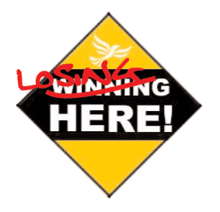
A truthful poster for the Lib DemsMeanwhile in Bromley & Chislehurst the Lib Dems' campaign did better than anyone expected - nastiness and all. Just look at Ben Abbotts' opening remarks in the speech.

Bob Neil's comments bear much consideration:

The most vicious, unpleasant, underhanded exampled of cynical personal abuse that I have encountered in thirty years in politics.
...
If you sometimes wonder why it is that people in this country are sometimes turned off by politics, get a mirror and look at yourselves.
Labour have done badly, but many readers of my blog can take heart. Eleven years ago the Conservatives dropped from second to fifth in a by-election.

Sunday, April 02, 2006

So what party are you?

Thanks to Liberty Hall Grapevine's post "Would I make a good Tory...?", I've been directed to SelectSmart.com, which has a number of tests, amongst others, on politics around the world. The first, and most inevitable test, is for the major British political parties and my results rank them in the following order:

1. Conservatives
2. Labour
3. Green Party
4. Liberal Democrats
5. Plaid Cymru
6. Scottish National Party

So not too surprising there. More interesting are the tests for other countries. Many have bemoaned the chaotic state of politics in the Republic of Ireland, where ideology is almost totally lacking and parties are based around personalities, and it's very hard to say which party is the equivalent of anything. One of the few parties that doesn't have its roots in the Irish Civil War are the Progressive Democrats, who call themselves a "Liberal Political Party" and are the Republic's affiliates to the various international federations of liberal political parties, but whilst there's an economic policy that British commentators would label "Orange Book",
one of their most prominent TDs, the Minister for Justice Michael McDowell, has acquired a reputation for being something of an authoritarian and is frequently portrayed as fascist by the Phoenix.
And no-one seems to be clear whether they're left, centre or right-wing! So what party does SelectSmart.com say I most agree with?

1. Progressive Democrats (An Páirtí Daonlathach)
2. Green Party (Comhaontas Glas)
3. Fine Gael (Family of the Irish)
4. Labour (Páirtí an Lucht Oibre)
5. Fianna Fáil (Soldiers of Destiny)
6. Sinn Féin ("we ourselves")

Well some of these are unsurprising. But the test falls back on asking for agreement or disagreement on the statement "Charles Haughey was a good Taoiseach", as though it needs to ask that in order to get a clear result vis a vis Fianna Fáil. I suspect that if I ever do find myself filling in a ballot paper for Dail Eireann I may end up combining a personality and tactical vote unless some of the above parties both offer good policies and don't raise the spectre of coalition government with disreputable parties, especially Sinn Féin.

There are many more tests there - I'd be particularly interested to see how well those readers from outside the UK match up to the parties they currently support.

LinkWithin

Related Posts Plugin for WordPress, Blogger...